
Short answer: a UTR is the 10-digit Unique Taxpayer Reference HMRC gives you when you register for Self Assessment. You get it by registering online; HMRC posts it about 15 days later, longer if you live abroad. If you already have one, it is in the HMRC app, your personal tax account, and on any HMRC letter or past return. You need it to file a return, to be paid under CIS without a 30% deduction, and to register for VAT as a sole trader. The deadline to register for a return on last year’s income is 5 October.
What a UTR is
It is HMRC’s account number for you as a taxpayer. Ten digits, sometimes shown with a K on the end, issued once and kept for life. It is different from your National Insurance number, which identifies you across government, and from a company’s Corporation Tax UTR, which belongs to the company. A sole trader has one personal UTR and uses it for everything: the tax return, CIS, VAT registration, dealing with an accountant.
When will your UTR arrive? Check your dates
Enter the date you registered, or plan to, and where you live. The tool gives you the likely arrival date and tells you whether you will have it in time for the deadlines that matter.
Uses HMRC’s published timing of about 15 days by post in the UK; abroad we allow four weeks. Online filing also needs an activation code, which HMRC posts separately.
How to get a UTR number
- Go to the GOV.UK Self Assessment registration page and choose that you are self-employed. You will need a Government Gateway login, which you can create on the spot.
- Give your National Insurance number, address, the date you started trading and what you do. There is no fee and nothing to post.
- Wait. HMRC posts the UTR to your address about 15 days later. It does not email it and cannot read it out over the phone to a new registrant.
- If you want to file online, HMRC then posts an activation code, roughly another ten days. Enter it within 28 days or it expires.
Do this as soon as you start trading rather than at the 5 October deadline. Nothing bad happens if you register in April and earn little; a great deal of stress happens if you register on 4 October and the post is slow.
Where to find a UTR you already have
| Place | How |
|---|---|
| HMRC app | Sign in, Self Assessment section, shown on the first screen |
| Personal tax account online | Self Assessment tile, top of the page |
| Any HMRC letter about Self Assessment | Top right, labelled "UTR" or "Tax reference" |
| A previous tax return or SA302 | First page, next to your name |
| Your accountant | They hold it on their agent account |
| None of the above | Call the Self Assessment helpline; HMRC posts it again, it will not say it on the phone |
Why CIS workers lose 10% without one
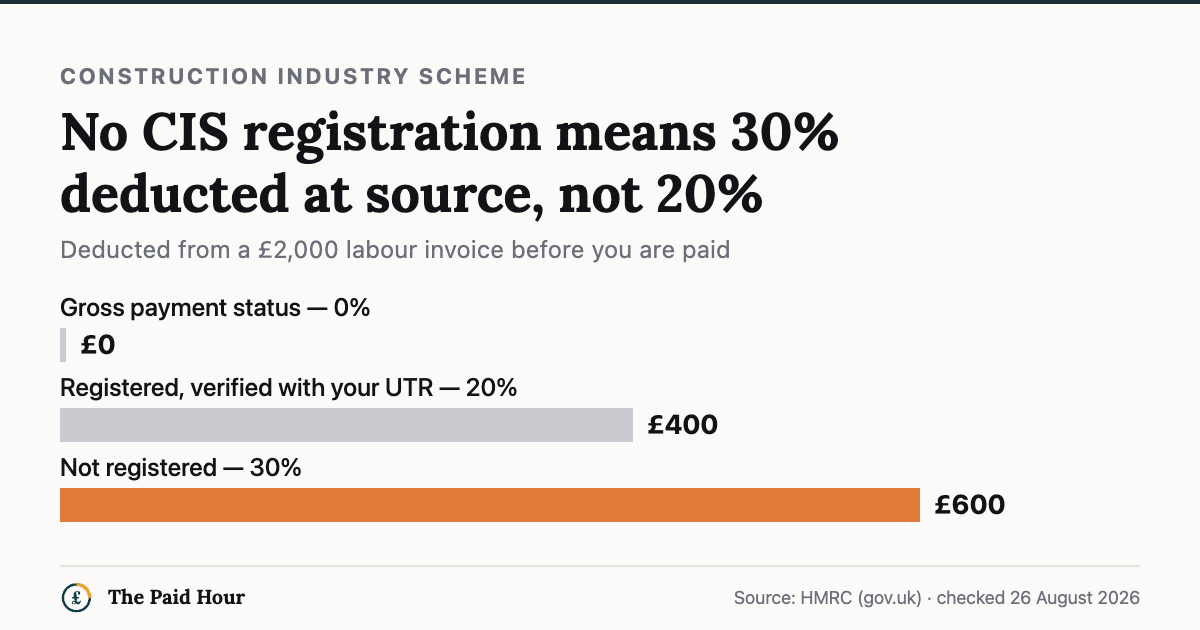
Under the Construction Industry Scheme a contractor checks your UTR against HMRC before paying you. Verified, they deduct 20% from the labour part of each invoice as tax on account. Not verified, because you have no UTR or have not registered for CIS, they must deduct 30%. On £3,000 of labour that is £300 a month more than it should be, and it only comes back after you file a tax return. The order is: get the UTR, register for CIS the same day, give the UTR to every contractor before the first invoice.
UTR, VAT and the order to do things in
You cannot register for VAT as a sole trader without a UTR, and HMRC will not issue a UTR faster because a VAT deadline is close. The VAT registration threshold is £90,000 of taxable turnover in any rolling 12 months, and your registration date is fixed by when you crossed it, not by when your paperwork catches up. If you are anywhere near that line, get the UTR first and keep the VAT application ready to go.
Do you actually owe HMRC anything yet?
Side Hustle Tax Starter 2026/27. A six-module starter course and six working templates that tell you, in an evening, whether you owe anything at all, and set up the twenty-minute monthly routine that keeps it that way.
- The nine badges of trade as questions you can answer about your own income
- What the platforms send HMRC, the small-seller exemption, and three reply letters for when a letter arrives
- A sales log with a running £1,000 alert, an allowance-versus-expenses sheet, and a tax set-aside calculator at 2026/27 rates
Selling platforms now hand your sales data to HMRC once a year. Selling your own old possessions is never taxable. Buying to resell, making things, or freelancing is. Knowing which side you are on is the whole question.
Buying more than one? All ten 2026/27 courses for £107, against £293 bought separately.
UTR number: common questions
What is a UTR number?
Your 10-digit Unique Taxpayer Reference from HMRC, issued when you register for Self Assessment. It identifies you for tax returns, CIS and VAT, and stays with you for life.
How long does it take to get a UTR number?
About 15 days by post after you register online, according to HMRC, and longer if you live outside the UK. An activation code for online filing follows about ten days later.
How do I find my UTR number?
In the HMRC app or your personal tax account, or on any Self Assessment letter, past return or SA302. If you have lost it entirely, HMRC will post it again; it will not give it over the phone.
Is a UTR the same as a National Insurance number?
No. The NI number is two letters, six digits and a letter and is used across government. The UTR is ten digits and is only for tax. You need the NI number to get a UTR.
Do I need a UTR to be self-employed?
You need one to file a Self Assessment return, which you must do once self-employed income passes £1,000 in a tax year. You can start trading before it arrives; you cannot file, register for CIS or register for VAT without it.
Just registered? Here is what happens in the 15 days after you register, from the confirmation to your UTR letter.
Sources
- GOV.UK, find your UTR number – where to find it, about 15 days to arrive, longer overseas
- GOV.UK, register for Self Assessment – 5 October registration deadline
- GOV.UK, what you must do as a CIS subcontractor – 20% and 30% deduction rates
- GOV.UK, VAT registration – £90,000 threshold
Read next
- How to File Self Assessment as a Freelancer, Step by Step
- SA1, CWF1 or SA400? Which Self Assessment Registration Route You Need
- Tax Year Dates 2026/27: Every Deadline UK Freelancers Need
- UK Freelancer Tax Calculator 2026/27
- Already File a Tax Return? You May Still Need to Register Again
Related guides — business bank accounts for sole traders and business insurance for the self-employed.