
Quick answer: Instead of reclaiming VAT line by line, the VAT Flat Rate Scheme pays HMRC a fixed percentage of gross turnover. It can simplify a service business, but the 16.5% “limited cost trader” rate wipes out most of the benefit, and it catches exactly the freelancers the scheme sounds made for.
The VAT Flat Rate Scheme is a decision that comes after VAT registration rather than before it, our VAT registration threshold guide covers when you have to register in the first place. This post is about whether the VAT Flat Rate Scheme is worth choosing over standard VAT accounting once you’re already registered.
Table of Contents
What it is
Instead of tracking VAT on every purchase and sale and reclaiming input VAT bit by bit, you pay HMRC a fixed percentage of your VAT-inclusive turnover, based on your trade sector. You still charge customers standard VAT, usually 20%, on invoices. The flat rate just changes what you hand over to HMRC and how much admin you’re doing behind the scenes. (Source: gov.uk. VAT Flat Rate Scheme, overview)
Who can join, and when you must leave
- To join: your VAT-taxable turnover, excluding VAT, needs to be expected at £150,000 or less over the next 12 months.
- Mandatory exit: you must leave if your total income including VAT goes over £230,000 at your scheme anniversary, or you expect to exceed £230,000 within the next 30 days alone. HMRC can let you stay on if your income is expected to drop back below £191,500.
(Source: gov.uk, join or leave the Flat Rate Scheme)
The rate that is easy to miss: 16.5% for “limited cost traders”
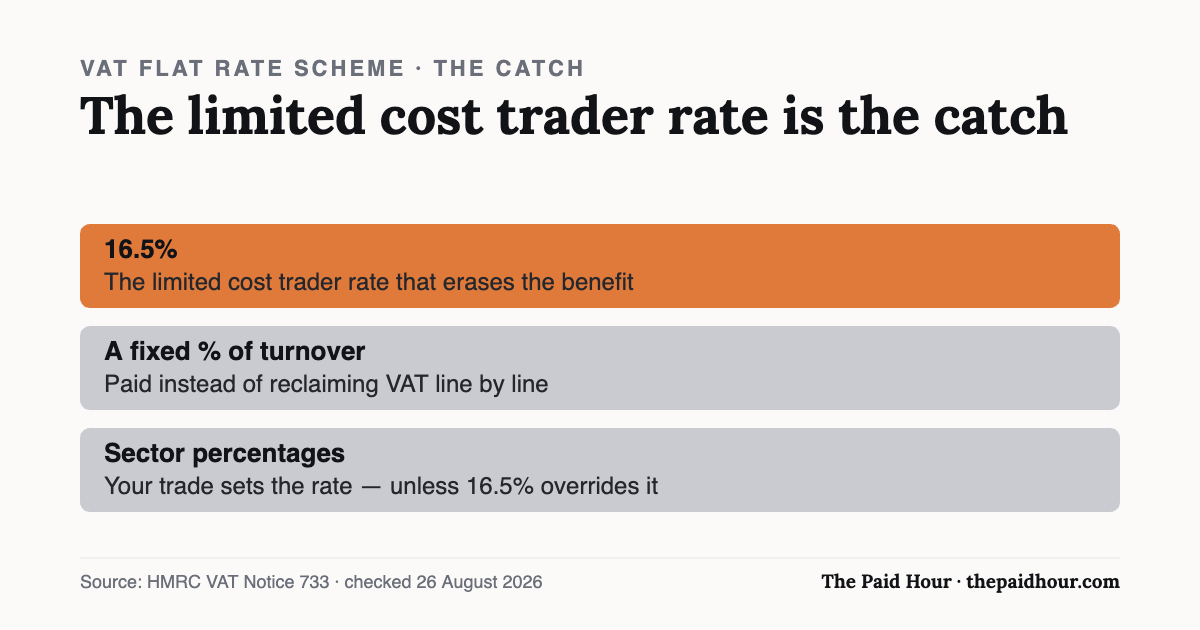
This is the part every freelancer offering services, rather than selling goods, needs to know before choosing this scheme. Spend on relevant goods under 2% of your turnover, or under £1,000 a year (£250 a quarter): whichever is higher, and you’re classed as a limited cost trader. You have to use a 16.5% flat rate regardless of what your actual trade sector rate would otherwise be. (Source: gov.uk — how much you pay)
For context, “relevant goods” doesn’t stretch to things like rent, food, fuel, or most services you buy in, it’s specifically stock and goods your business consumes. Most consultants, designers, writers and other service-based freelancers spend very little on physical goods, so plenty end up on the 16.5% rate whether or not their actual sector rate would have been lower.
Example sector rates (for comparison)
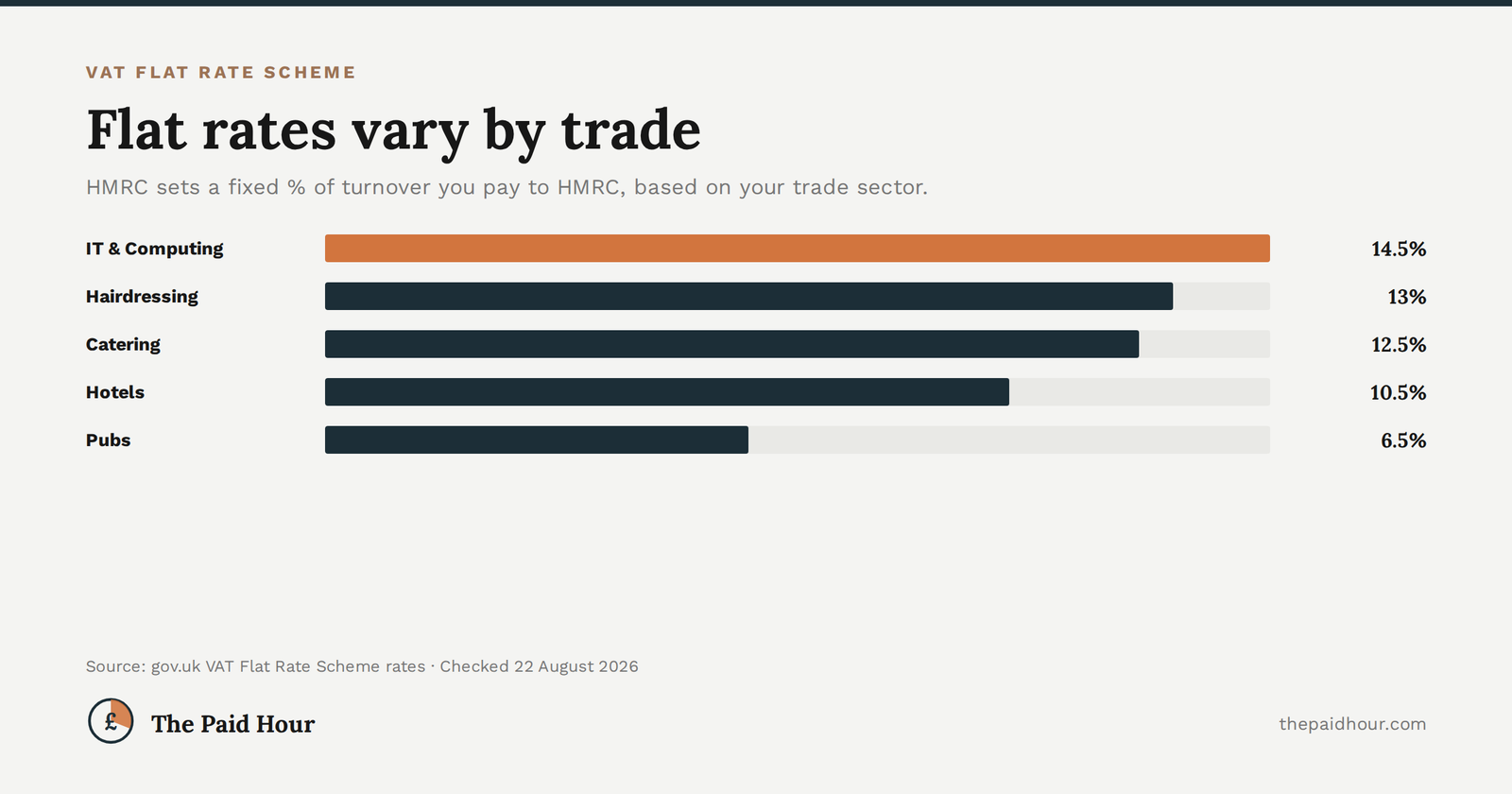
- IT/computer consultancy: 14.5%
- Legal services: 14.5%
- Accountancy/bookkeeping: 14.5%
- Hairdressing/beauty: 13%
- Catering (restaurants/takeaways): 12.5%
- Hotels/accommodation: 10.5%
- Pubs: 6.5%
(Source: gov.uk. Flat Rate Scheme for small businesses, VAT Notice 733)
The first-year discount
New VAT registrants get a 1% discount off their flat rate for the first 12 months from their registration date, but only if you join within 12 months of becoming VAT-registered. Miss that window, and the discount simply isn’t available anymore.
Who tends to win, and who tends to lose
This next part is practical judgement instead of an HMRC ranking, HMRC doesn’t publish a winners-and-losers list, but the logic holds up: since you can’t reclaim input VAT on the Flat Rate Scheme, businesses with very low costs: plenty of one-person consultancies and service freelancers among them, often end up on the 16.5% limited-cost-trader rate and can pay more VAT overall than they would under standard accounting, where they’d reclaim VAT on expenses instead. Businesses with genuine ongoing goods costs, like catering or trades using materials, are more likely to see a real benefit from the simpler flat rate.
The only way to know for certain which is better for you is to run the numbers on your actual turnover and costs, or ask whoever does your VAT returns to compare both approaches for a quarter before you commit to anything.
A worked example: standard VAT against the VAT Flat Rate Scheme
Numbers make the trade-off obvious in a way percentages never do. Take a consultant who invoices £60,000 net over a year and adds 20% VAT, so clients pay £72,000 and £12,000 of that is VAT.
Under standard VAT accounting, that £12,000 goes to HMRC less whatever VAT was paid on business purchases. Say £4,000 of VATable costs across the year, software, an accountant, a laptop. That is £800 reclaimed, so £11,200 leaves the business.
Under the VAT Flat Rate Scheme the sum is simpler and usually worse. A limited cost trader pays 16.5% of the £72,000 gross: £11,880, and reclaims nothing at all. Standard accounting wins by £680 here, and the gap widens with every pound of VATable cost.
The first year is the exception. The 1% new-registrant discount takes the rate to 15.5%, or £11,160, which is about £40 better than standard accounting on these figures. Then the discount ends and the arithmetic flips.
The trap sits inside that £4,000 of costs. Software, professional fees and rent all carry VAT you can reclaim under standard accounting, and none of them are “relevant goods” for the limited cost trader test. So a consultant can be spending real money on VATable purchases and still be pushed onto 16.5%, which is why the VAT Flat Rate Scheme so often disappoints the freelancers its simplicity was supposed to help.
Run your own version before committing: one year of turnover, one year of VATable costs, and one year of spend on physical goods. The third figure decides which rate you get. The first two decide whether the scheme is worth having at all.
FAQs: VAT Flat Rate Scheme
What is the VAT Flat Rate Scheme?
The VAT Flat Rate Scheme lets you pay HMRC a fixed percentage of your VAT-inclusive turnover instead of tracking and reclaiming VAT on every purchase. You still charge customers standard VAT on invoices, the scheme only changes what you hand over to HMRC and how much admin the VAT return actually takes.
Who can join the VAT Flat Rate Scheme?
You can join if your VAT-taxable turnover, excluding VAT, is expected to be £150,000 or less over the next 12 months. You must leave once your total income including VAT passes £230,000 at your scheme anniversary, or if you expect to exceed that figure within the next 30 days alone.
What is the 16.5% limited cost trader rate?
Under the scheme, a “limited cost trader” pays a flat 16.5% rate regardless of their actual sector rate. You’re classed as one if your spend on relevant goods is below 2% of turnover, or below £1,000 a year, whichever is higher. Most service-based freelancers (consultants, designers, writers), spend little on physical goods, so many land on this 16.5% rate by default.
Is the VAT Flat Rate Scheme worth it for freelancers?
It depends entirely on your costs. Because you can’t reclaim input VAT under the scheme, low-cost service freelancers on the 16.5% rate can end up paying more VAT overall than they would under standard accounting. Businesses with genuine ongoing goods costs are more likely to come out ahead. Running the numbers on your actual turnover and expenses, or asking whoever handles your VAT returns. Is the only reliable way to tell which side you’re on.
This is general guidance based on current gov.uk rules rather than personalised tax advice.
Watching the £90,000 line?
First Year of VAT 2026/27. Eight modules and a four-sheet toolkit that take you from monitoring the threshold to filing a correct first return, without a penalty.
- A rolling twelve-month threshold monitor that warns you before you cross, including the overseas purchases that count
- The flat-rate-versus-standard calculator with the limited cost trader test built in, on your own figures
- Pre-registration reclaims, the twelve mandatory invoice fields, and the price-rise letters for B2B and B2C clients
The £90,000 test runs on any rolling twelve months, not your tax year, and services you buy from overseas count towards it. Plenty of freelancers register late without ever noticing they crossed.
Buying more than one? All ten 2026/27 courses for £107, against £328 at full price.
Sources
- gov.uk: VAT Flat Rate Scheme
- gov.uk, Flat Rate Scheme: how much you pay
- gov.uk: VAT Notice 733 (Flat Rate Scheme)
The 16.5% limited-cost rate, the 2%/£1,000 goods test and the first-year 1% discount were re-checked against gov.uk on 26 August 2026. This is general information about how the rules work, not tax advice. The links above go to the primary sources; for your own circumstances, speak to an accountant or contact HMRC directly.