
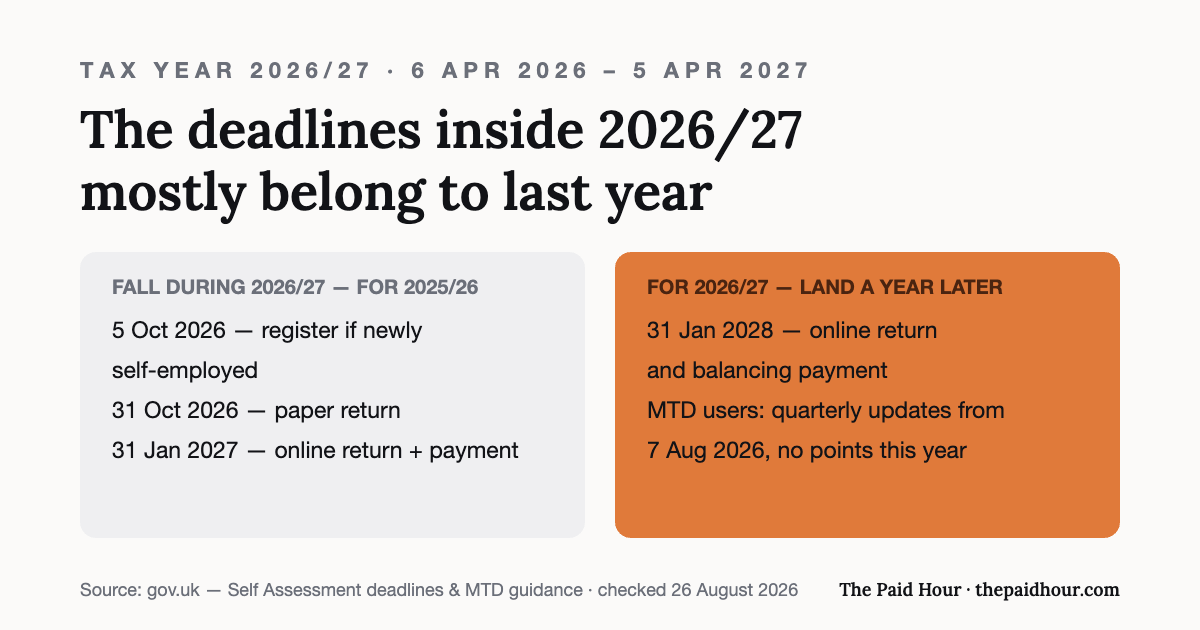
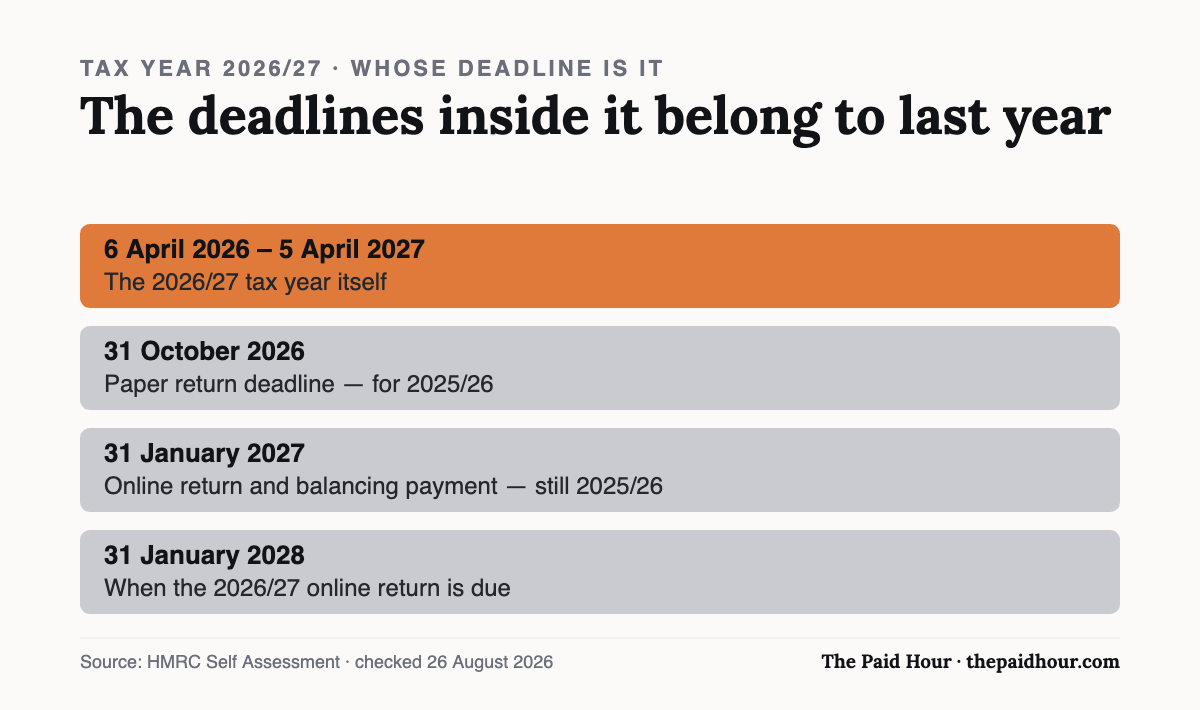
Before you read on: The 2026/27 tax year runs from 6 April 2026 to 5 April 2027. Most deadlines that fall inside it belong to the previous year: paper return 31 October 2026, online return and balancing payment 31 January 2027. The deadlines for 2026/27 land a year later, with the online return due 31 January 2028. If your qualifying income is over £50,000 you also have Making Tax Digital quarterly updates, and the first one fell on 7 August 2026.
Table of Contents
The tax year dates a UK sole trader works to have nothing to do with the calendar year, and that single fact causes more missed deadlines than anything else in a first year of self-employment. The 2026/27 tax year starts on 6 April 2026 and ends on 5 April 2027. Every registration, filing and payment deadline hangs off that odd start date.
The confusion is not really about the dates themselves. It is that two tax years are always live at once. In January 2027 you file for 2025/26 while you are still earning in 2026/27, and the same month can belong to either. So here are both lists, kept apart.
Dates that fall during the 2026/27 tax year
These land between 6 April 2026 and 5 April 2027. Notice how many of them are settling up for 2025/26.
| Date | What is due | Tax year it belongs to |
|---|---|---|
| 6 April 2026 | 2026/27 tax year begins | 2026/27 |
| 31 July 2026 | Second payment on account | 2025/26 |
| 7 August 2026 | First MTD quarterly update (6 Apr to 5 Jul 2026) | 2026/27 |
| 5 October 2026 | Tell HMRC you need to file, if 2025/26 was your first year | 2025/26 |
| 31 October 2026 | Paper tax return | 2025/26 |
| 7 November 2026 | Second MTD quarterly update (6 Apr to 5 Oct 2026) | 2026/27 |
| 30 December 2026 | File online if you want the bill collected through your tax code | 2025/26 |
| 31 January 2027 | Online return, balancing payment, first payment on account | 2025/26 |
| 7 February 2027 | Third MTD quarterly update (6 Apr 2026 to 5 Jan 2027) | 2026/27 |
| 5 April 2027 | 2026/27 tax year ends | 2026/27 |
Deadlines for the 2026/27 tax year itself
What you earn between April 2026 and April 2027 is reported on a return you file the following winter. These are its dates.
| Date | What is due |
|---|---|
| 7 May 2027 | Fourth MTD quarterly update (6 Apr 2026 to 5 Apr 2027) |
| 5 October 2027 | Tell HMRC you need to file, if 2026/27 is your first year |
| 31 October 2027 | Paper tax return |
| 30 December 2027 | File online to have the bill collected through your tax code |
| 31 January 2028 | Online return, balancing payment, first payment on account for 2027/28 |
| 31 July 2028 | Second payment on account for 2027/28 |
Registering: 5 October in your first tax year
HMRC puts it plainly: you must tell them by 5 October if you need to complete a tax return for the previous year and you have not sent one before. For a business that started in the 2026/27 tax year, that means 5 October 2027.
Miss it and you do not lose the ability to register. What changes is the deadline. Register after 5 October and HMRC sends a letter or email carrying a different date, three months from the date on that notice. That sounds generous. It is not, because the payment deadline of 31 January does not move with it, so you can end up filing in good time and still paying late.
Filing and paying after the tax year ends: four dates, not one
- 31 October, 11:59pm: paper returns. Almost nobody uses this now.
- 30 December, 11:59pm: the one most people have never heard of. File online by this date and HMRC can collect the bill through your PAYE tax code across the following year instead of taking it in one go. You need to owe less than £3,000, and you need to already pay tax through PAYE, so it works for anyone with a job alongside the freelancing. You cannot make a part payment to get under £3,000.
- 31 January, 11:59pm: the online return, the balancing payment for the year just filed, and the first payment on account toward the next one.
- 31 July: the second payment on account.
Payments on account are easy to miss more than the filing dates do, because the January bill is often close to one and a half times what they expected. There is a fuller explanation in the guide to how payments on account work and when you can reduce them, and a walkthrough of the annual cycle in the Self Assessment deadlines guide.
What missing 31 January actually costs
The £100 everyone quotes is only the first rung. HMRC charges it even if you owe no tax at all. Then it escalates:
| How late | Filing penalty | Payment penalty |
|---|---|---|
| 1 day | £100 | Interest starts |
| 30 days | — | 5% of the tax unpaid |
| 3 months | £10 a day, up to £900 | — |
| 6 months | 5% of the tax due, or £300 if greater | A further 5% |
| 12 months | Another 5%, or £300 if greater | A further 5% |
Filing and paying are penalised separately, which is why filing on time matters even when you cannot pay. File the return, then talk to HMRC about a payment plan. Interest runs on the unpaid tax throughout, on top of the percentages above.
Making Tax Digital quarterly update dates
2026/27 is the first year this applies to anyone. If your qualifying income from self-employment and property was over £50,000, you are in it now. HMRC said in July 2026 that more than 864,000 people were within scope, and the first quarterly update was due on 7 August 2026. The £30,000 group joins on 6 April 2027 and the £20,000 group on 6 April 2028.
| Period covered | Deadline | Calendar-quarter alternative |
|---|---|---|
| 6 Apr to 5 Jul | 7 August | 1 Apr to 30 Jun |
| 6 Apr to 5 Oct | 7 November | 1 Apr to 30 Sep |
| 6 Apr to 5 Jan | 7 February | 1 Apr to 31 Dec |
| 6 Apr to 5 Apr | 7 May | 1 Apr to 31 Mar |
Read the left column again. Each update is cumulative from 6 April rather than a standalone three months, so the fourth one covers the whole year. Getting a figure wrong in July is corrected by the next update rather than by an amendment. You can also file up to ten days early if you know no more transactions are coming.
One point worth having straight, because a lot of coverage has it backwards: there are no penalties for missing a quarterly update deadline in the 2026 to 2027 tax year. Points start applying to quarterly updates from 2027/28. The MTD quarterly deadlines guide goes through the mechanics in full.
National Insurance figures for the 2026/27 tax year
Both classes are settled through Self Assessment on 31 January, so there is no separate NI deadline to diarise. The figures do change, and these are the 2026/27 ones:
- Class 2: £3.65 a week, with a Small Profits Threshold of £7,105. Above that threshold the contributions are treated as having been paid, so your record is protected and you do not hand over the money.
- Class 4: 6% on profits between £12,570 and £50,270, then 2% on anything above £50,270.
The VAT date that is not in anyone’s calendar
VAT registration is not an annual deadline. It is a rolling one, and it can fall on any day of the year. The threshold is £90,000 and there are two separate tests.
Looking back: if your turnover over the last twelve months went over £90,000, you must register within 30 days of the end of the month you crossed it, and registration takes effect from the first day of the second month after you went over. Looking forward: if you expect to go over £90,000 in the next 30 days alone, you must register by the end of that 30-day period, and registration takes effect from the date you realised it.
The forward test is the one that bites. A single large contract signed in March can make you VAT-registered from that day, months before your annual figures would have suggested it.
Voluntary National Insurance: 5 April, six years back
A gap in your NI record can normally be filled for six years, and the cut-off is 5 April. So a gap in 2026/27 has to be dealt with by 5 April 2033. Class 3 costs £18.40 a week for 2026/27, Class 2 £3.65 where you qualify for it. The guide to voluntary Class 2 contributions covers who is eligible for the cheaper rate.
The three tax year dates worth a calendar reminder
Most of this becomes automatic after one full cycle. In the first year, three reminders do almost all the work: 5 October to register, 30 December if you have PAYE income and would rather spread the bill, and 31 January. Set them the week you register, while it still feels urgent. October does not feel urgent when the bill is four months away, which is exactly why people miss it.
Missing one of the quarterly dates in 2026/27 carries no penalty at all, the points system starts with 2027/28.
Filing early shortens the window HMRC has to query the return. twelve months from the day it is received, not from 31 January.
Filing it yourself this year?
HMRC Tax & Expense Mastery 2026/27. Nine modules and eleven working templates that take a UK freelancer from “do I even need to register” to a correct return, with MTD quarters built in.
- Fifteen expense categories, with the trap inside each one (training, clothing, meals, the seven-year pre-trading rule)
- Home and vehicle: flat rate against actual cost, with the £312 break-even worked out and the mileage lock-in rule
- The year-one payments-on-account cash shock, and the routine that stops it landing twice
HMRC does not send a list of what you forgot to claim. Most freelancers leave several hundred pounds of legitimate expenses on the table every single year, and the return still gets filed.
Buying more than one? The Complete Freelancer System, all five for £87, against £215 at full price.
Need this ready-made? → Self Assessment Prep Checklist Pack, every deadline, record and allowance in 9 pages (£7.99, instant download)
For anyone whose first self-employed year was 2025/26, the first date on this calendar that bites is 5 October 2026: how to register as a sole trader with HMRC before then.
Sources
- gov.uk: Self Assessment tax returns: deadlines
- gov.uk — Self Assessment tax returns: penalties
- gov.uk, Pay your Self Assessment tax bill through your tax code
- gov.uk. Send quarterly updates for Making Tax Digital for Income Tax
- gov.uk, Find out if and when you need to use Making Tax Digital for Income Tax
- gov.uk: Penalties for Making Tax Digital for Income Tax
- HMRC news, 23 July 2026, Deadline approaches for first Making Tax Digital quarterly update
- gov.uk. Self-employed National Insurance rates
- gov.uk: Register for VAT
- gov.uk, Voluntary National Insurance contributions
Deadlines re-checked against gov.uk on 26 August 2026.
Every date and figure above was checked against gov.uk on 25 August 2026. This is general information about how the deadlines work, not tax advice. For your own circumstances, speak to an accountant or contact HMRC directly.
Work out your own numbers. Our free UK freelancer tax calculator gives you the 2026/27 Income Tax and Class 4 National Insurance on your profit, plus the amount to set aside each month.