
Type in what you invoiced and what you spent. This works out the 2026/27 Income Tax and National Insurance HMRC will ask for, what lands in your account, and the amount to move into a savings pot every month so January never bites.
Work out your Self Assessment bill
Sole trader, or a job plus freelance work on the side. Results update as you type.
Your year
What it means
Three numbers, in the order they matter
- 1Profit, not turnoverHMRC taxes what is left after allowable costs. Every expense you forget to claim is money handed over for nothing.
- 2The bill, not the taxIncome Tax and Class 4 National Insurance arrive as one demand in January. Budget for the total, not one half of it.
- 3The monthly sliceDivide by twelve and move it on the day each invoice clears. This is the only habit that makes a tax bill boring.
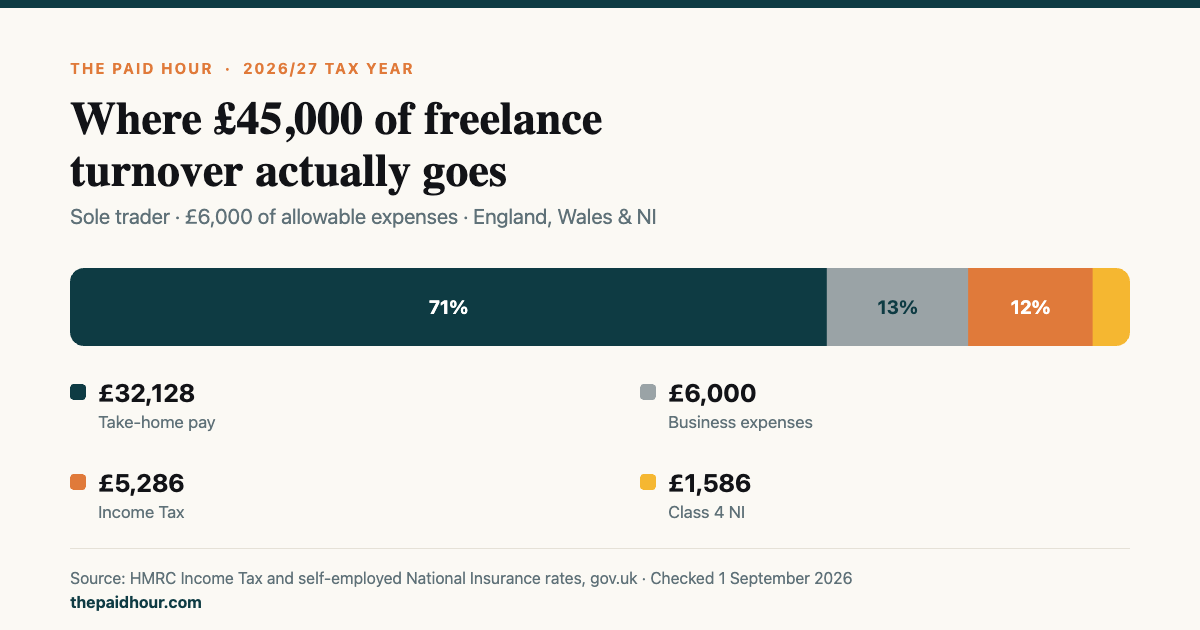
The 2026/27 rates behind the answer
Nothing here is rounded or remembered. Every figure below was read off gov.uk on 1 September 2026 and applies to the tax year running 6 April 2026 to 5 April 2027.
Income Tax — England, Wales and Northern Ireland
| Band | Taxable income | Rate |
|---|---|---|
| Personal Allowance | Up to £12,570 | 0% |
| Basic rate | £12,571 to £50,270 | 20% |
| Higher rate | £50,271 to £125,140 | 40% |
| Additional rate | Over £125,140 | 45% |
Income Tax — Scotland
| Band | Taxable income | Rate |
|---|---|---|
| Personal Allowance | Up to £12,570 | 0% |
| Starter rate | £12,571 to £16,537 | 19% |
| Basic rate | £16,538 to £29,526 | 20% |
| Intermediate rate | £29,527 to £43,662 | 21% |
| Higher rate | £43,663 to £75,000 | 42% |
| Advanced rate | £75,001 to £125,140 | 45% |
| Top rate | Over £125,140 | 48% |
National Insurance for the self-employed
| Class | Applies to | What you pay |
|---|---|---|
| Class 2 | Profits over £7,105 | Treated as paid — nothing due. Voluntary rate £3.65 a week. |
| Class 4 | £12,570 to £50,270 of profit | 6% |
| Class 4 | Profit above £50,270 | 2% |
How the maths is done
- Salary and profit are stacked into one total, then the Income Tax bands are applied once across the lot. That is why a side hustle on top of a job can be taxed at 40% from the first pound.
- Class 4 National Insurance is charged on profit alone. A salary does not push your Class 4 rate up.
- Tax your employer already took is stripped out, so the Self Assessment figure is what you personally have to find, not a gross total you have partly paid.
- The monthly figure is that bill divided by twelve, shown as a percentage of profit so you can apply it to every invoice as it lands.
What it deliberately does not model
A calculator that claims to cover everything is a calculator that is quietly wrong somewhere. This one leaves out student loan repayments, pension contributions, dividends, savings and rental income, the High Income Child Benefit Charge, capital allowances, and the annual maximum that caps Class 1 and Class 4 together when you have both a job and a business. If any of those apply to you, treat the answer as a solid starting point and check the detail before you commit to it.
The dates this bill lives on
| Date | What happens |
|---|---|
| 5 October 2027 | Register for Self Assessment if 2026/27 was your first year of trading |
| 31 October 2027 | Paper tax return deadline |
| 30 December 2027 | Last day to ask for tax under £3,000 to be collected through your tax code |
| 31 January 2028 | Online return filed, balancing payment made, first payment on account due |
| 31 July 2028 | Second payment on account due |
Questions people actually ask
How much should I set aside for tax as a freelancer?
Between 20% and 25% of profit covers Income Tax and Class 4 National Insurance for most sole traders earning £20,000 to £50,000. Above the higher-rate threshold it climbs fast. The calculator gives you your own percentage rather than a rule of thumb that stops being true the year you have a good one.
Do I still pay Class 2 National Insurance?
No. With profits above £7,105 your Class 2 contributions are treated as having been paid, so your State Pension record is protected and nothing is charged. Below that you can still pay voluntarily at £3.65 a week to keep the year qualifying, which is usually worth doing.
What is a payment on account, and why is my first bill so big?
If your Self Assessment bill is over £1,000, HMRC asks you to pre-pay the following year in two halves — one on 31 January alongside the bill you already owe, one on 31 July. That is why a first tax year often costs 150% of what people budgeted for, and why so many freelancers describe January as the month that ambushed them.
Does this work if I have a job as well?
Yes. Put your gross salary in the third box. The calculator stacks it under your profit, applies the bands once, then subtracts the tax your employer has already deducted so the Self Assessment figure is the amount you personally have to find.
When do I have to register for VAT?
When your taxable turnover passes £90,000 in any rolling 12 months, or when you expect to pass it within the next 30 days. It is turnover, not profit, and the 12 months is a moving window rather than your accounting year — which is how people cross it without noticing.
Is anything I type stored or sent anywhere?
No. The whole calculation runs in your browser. Nothing is saved, logged or transmitted, there is no sign-up, and closing the tab erases it.
Read next
Prefer watching to reading? The Paid Hour is on YouTube, short explainers on Self Assessment, expenses, MTD and this calculator.Subscribe on YouTube
Sources
- HMRC, Income Tax rates and Personal Allowances
- HMRC, Self-employed National Insurance rates
- HMRC, Income Tax in Scotland
- HMRC, VAT registration thresholds
- HMRC, Self Assessment deadlines
All rates checked against gov.uk on 1 September 2026, and rechecked every April when the new tax year starts. This page explains how UK tax works for sole traders. It is general information, not personal tax advice.