

An HMRC letter about Making Tax Digital means your 2025 to 2026 tax return showed qualifying income over £30,000, so you must use Making Tax Digital for Income Tax from 6 April 2027. Qualifying income is turnover before expenses, self-employment and property combined. No letter does not mean no obligation. Source: GOV.UK, checked 12 September 2026.
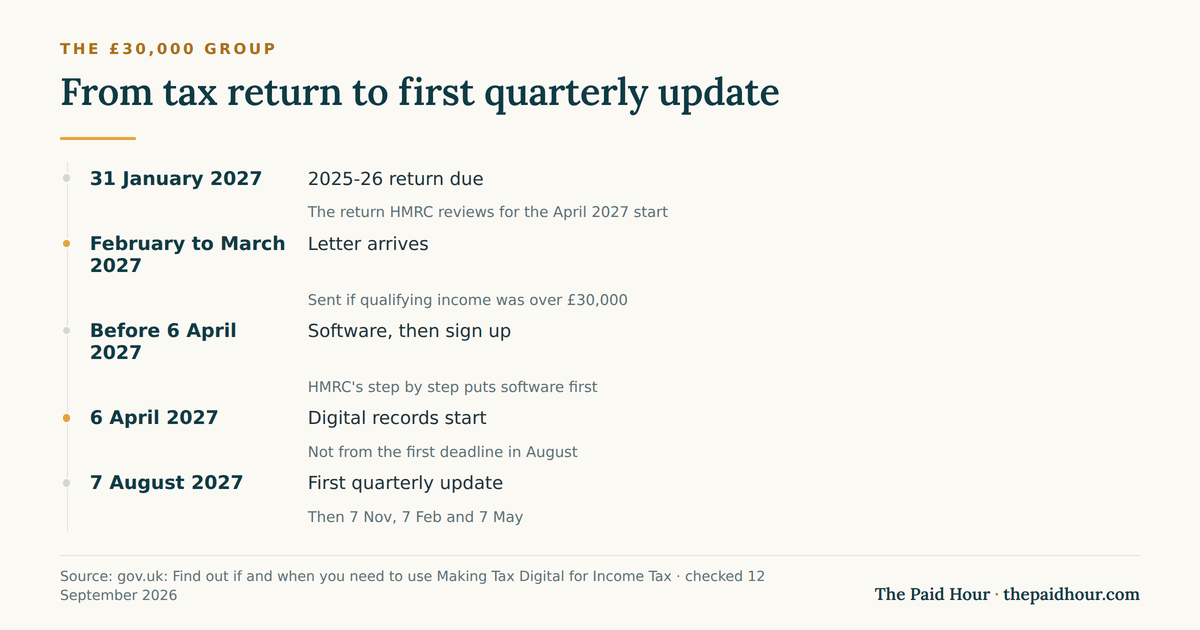
The HMRC letter about Making Tax Digital is not a penalty notice, a check on your return or a sign that anything went wrong. It is an output of a computer run. HMRC looked at the qualifying income figure on your 2025 to 2026 return, saw it above £30,000, and posted you the consequence. The awkward part is the timing. Most people file that return in the last week of January, which means the letter lands somewhere in February or March, and the thing it is telling you to do starts on 6 April.
You are not alone in getting one. In its October 2026 press release, HMRC put the April 2027 group at around 1,077,000 more sole traders and landlords, based on its analysis of 2024 to 2025 returns, and asked them to sign up now rather than wait for the deadline.
So you get weeks, not months. Here is what the letter actually commits you to, and what to check before you act on it.
What the letter is telling you
One thing only: that you are in the regime from the start of the next tax year. GOV.UK puts it as “if your income is above the relevant threshold HMRC will write to you, confirming that you need to start using Making Tax Digital for Income Tax by the start of the following tax year”.
It does not sign you up, pick software for you, or move a deadline you already have. Your 2026 to 2027 return is still an ordinary Self Assessment return due by 31 January 2028, filed the old way, because the new rules bite on income earned from 6 April 2027 onwards.
And if nothing came through the door, that changes nothing. The guidance is blunt about it: “If you did not receive a letter, it is still your responsibility to check if and when you need to use Making Tax Digital for Income Tax, and make sure you are signed up.” Post goes missing. Addresses go stale. The obligation does not care.
The return that triggered it
Each threshold is decided by the return two tax years back, not by what you are earning now.
| Qualifying income | Return HMRC reviews | That return was due | You must use MTD from |
|---|---|---|---|
| Over £50,000 | 2024 to 2025 | 31 January 2026 | 6 April 2026 |
| Over £30,000 | 2025 to 2026 | 31 January 2027 | 6 April 2027 |
| Over £20,000 | 2026 to 2027 | 31 January 2028 | 6 April 2028 |
Read the middle row again and the squeeze is obvious. The return that decides your April 2027 start is the one due on 31 January 2027. File it on the last day, as roughly a million people do every year, and HMRC cannot assess you until February. Nine or ten weeks later the obligation starts.
Check the number before you accept it
Qualifying income is turnover, not profit. That single point catches more people than anything else in these rules. A sole trader with £34,000 of invoices and £9,000 of profit is over the line. A landlord with £31,000 of rent and a mortgage that eats most of it is over the line.
What GOV.UK counts towards the figure:
- Self-employment turnover, before expenses and before the £1,000 trading allowance.
- UK property income, and foreign property income if you are UK tax resident.
- Your share of jointly owned property. Rent of £50,000 split evenly between two owners is £25,000 each, not £50,000.
- Income from bare trusts and interest in possession trusts.
Budget update, 28 October 2026: the trading allowance rises from £1,000 to £3,000 from 6 April 2027, and the Self Assessment reporting threshold for trading income moves to £3,000 with it. For the 2026/27 tax year the £1,000 limit still applies. GOV.UK policy paper.
What does not count: employment and PAYE income, pensions including the State Pension, dividends, savings interest, income from REITs and PAIFs, qualifying care relief, and your profit share from a partnership. That last one surprises people. A partner in a trading partnership can be drawing a large share and still have no qualifying income of their own.
Add the right figures up. If the total really does sit under £30,000 and the letter says otherwise, GOV.UK’s line is short: “You should contact HMRC, if you do not think you need to use Making Tax Digital for Income Tax.” Do it in writing and keep the copy. This is a different beast from the nudge letters HMRC sends about undeclared income, and it needs a different response.
What ignoring the HMRC Making Tax Digital letter costs
Take Dan. Van-based carpet fitter, £34,600 turnover in 2025 to 2026, profit around £19,000. His letter arrives in February 2027 and he files it under things to deal with later.
From 6 April 2027 he owes four quarterly updates, due 7 August, 7 November, 7 February and 7 May. He misses all four. The penalty system runs on points: one point per missed deadline, and HMRC’s guidance sets the threshold at four points, at which you get a £200 penalty. So four misses, £200. The final declaration for 2027 to 2028 is due 31 January 2029, and missing that once he is already at the threshold is another £200. That is £400 on a business making £19,000, paid entirely for paperwork.
Two details soften it slightly. There are no penalties for missing a quarterly update deadline in the 2026 to 2027 tax year, so the clock starts with his first year. And points below the threshold are removed automatically 24 months after the deadline you missed. Our note on how MTD penalty points work has the full count.
Late payment penalties are a separate system on top, starting at day 16 and again at day 31, with interest alongside.
Three jobs, in this order
HMRC’s own step by step puts software before sign-up, and that order matters. Sign up first and you have committed to a start date with nothing to file from.
- Get software that is on the recognised list. HMRC does not supply any. Check it handles every income source you have, and check whether it supports calendar update periods if your books run to month ends. Our guide to recognised MTD software covers what to look at.
- Sign up through GOV.UK. You need to be registered for Self Assessment, to have filed a return in the last two years, and to have the same Government Gateway user ID you registered with. You will be asked for your business start date, business name as it appears on your invoices, business address and trade. An agent can do it for you.
- Start keeping digital records from 6 April 2027. Not from the first update deadline in August. The records have to exist as you go.
If the quarterly rhythm is the part you are dreading, that is a bookkeeping habit problem rather than a software problem, and our Digital Bookkeeping System course builds the month-end routine that makes the four updates unremarkable.
If you cannot work digitally
Exemption exists and it is applied for, not assumed. The main ground is being digitally excluded, and HMRC wants “the reason you think you are digitally excluded, including any information to support this”, in writing or by phone through Self Assessment general enquiries.
Two dates to hold on to. HMRC aims to respond within 28 calendar days, and you can appeal up to 30 days after the date on the refusal letter. Apply before the obligation starts, not after, and carry on preparing while you wait, because an application is not a pause button.
Questions I get about this
Is the HMRC Making Tax Digital letter genuine?
HMRC does write to people about Making Tax Digital, so a letter on its own is not a red flag. A genuine one tells you to check GOV.UK and sign up. It never asks for a payment, a card number or a login. Anything that does is a scam, whatever the letterhead looks like.
My income has dropped since that return. Am I still in?
The test is the return HMRC reviewed, so a later fall does not undo the start date by itself. Contact HMRC if you think the assessment is wrong, and do it before 6 April 2027 rather than after.
Do I still file a Self Assessment tax return?
Yes, in a different shape. Quarterly updates are running totals, not returns, and the year is closed off by a final declaration through your software. Our overview of Making Tax Digital for sole traders sets out how the year fits together.
What to do this week
- Pull up your 2025 to 2026 return and add the turnover boxes, not the profit boxes. Confirm for yourself that you are over £30,000.
- If you are under it and the letter says otherwise, contact HMRC in writing now and keep the copy.
- Pick software off the recognised list and set it up before you sign up, checking it covers every income source you have.
- Put 7 August 2027, 7 November 2027, 7 February 2028 and 7 May 2028 in the calendar. The quarterly deadline dates do not move for anyone.
- If you think you are digitally excluded, apply now and allow 28 days for a reply.
- Keep the letter. It records which tax year HMRC decided you crossed the threshold.
Sources
- GOV.UK: Find out if and when you need to use Making Tax Digital for Income Tax
- GOV.UK: Work out your qualifying income for Making Tax Digital for Income Tax
- GOV.UK: Sign up for Making Tax Digital for Income Tax
- GOV.UK: Choose the right software for Making Tax Digital for Income Tax
- GOV.UK: Apply for an exemption from Making Tax Digital for Income Tax
- GOV.UK: Penalties for Making Tax Digital for Income Tax
- GOV.UK: Making Tax Digital for Income Tax for sole traders and landlords, step by step
Figures and wording checked against GOV.UK on 12 September 2026. This is general information, not financial or tax advice.
MTD quarters coming and the books are a shoebox?
Digital Bookkeeping System (MTD-ready) 2026/27. Seven modules and a seven-sheet toolkit, built around a category-to-tax-box mapping table that makes your quarterly updates fill themselves.
- A software decision sheet costed over three years, split by turnover, VAT status and phone-or-desktop
- The chart of categories mapped to the Self Assessment and MTD boxes, and the three categories never to auto-categorise
- Weekly and month-end cards, an MTD quarter-close checklist, and an export-and-archive index so their cloud is never your only copy
Software is priced monthly, excluding VAT, and you will hold the subscription for years. Pick on the wrong number and the difference over three years is more than every course on this site combined.
Buying more than one? All ten 2026/27 courses for £107, against £293 bought separately.