

Advertising is one of the least argued-about deductions there is: adverts, mailshots, leaflets, free samples and the ordinary running costs of a website all go through box 24. Sponsorship is where it goes wrong. It is only allowable if it was wholly and exclusively for the trade, and HMRC’s guidance is explicit that one non-business purpose is enough to lose all of it. Its first warning sign is a sponsored person who is a relative or friend. Its sharpest one is a fee that happens to match what they needed.
Are advertising costs tax deductible when you are self-employed? Yes, and there is very little more to say about the ordinary cases.
What makes this worth a page is the thing sitting next to advertising in most people’s accounts. Sponsorship looks like advertising, gets booked like advertising, and is refused far more often than any other marketing cost.
The easy half
Box 24 of the self-employment pages is advertising and business entertainment costs, and HMRC’s note lists what belongs there: advertising in newspapers and directories, mailshots, free samples, and website costs.

Online spending sits in the same place even though the note predates most of it. Search ads, social ads, a directory listing, a sponsored newsletter slot, the fee to a designer for the artwork. It is all buying attention, which is what advertising is.
The one item in that box that does not stay there is hospitality. HMRC’s note tells you that if you include the cost of entertaining clients, suppliers and customers, or hospitality at events, you also have to put it in box 39, the disallowable column. Advertising at an event is a cost. Feeding people at it is not.
Sponsorship is advertising until it is not
HMRC’s own manual opens by saying sponsorship is often a form of advertising, and that costs are allowable where the business is seeking commercial benefit from the association. Nothing hostile about that.
Then comes the sentence that decides most cases: if there is a non-business purpose to the sponsorship, even if there is also a business purpose, no allowance is due.
Not reduced. None. This is the same all-or-nothing structure that runs through the rest of the wholly and exclusively rule, and sponsorship is where it bites hardest, because sponsorship is so often something the owner also personally wanted to happen.
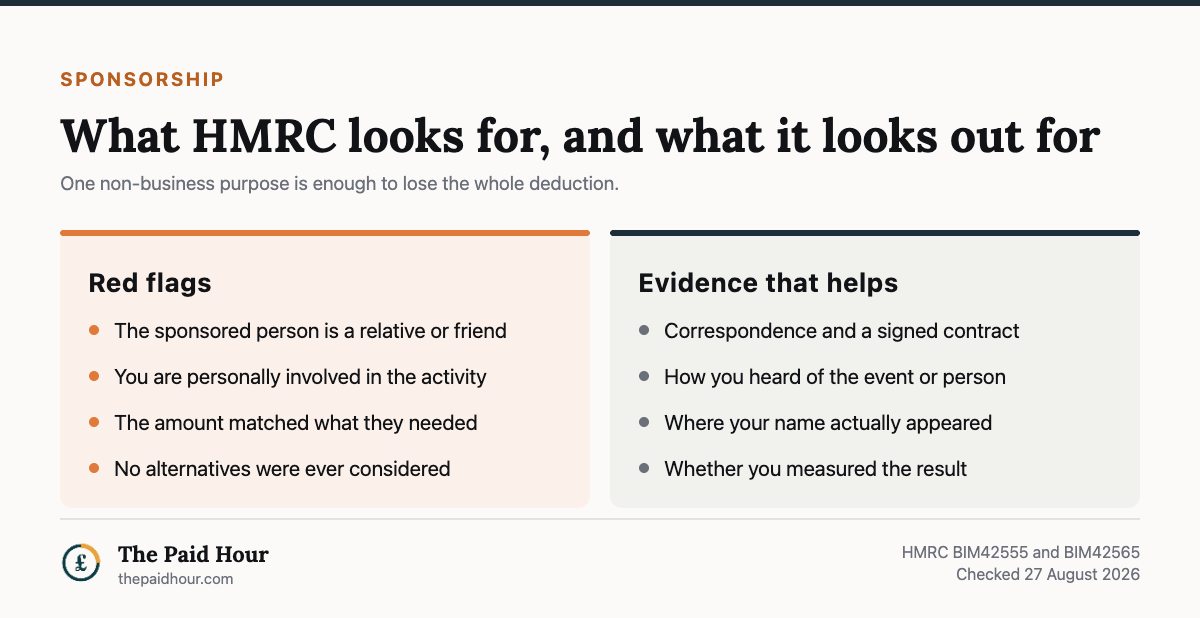
The two warning signs HMRC names
The manual sets them out plainly: there may typically be a non-business purpose where the sponsored person is a relative or close friend of the proprietor, or where the proprietor has a personal involvement in the sponsored activity.
Which covers a large share of small-business sponsorship in this country. The kit for your son’s under-11s. The village team you played for. The car you race at weekends with the business name down the side.
None of those is automatically disallowed. HMRC says typically, not always. But the presumption is against you and the burden of showing otherwise is yours.
The detail that decided a real case
In Executive Network (Consultants) Ltd v O’Connor, from 1996, the Special Commissioner found the payments were not wholly and exclusively for the trade. The reasoning is worth memorising, because it is a test you can apply to your own arrangement in ten seconds.
The amount paid was determined by the amount the sponsored party needed.
That is the giveaway. A commercial sponsorship is priced by what the exposure is worth to you. A payment priced by what the other side was short of is a contribution to their activity that happens to have a logo attached.
So the question is not did I get advertising out of it. It is how did I arrive at this number.
What HMRC asks to see
Contemporary evidence, and the list in the manual reads like a description of a normal commercial decision: how you came to hear of the event or person, why that one, what alternatives you considered and why you rejected them, the correspondence and the contract, how prominently your name appeared, and what arrangements existed for assessing whether it worked.
HMRC also says it will look at your website, at general information about the activity, and at anything the sponsored party has said publicly. That last one catches people: a club thanking a generous supporter is not describing an advertising contract.
None of this is hard to produce at the time. All of it is close to impossible to produce afterwards, which is the same pattern as everything else in what triggers a tax return enquiry.
Two other ways sponsorship fails
It was capital. Buying the racehorse or the car is not sponsorship spending, it is buying an asset, and HMRC names both. A contribution that gives an enduring benefit rather than a season’s exposure goes the same way.
It was entertaining in a different wrapper. Sponsorship packages routinely include hospitality, a table, tickets, a marquee. That element is barred by its own statutory rule regardless of how commercial the rest of the deal was, so ask for a split invoice rather than hoping the whole thing goes through.
Donations are a different question again
If what you actually want to do is support something, a donation is honest and a sponsorship agreement dressed over it is not. Charitable giving has its own routes and its own relief, and they do not run through your trading profits.
The version that fails worst is the one where a genuine donation gets a contract wrapped around it afterwards to make it deductible. That is the arrangement HMRC’s evidence list is designed to find.
Paperwork to keep for adverts and sponsorship
For advertising: the invoice, and that is it.
For sponsorship: the contract, the emails that led to it, a note of how you priced it and what else you considered, and a photograph of where your name appeared. Written at the time, it is twenty minutes. Reconstructed later, it is an argument you lose. Keep it for five years after the filing deadline, and check the treatment against disallowable expenses before you file. The full list of what else goes through is in allowable expenses for UK freelancers.
Claiming everything you are owed?
HMRC Tax & Expense Mastery 2026/27. Nine modules and eleven working templates that take a UK freelancer from “do I even need to register” to a correct return, with MTD quarters built in.
- Fifteen expense categories, with the trap inside each one (training, clothing, meals, the seven-year pre-trading rule)
- Home and vehicle: flat rate against actual cost, with the £312 break-even worked out and the mileage lock-in rule
- The year-one payments-on-account cash shock, and the routine that stops it landing twice
HMRC does not send a list of what you forgot to claim. Most freelancers leave several hundred pounds of legitimate expenses on the table every single year, and the return still gets filed.
Buying more than one? The Complete Freelancer System, all five for £87, against £193 bought separately.
Sources
- BIM42555: sponsorship, HMRC Business Income Manual
- BIM42565: sponsorship, evidence to look for, HMRC Business Income Manual
- Self-employment (full) SA103F and notes, GOV.UK
- Expenses if you are self-employed, GOV.UK
The box 24 list and the box 39 instruction are quoted from HMRC’s notes to the SA103F self-employment pages, reference 12/25. The sponsorship rules, the warning signs and the evidence list are from HMRC’s Business Income Manual at BIM42555 and BIM42565, both last updated 4 August 2026. Executive Network (Consultants) Ltd v O’Connor is reported at [1996] SpC 56 and is described here as HMRC records it rather than from the decision itself. All pages read on 27 August 2026. This is general information about how the rules work, not tax advice. Check your own position with HMRC or an accountant before you file.