
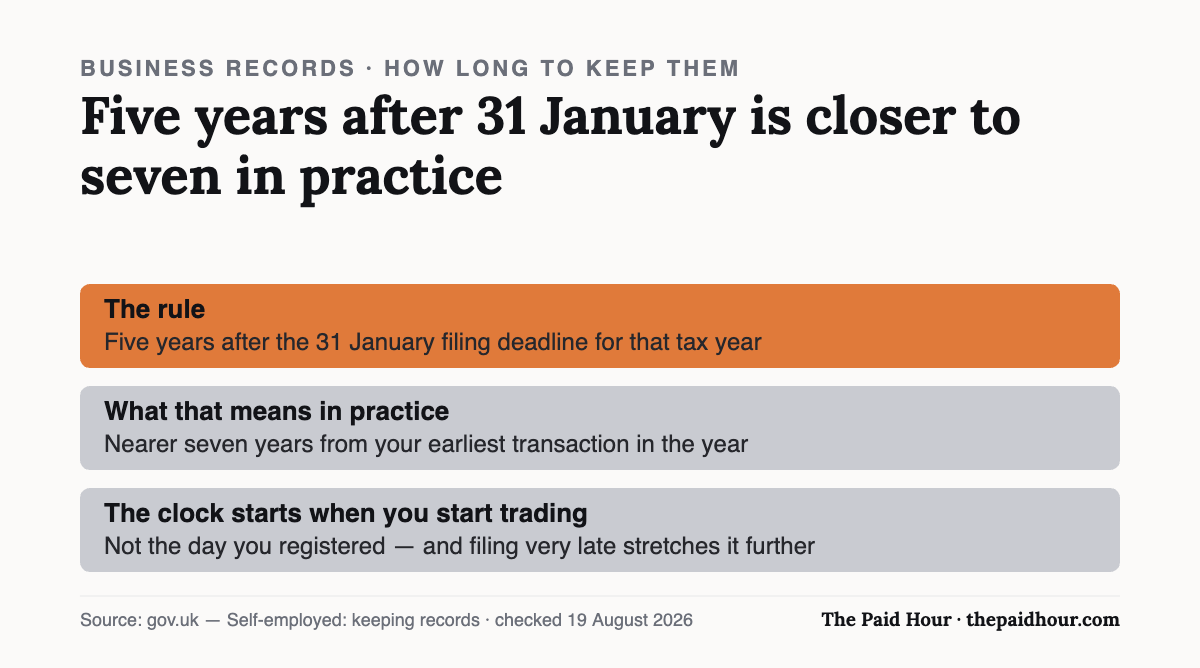
Straight answer: HMRC’s rule is five years after the 31 January filing deadline of the tax year, which works out closer to seven years from your earliest transaction. Records count from the day you start trading rather than the day you registered. File very late and the clock stretches further.
How long to keep business records? At least five years after the 31 January submission deadline of the relevant tax year. Because that deadline lands almost ten months after the tax year ends, the real retention period from your earliest transaction works out closer to seven years. And records are required from the day you start trading, not from whenever you got around to registering with HMRC.
How long to keep business records: five years from when
This is the detail people get wrong, and getting it wrong means binning things too early.
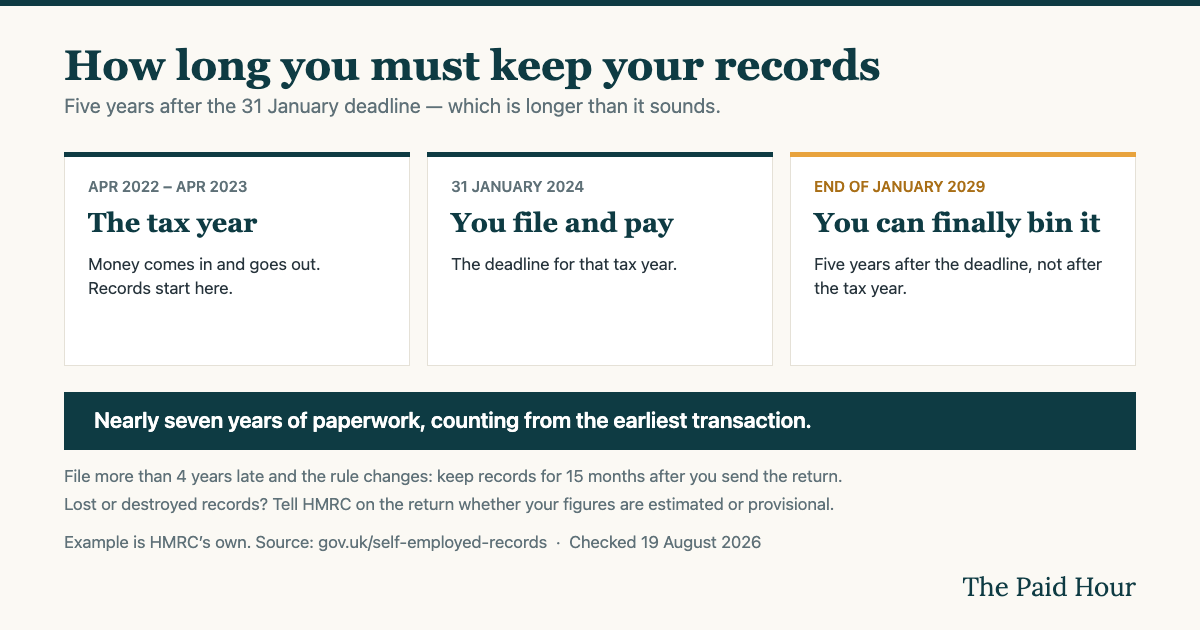
The five years runs from the 31 January submission deadline, not from the end of the tax year, and not from whatever date you filed. HMRC’s own example: send your 2022/23 return online by 31 January 2024, and you have to keep those records until at least the end of January 2029.
Now count from the other end. A receipt from April 2022, the first month of that tax year, has to survive all the way until January 2029. That’s six years and nine months. In practice, anything you’re filing right now needs keeping for the best part of seven years.
HMRC keeps this window for a reason: it can open a compliance check to make sure you paid the right amount. Open one and you can’t produce the evidence, and the deductions you claimed are what’s at risk.
The rule changes if you file very late
Send a return more than four years after the deadline, and the five-year rule gets replaced entirely: you keep the records for 15 months after you actually send the return.
Sounds like a relief. Mostly isn’t. By the time you’re four years late, the penalties have long since maxed out, and you still need those records to build the return in the first place.
What counts as business records
You need records of business income and expenses, and separately of your personal income. There’s no prescribed format here. HMRC cares that records are accurate, complete and readable, not that they came out of some particular piece of software.
What HMRC lists as acceptable evidence:
- copies of your invoices, paper or electronic
- a spreadsheet of income receipts
- emails confirming income received
- statements from whoever paid you
- bank statements and paying-in records
- a diary or appointments book showing income from each customer
A spreadsheet updated monthly is entirely legal and beats software you never open. What matters is that it exists as you go, trying to reconstruct two years of transactions from bank statements in January is exactly where mistakes and guesses creep in.
Two things worth flagging. If you’re the nominated partner in a partnership, you’re keeping the partnership’s records too. And limited companies run under entirely different rules, this page is written for sole traders and partners.
Even the trading allowance needs business records
This one surprises people. Under £1,000 and using the trading allowance? You generally don’t have to tell HMRC anything, but you still have to keep a record of the income. HMRC can charge a penalty if your records aren’t accurate, complete and readable, or if you simply don’t keep them long enough.
Same logic applies to simplified expenses: the flat rate removes the receipts, not the record-keeping itself. You’re still logging business miles and hours worked at home.
If your business records are lost or destroyed
Fire, flood, theft, a dead laptop, it happens. If you can’t replace them, HMRC’s instruction is to do your best to provide figures and tell them on the return which kind you’re using:
- Estimated figures: your best guess, used where the actual figures simply can’t be provided.
- Provisional figures: temporary estimates while you wait for the real numbers. You must submit the actual figures once you have them.
Declaring an honest estimate is a completely different position from filing a made-up number as if it were real. The box on the return exists precisely so you can be straight about which one you’re doing.
How long to keep business records: what to do with this
- Work out your real bin date for each year: the 31 January deadline plus five years. Write it on the folder itself.
- Keep it digital and backed up. Seven years of paper receipts fade; scans don’t, and HMRC accepts electronic copies without issue.
- Record as you go, monthly. This is the entire difference between a calm January and a frantic one.
- Keep records even under the £1,000 allowance, and even on flat-rate expenses.
- Something lost? Estimate honestly and flag it on the return instead of inventing a figure.
Related: which accounting method you use changes what you need to record, and Making Tax Digital is changing the record-keeping rules again from April 2026.
A scan counts as the record, not just a copy of one, provided the image carries everything the paper did. The rules on that are in the guide to whether HMRC accepts photos of receipts.
MTD quarters coming and the books are a shoebox?
Digital Bookkeeping System (MTD-ready) 2026/27. Seven modules and a seven-sheet toolkit, built around a category-to-tax-box mapping table that makes your quarterly updates fill themselves.
- A software decision sheet costed over three years, split by turnover, VAT status and phone-or-desktop
- The chart of categories mapped to the Self Assessment and MTD boxes, and the three categories never to auto-categorise
- Weekly and month-end cards, an MTD quarter-close checklist, and an export-and-archive index so their cloud is never your only copy
Software is priced monthly, excluding VAT, and you will hold the subscription for years. Pick on the wrong number and the difference over three years is more than every course on this site combined.
Buying more than one? All ten 2026/27 courses for £107, against £328 at full price.
Need this ready-made? → UK Sole Trader Expense Tracker (Excel): HMRC expense categories pre-built (£5.99, instant download)
Sources
- GOV.UK — How long to keep your records
- GOV.UK, What records to keep
- HMRC. Records required under the trading allowance
- GOV.UK, Tax compliance checks
Rules checked 19 August 2026. This is general information, not financial or tax advice.