
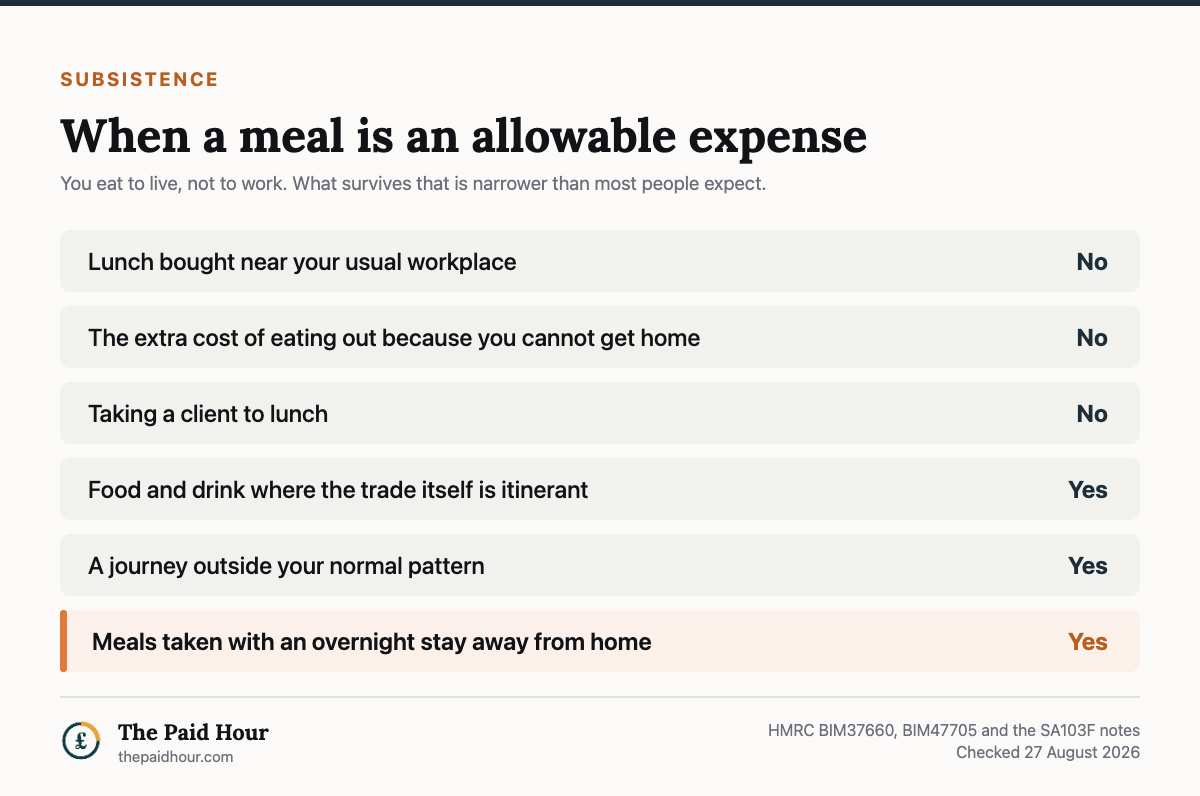
Quick answer: Your ordinary lunch is not an allowable expense, and the reason is older than you might think. A taxpayer must eat in order to live, not in order to work. But HMRC does allow reasonable food and drink in three situations: when the trade itself is itinerant, when a journey falls outside your normal pattern, and on any trip that keeps you away overnight. On an overnight trip the hotel and the meals both count, whether or not they are on the same bill.
Table of Contents
Claiming food when self-employed is one of those questions where the popular answer is no and the accurate answer is sometimes, and here is exactly when. The gap between those two costs mobile trades real money every year.
Two HMRC documents cover this. They do not say the same thing. That is the first useful thing to know.
Can you claim food and drink when self-employed?
The starting position is that you cannot. Food keeps you alive whether you are working or not, so buying it serves a purpose that has nothing to do with the trade, and that is enough to fail the wholly and exclusively test.
What survives that is a short list.
The carpenter who tried to claim the difference
In Caillebotte v Quinn, decided in 1975, a self-employed carpenter worked at sites within about forty miles of home. When he could get home he ate a light lunch that cost him around ten pence. When he could not, he bought lunch out for about forty pence.
He did not claim the forty pence. He claimed the thirty pence difference. The part of the cost that only existed because of where the work was. It is a reasonable-sounding argument and it is the one almost everybody reaches for.
The General Commissioners agreed with him. The High Court did not. The reasoning, as HMRC records it, is that a self-employed taxpayer like any other must eat in order to live, he does not eat in order to work. The lunch was not a business cost that happened to feed him. It was food.
The judge did draw one line worth noticing. Food consumed by an actor during a performance is a different thing, because it is incidental to the work being performed rather than the sustenance the performer lives on. That is how narrow the exception is.
Why the extra cost argument for food and drink fails
People assume the answer is to claim a proportion. It is not available. Where an expense carries a non-business purpose through the whole of it, the legislation gives no business percentage, only the narrow case where a definite part of the spending was itself wholly and exclusively for the trade.
A sandwich has no definite part. Neither does the thirty pence, which is why the carpenter lost. If you are working through the wider list of disallowable expenses, subsistence sits with the ones that fail on principle rather than on evidence.
The itinerant trade rule for food and drink
Here is the part that gets left out. HMRC’s Business Income Manual says a deduction is, however, allowable for reasonable expenses on food and drink for consumption by the trader either at a place to which the trader travels in the course of the trade or while travelling in the course of the trade, if certain conditions are satisfied.
The conditions are two, and you need one of them:
- The trade is itinerant: travelling is how the work is done, not something the work occasionally requires.
- You travel to the place only occasionally, and either that journey sits outside your normal pattern or you have no normal pattern at all.
Read that second condition slowly, because it is the one that catches a lot of people. A one-off trip to a client three counties away is outside your pattern. Going to the same client every Tuesday is your pattern, and the coffee you buy on the way is not deductible however far you drove for it. Frequency, not distance, is what HMRC is testing.
The mileage is a separate question with a separate answer, see the self-employed mileage allowance.
Overnight trips: the clean case for food and drink
If a business trip means at least one night away from home, HMRC states plainly that the hotel accommodation and reasonable costs of overnight subsistence are deductible. And then it removes the argument accountants used to have with clients about receipts: the reasonable costs of meals taken in conjunction with overnight accommodation are allowable whether or not paid on the same bill.
Dinner charged to the room and dinner bought down the road are treated alike. There is separate treatment for self-employed long-distance lorry drivers who sleep in the cab rather than take a room.
One limit, and it is absolute. None of this extends to accommodation and subsistence at your base of trade operations, even if there is a contractual requirement for the trader to reside in a particular place. Where you work from is where you live, for these purposes, and living there is not a business cost. That is the same principle underneath working from home tax relief, which is a use-of-home claim rather than a cost-of-living one.
HMRC’s form notes are narrower than HMRC’s manual
The notes to box 20 of the self-employment pages list what goes in with travel: fares, parking, vehicle running costs, and hotel room costs and meals on overnight business trips. Then, in the disallowable column, four words. Other meals are disallowable.
Taken alone, that reads as: overnight only, nothing else. The manual says more than that. Both documents are HMRC’s.
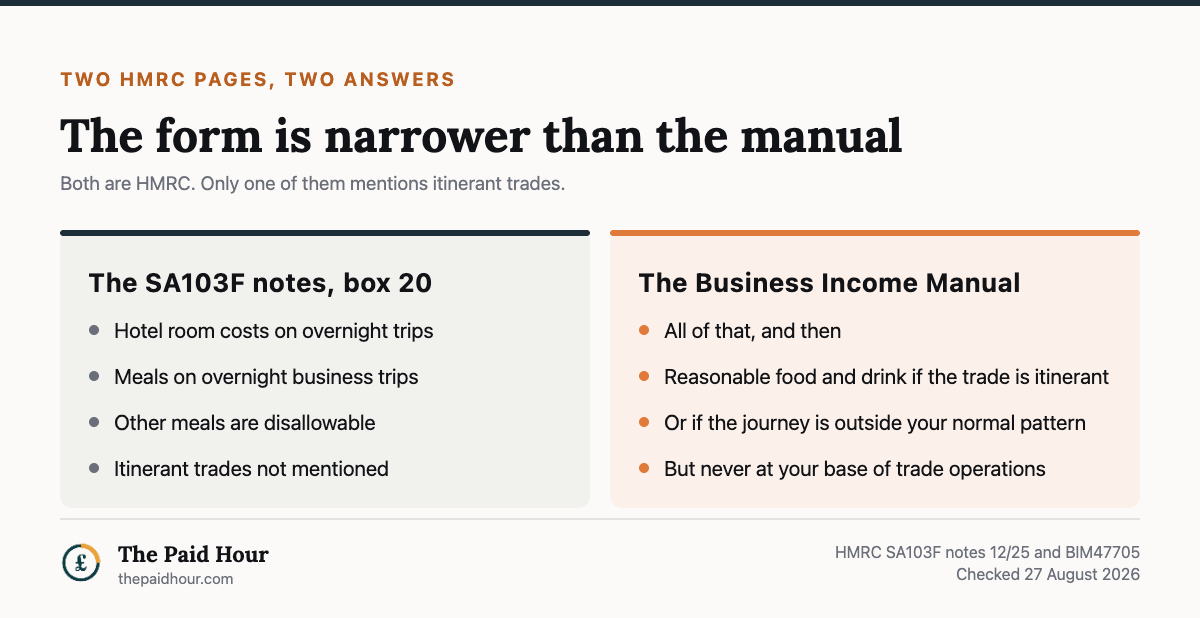
The sensible way to hold the two together: the notes are a summary printed on a form, the manual is HMRC’s own detailed statement of how it applies the law. A claim that goes beyond the notes is not wrong, but it is a claim you should be able to evidence, so the pattern of your travel has to be visible in your records, not just in your memory.
What counts as reasonable food and drink
HMRC does not publish a figure for the self-employed. It publishes benchmark scale rates for meals, but those belong to employers reimbursing employees, and the table sitting in the employment manual is an old set kept for historic years. Do not lift those numbers onto a sole trader’s return.
The simplified expenses flat rates do not help either. They cover vehicles, working from home and living on business premises. Food is not on the list.
So reasonable means what it says, judged on the facts. A meal while away on business is reasonable. A tasting menu is a conversation you will have to have.
Client lunches are not food and drink for this purpose
Taking a client out is business entertaining, and business entertaining is blocked by its own provision regardless of how commercial the motive was. Your own meal on that occasion goes down with it. Nothing in the itinerant trade rule rescues it.
What to keep
The receipt, the date, where you went and why the journey was not routine. On an overnight trip the hotel invoice does most of that work by itself. On an occasional journey it is the occasional you would be evidencing, and that lives in your diary rather than on the receipt.
Keep it for the same period as everything else, at least five years after the filing deadline. Subsistence is a small line that attracts attention out of proportion to its size, for the same reason clothing does: it is where HMRC expects to find optimistic claims. More on that in what triggers a tax return enquiry, and the full picture in allowable expenses for UK freelancers.
Filing it yourself this year?
HMRC Tax & Expense Mastery 2026/27. Nine modules and eleven working templates that take a UK freelancer from “do I even need to register” to a correct return, with MTD quarters built in.
- Fifteen expense categories, with the trap inside each one (training, clothing, meals, the seven-year pre-trading rule)
- Home and vehicle: flat rate against actual cost, with the £312 break-even worked out and the mileage lock-in rule
- The year-one payments-on-account cash shock, and the routine that stops it landing twice
HMRC does not send a list of what you forgot to claim. Most freelancers leave several hundred pounds of legitimate expenses on the table every single year, and the return still gets filed.
Buying more than one? The Complete Freelancer System, all five for £87, against £215 at full price.
Sources
- BIM37660: duality of purpose, subsistence, HMRC Business Income Manual
- BIM47705: travel and subsistence, general, HMRC Business Income Manual
- Self-employment (full) SA103F and notes, GOV.UK
- EIM05231: table of benchmark scale rates, HMRC Employment Income Manual
- Simplified expenses if you are self-employed, GOV.UK
- Expenses if you are self-employed, GOV.UK
Caillebotte v Quinn is reported at [1975] 50 TC 222 and the facts and reasoning here are taken from HMRC’s Business Income Manual at BIM37660 rather than from the law report. The itinerant trade and overnight subsistence wording is quoted from BIM47705. The box 20 wording is from HMRC’s notes to the SA103F self-employment pages, reference 12/25, covering 6 April 2025 to 5 April 2026. All pages read on 27 August 2026. This is general information about how the rules work, not tax advice. Check your own position with HMRC or an accountant before you file.