
Table of Contents
Disallowable expenses self-employed sole traders sometimes try to sneak through are exactly what HMRC checks for first, here’s what fails the “wholly and exclusively” rule.
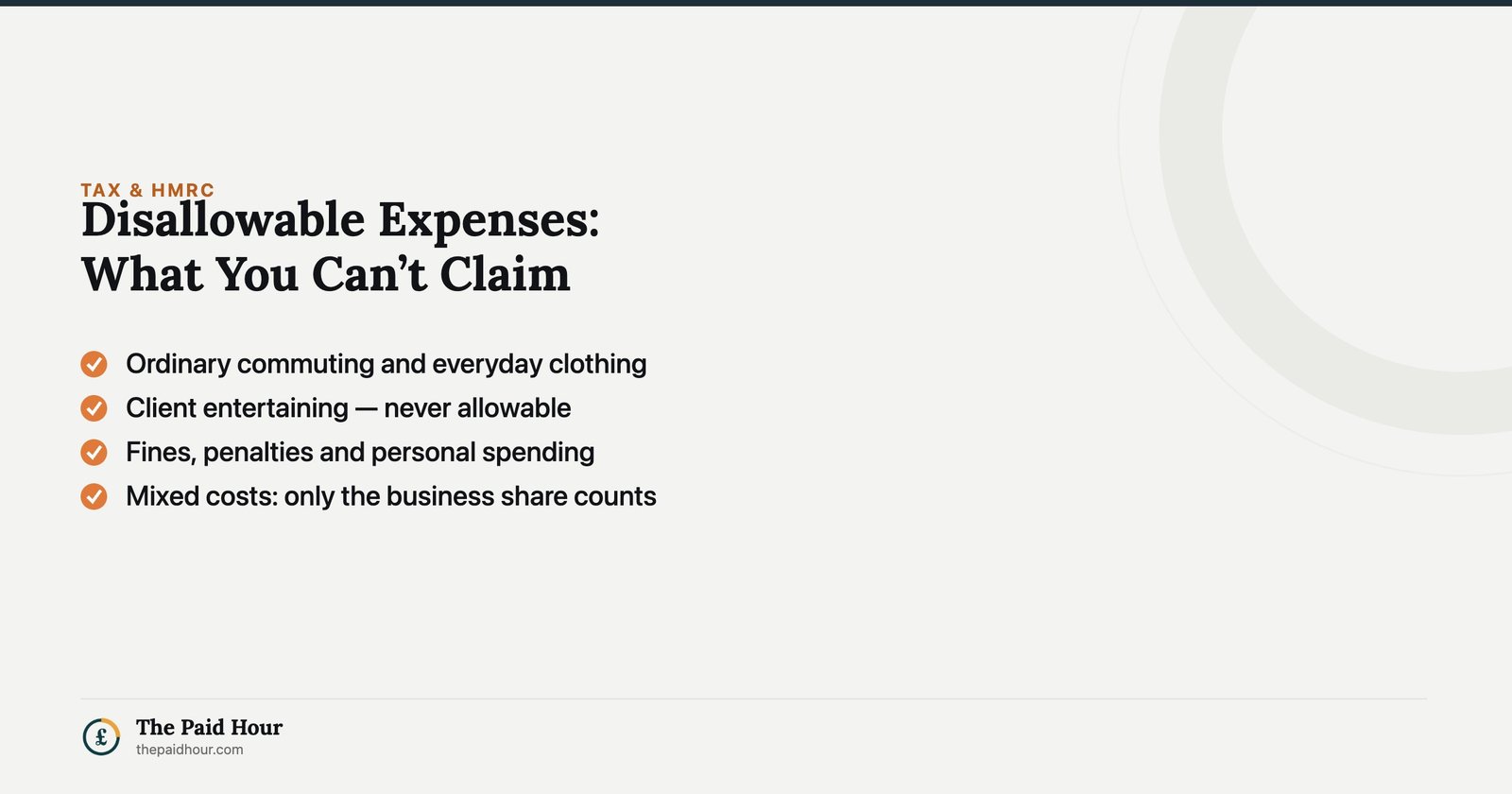
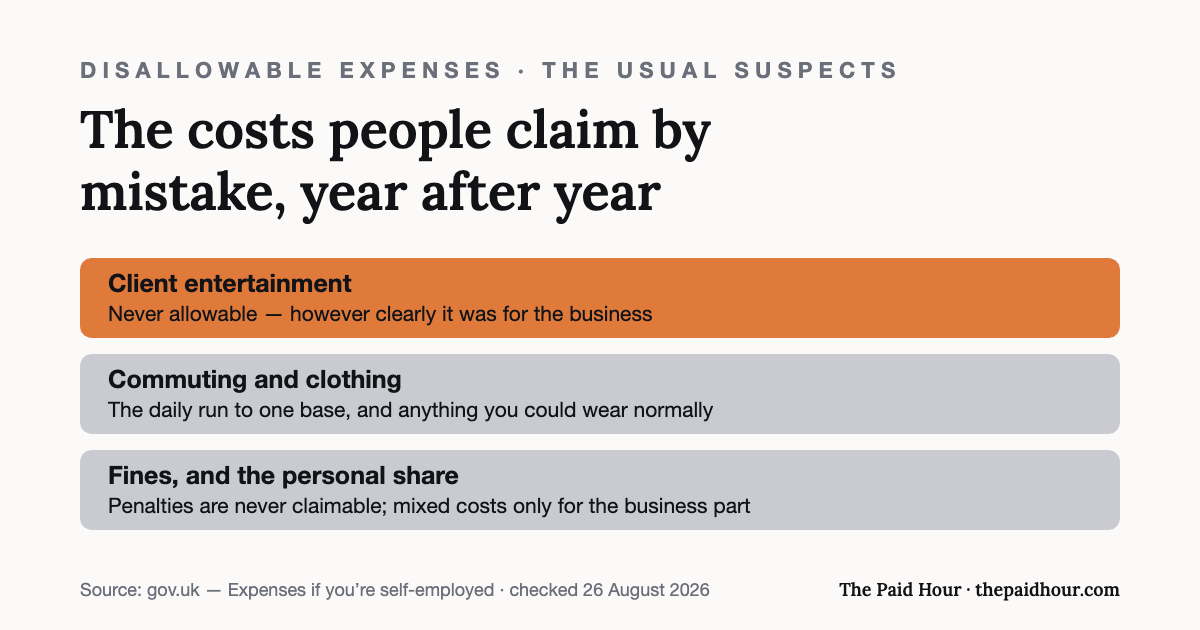
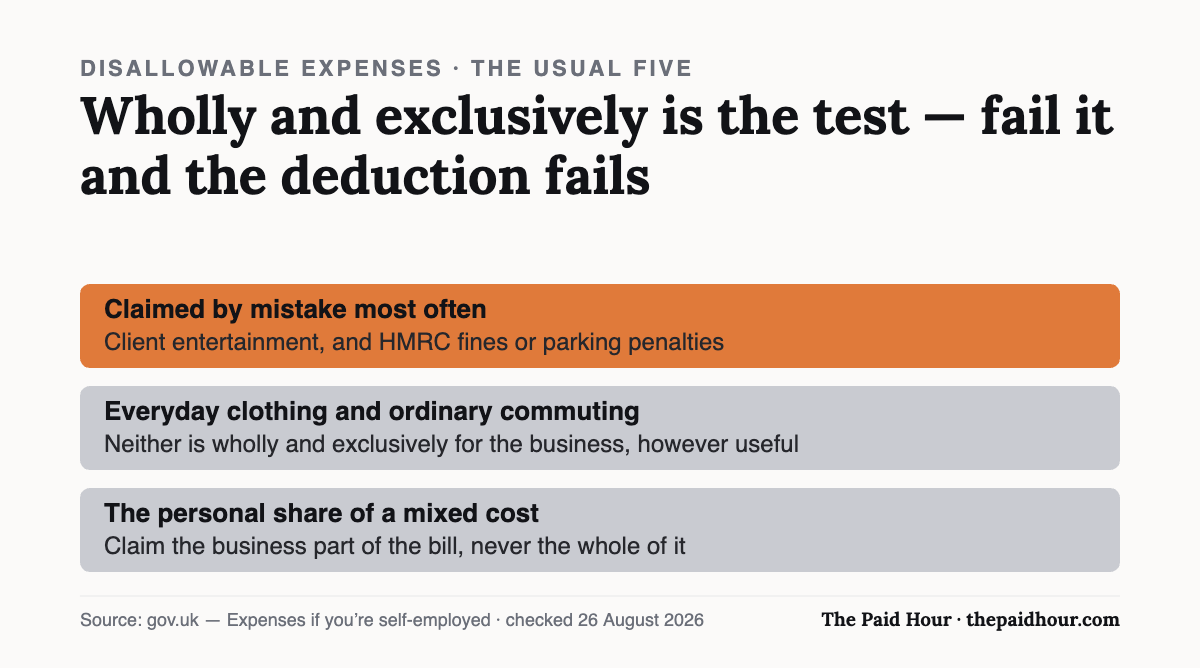
In short: The costs most often claimed by mistake: client entertainment, HMRC fines and parking penalties, everyday clothing, ordinary commuting, and the personal share of any mixed-use cost. “Wholly and exclusively” is the test, fail it and the deduction fails, however business-flavoured the receipt looks.
Our guide to allowable expenses for UK freelancers covers the basic rule: a cost has to be “wholly and exclusively” for your business to bring your tax bill down. This post is the mirror image. Disallowable expenses for self-employed people are the ones that get claimed by mistake most often, and why HMRC won’t accept them. Get this wrong on a Self Assessment return and, at best, you overpay; at worst, you invite a compliance check.
What Makes an Expense Disallowable?
HMRC’s starting principle is simple: allowable expenses must be for business purposes only, and “allowable expenses do not include money taken from your business for personal use” (gov.uk). Anything that’s really a personal cost, a penalty, or a capital purchase falls outside that test, which is exactly where most disallowable expenses for self-employed traders come from.
Is client entertainment one of the disallowable expenses?
No. Gov.uk lists this explicitly among costs you cannot claim: “entertaining clients, suppliers and customers” and “event hospitality” (gov.uk). The same page rules out most gifts, gym membership fees, donations to charity, and payments to political parties.
It’s an easy trap because entertaining a client can feel like a legitimate business activity, but tax law treats hospitality as a personal-benefit cost rather than a business one, and HMRC’s internal manual confirms the cost of food, drink or hospitality laid on for non-employees is disallowable under the legislation (gov.uk).
Are fines and penalty charges disallowable expenses?
No. Gov.uk’s guidance on travel costs specifically rules out “fines or penalty charges” (gov.uk). This covers things like parking tickets and speeding fines picked up while driving for work.
HMRC’s internal manual sets out the reasoning: “a fine incurred as a result of a trader’s infraction of the law is not allowable,” because its purpose is punitive, and letting it reduce your tax bill would undercut the point of the penalty (gov.uk). A £60 parking fine picked up on a client visit is a common one, it feels business-related, but it’s still disallowed.
Clothing: allowable or disallowable expenses?
Only specific types. Gov.uk allows “uniforms, protective clothing needed for your work, [and] costumes for actors or entertainers”, but explicitly states: “you cannot claim for everyday clothing (even if you wear it for work)” (gov.uk). That means a smart suit you bought specifically for client meetings still doesn’t qualify, it’s ordinary clothing you could wear outside work, regardless of your intent when you bought it.
What About the Personal Part of a Mixed-Use Cost?
Where something is used for both business and personal life, only the business proportion is allowable. Gov.uk’s own worked example: a mobile phone bill of £200, split between £130 personal and £70 business use, means only the £70 is claimable (gov.uk). The same logic applies to a car, a laptop, or your home internet (you need a reasonable, justifiable split rather than the full bill), claim the personal slice too and it becomes another disallowable expense for self-employed people to untangle at tax time.
Is commuting to your regular workplace one of the disallowable expenses?
Generally, no. HMRC’s Business Income Manual is explicit that “the cost of travelling from home to place of work is generally disallowed,” because it reflects “the (private) choice of where to live,” giving the journey a dual purpose that fails the wholly-and-exclusively test (gov.uk). Gov.uk’s consumer-facing guidance confirms the same point in plain terms, ruling out “travel between home and work” alongside “non-business driving or travel costs” (gov.uk).
By contrast, genuine business travel (fuel, parking, train and taxi fares, hotel rooms and meals on overnight trips to a client site or a temporary location), is allowable (gov.uk).
Do Capital Items Count as Expenses?
Not in the same way. Equipment, machinery, and business vehicles (cars, vans, lorries, bicycles) you buy and keep for the business are capital items, dealt with through capital allowances instead of claimed as a straightforward expense (gov.uk). If you’re using cash basis accounting, there’s a partial exception: you can claim capital allowances on a car you buy for the business, but everything else you buy and keep should still go through allowable expenses in the normal way (gov.uk).
One more restriction to know: if you use the £1,000 tax-free trading allowance instead of claiming actual expenses, you cannot also claim capital allowances (gov.uk).
Disallowable expenses for self-employed people: the mistakes, summarised
- Claiming a client dinner or a corporate hospitality box as a business cost
- Trying to expense a parking or speeding fine picked up on a work journey
- Expensing a suit, coat, or other everyday clothing bought “for work”
- Claiming 100% of a phone, car, or internet bill that’s used for both business and personal life
- Claiming your daily commute to a regular workplace as a travel expense
- Expensing a laptop, van, or other equipment purchase directly instead of via capital allowances
A note on verification: Every rule above is sourced directly from gov.uk’s consumer guidance and HMRC’s internal Business Income Manual. One nuance worth flagging: the detailed “temporary workplace” rules many people know from employment tax (the kind that let an employee claim travel to a short-term site) are built for employees, not the self-employed.
For sole traders, the relevant principle instead comes from HMRC’s Business Income Manual (the wholly-and-exclusively test at BIM37605), which disallows home-to-regular-workplace travel on dual-purpose grounds rather than via a formal permanent/temporary workplace test. If your situation involves multiple regular sites or an itinerant trade, it’s worth checking your specific facts against HMRC’s guidance or with an accountant, since this is one of the more fact-dependent areas of allowable expenses.
Claiming everything you are owed?
HMRC Tax & Expense Mastery 2026/27. Nine modules and eleven working templates that take a UK freelancer from “do I even need to register” to a correct return, with MTD quarters built in.
- Fifteen expense categories, with the trap inside each one (training, clothing, meals, the seven-year pre-trading rule)
- Home and vehicle: flat rate against actual cost, with the £312 break-even worked out and the mileage lock-in rule
- The year-one payments-on-account cash shock, and the routine that stops it landing twice
HMRC does not send a list of what you forgot to claim. Most freelancers leave several hundred pounds of legitimate expenses on the table every single year, and the return still gets filed.
Buying more than one? The Complete Freelancer System, all five for £87, against £215 at full price.
Need this ready-made? → UK Sole Trader Expense Tracker (Excel): HMRC expense categories pre-built (£5.99, instant download)
Sources
- Expenses if you’re self-employed: Overview – GOV.UK
- Expenses if you’re self-employed: Marketing, entertainment and subscriptions – GOV.UK
- Expenses if you’re self-employed: Travel – GOV.UK
- Expenses if you’re self-employed: Clothing – GOV.UK
- Expenses if you’re self-employed: Office, property and equipment – GOV.UK
- BIM45050 – Specific deductions: entertainment: contents – HMRC internal manual – GOV.UK
- BIM42515 – Specific deductions: administration: fines – HMRC internal manual – GOV.UK
- BIM37605 – Wholly and exclusively: duality of, or non-trade, purpose: travel costs: home to work – HMRC internal manual – GOV.UK
The wholly-and-exclusively rule was re-checked against gov.uk on 26 August 2026.
This is general information about how the rules work, not tax advice. The links above go to the primary sources; for your own circumstances, speak to an accountant or contact HMRC directly.
The pattern behind most disallowable expenses self-employed people get caught claiming is the same one: personal benefit mixed in with a genuine business cost.