
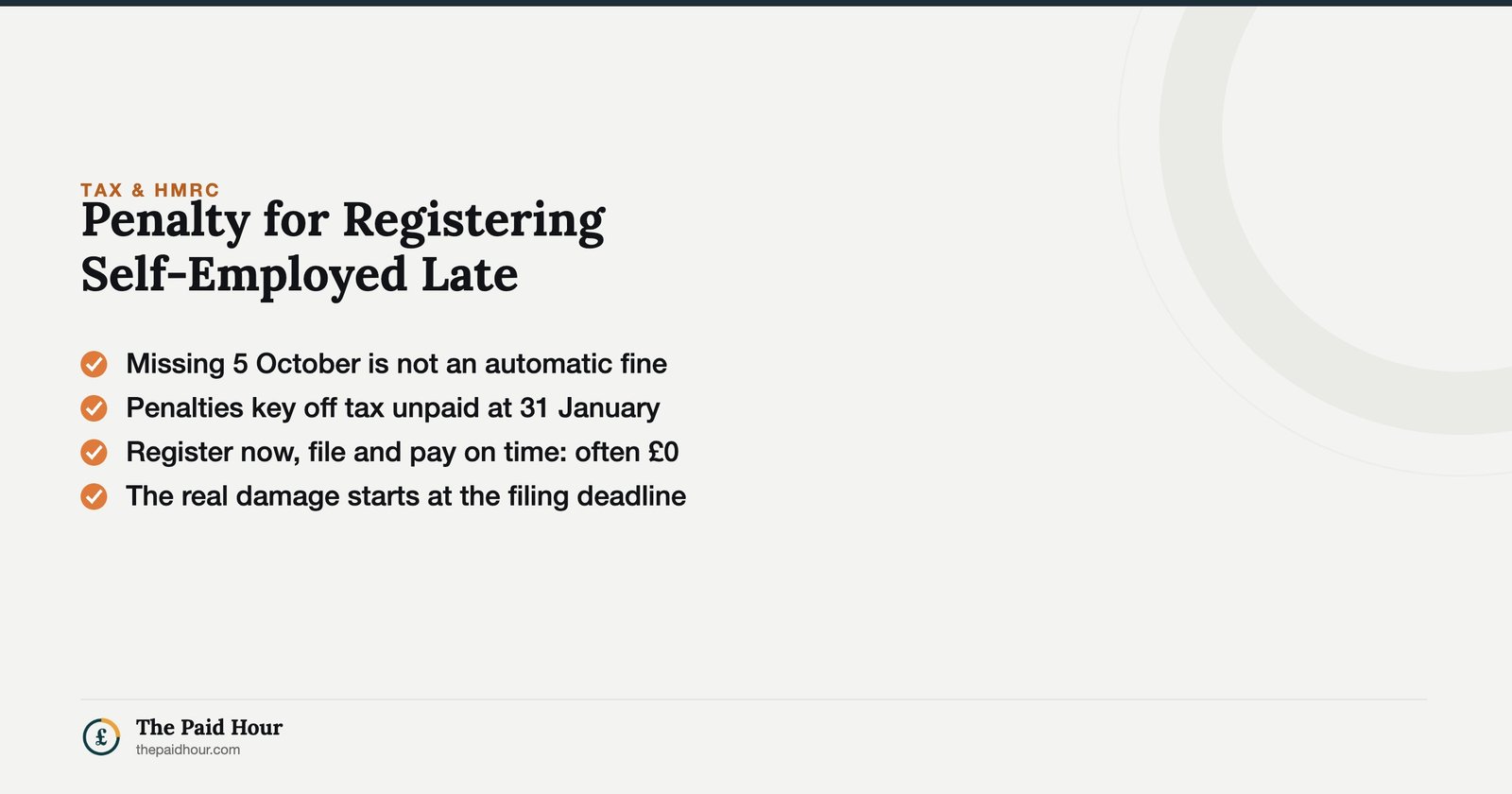
Quick answer: Missing 5 October is not an automatic fine. The failure-to-notify penalty is calculated from tax left unpaid at 31 January, register now, file on time, pay in full, and it usually comes to nothing. The real damage starts when the delay runs into the filing deadline itself.
The penalty for registering self-employed late is not the flat fine most people assume. Missed the 5 October deadline to tell HMRC you’re self-employed? Take a breath first. This is one of the most common Self Assessment slip-ups, and in a lot of cases it costs nothing at all, but it’s worth understanding exactly which penalty regime you’re dealing with before you panic.
Important distinction up front: being late to register as self-employed is a completely different penalty from being late to file your tax return once you’re registered. This post is about the first one. HMRC calls it “failure to notify.” If you’ve already registered and it’s your tax return that’s overdue, you want our separate guide instead: Self Assessment late filing penalties. Mixing the two up is easy to do, and the numbers involved are not the same.
Registering self-employed late: what’s the deadline?
You must tell HMRC by 5 October following the end of the tax year in which you started trading. So if you began working for yourself at any point in the 2024/25 tax year (6 April 2024 to 5 April 2025), the deadline to register was 5 October 2025 (gov.uk). The same 5 October cut-off applies every year, tied to whichever tax year you first had self-employed income in.
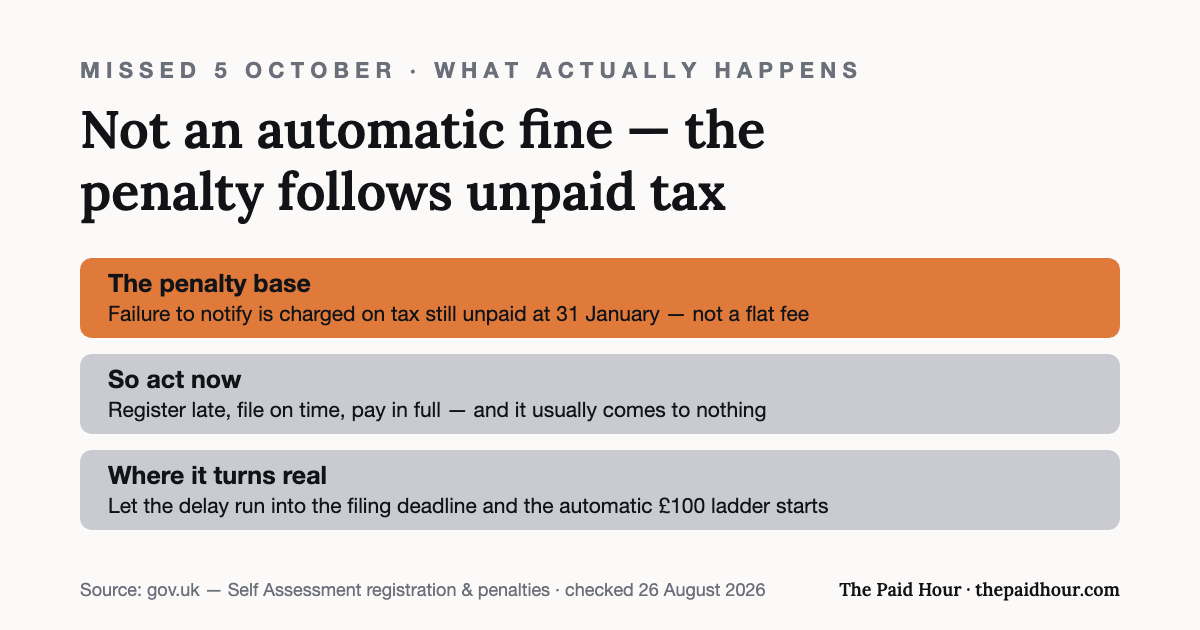
Miss it, and gov.uk is explicit: “you could get a penalty” (gov.uk). The key word is could, this isn’t an automatic flat fee like the £100 you get for filing a return late. It’s a separate penalty called “failure to notify,” and whether you pay anything depends heavily on your circumstances and how much tax was due.
How the penalty for registering self-employed late is calculated
Unlike late filing penalties, this one isn’t a fixed amount: it’s calculated as a percentage of the tax you owed but hadn’t yet told HMRC about, and the percentage depends on your behaviour (gov.uk):
- Reasonable excuse: No penalty at all, provided you had a genuine reason for the delay, it wasn’t deliberate, and you told HMRC without unreasonable delay once that reason ended (gov.uk).
- Non-deliberate failure (you simply didn’t realise, or didn’t get round to it): the penalty can range from 0% up to 30% of the tax due, with the exact figure depending on how quickly you came forward and whether you told HMRC yourself (“unprompted”) or only after they’d already started asking questions (“prompted”). Confirmed on both HMRC’s CC/FS11 factsheet and its penalties overview for agents (gov.uk; gov.uk).
- Deliberate failure (you knew you should register and chose not to): 20% to 70% of the tax due.
- Deliberate and concealed (you also took active steps to hide it): 30% to 100% of the tax due.
Within whichever band applies, HMRC reduces the penalty further based on the quality of your disclosure — essentially, how much you help by telling them promptly, cooperating, and handing over records (gov.uk).
Note: the exact sub-band cut-offs within that non-deliberate 0–30% range (how far coming forward within 12 months shifts you toward the lower end) weren’t fully confirmed on the public gov.uk pages checked. Treat 0–30% as the reliable headline figure, and check with HMRC or an accountant for your exact position.
The point most people miss: if you owed no tax, or you register late but still pay everything on time, there’s nothing to calculate a percentage of, which is why registering self-employed late often ends up penalty-free, provided the return itself is filed and paid correctly.
Late registration vs late filing: two different penalties
No, and this is where people confuse themselves. gov.uk’s own penalties page keeps these as three separate categories: late filing penalties (the automatic £100 and daily charges for a late tax return), late payment penalties (percentage charges for tax paid late), and failure to notify penalties (this one, for registering late) (gov.uk).
It’s entirely possible to be hit with a failure-to-notify penalty for registering self-employed late and separately with late filing and late payment penalties if the return and tax that follow are also late. They stack independently. For the filing and payment side, see our full breakdown: Self Assessment late filing penalties.
What to do right now if you’re registering self-employed late
- Register today. The clock only gets worse the longer you leave it, and unprompted disclosure earns a lower penalty band than being caught later. Use HMRC’s checker: gov.uk – Register for Self Assessment. If you want the full sole trader registration process, see registering as a sole trader with HMRC.
- Gather your records: invoices, bank statements, expense receipts, for every tax year you’ve traded but not declared. HMRC wants an accurate picture rather than an estimate.
- Expect a penalty conversation only if tax was actually owed and undeclared. No tax due, or you’re within a reasonable-excuse window? You may face no charge: HMRC decides case by case.
- File and pay as soon as you’re registered. Get the return in and tax paid promptly once you have your Unique Taxpayer Reference, this keeps you clear of the separate late filing and late payment penalties.
Registering self-employed late is fixable. The worst move is doing nothing and letting the gap get longer.
Common questions about late registration
What is the penalty for registering self-employed late?
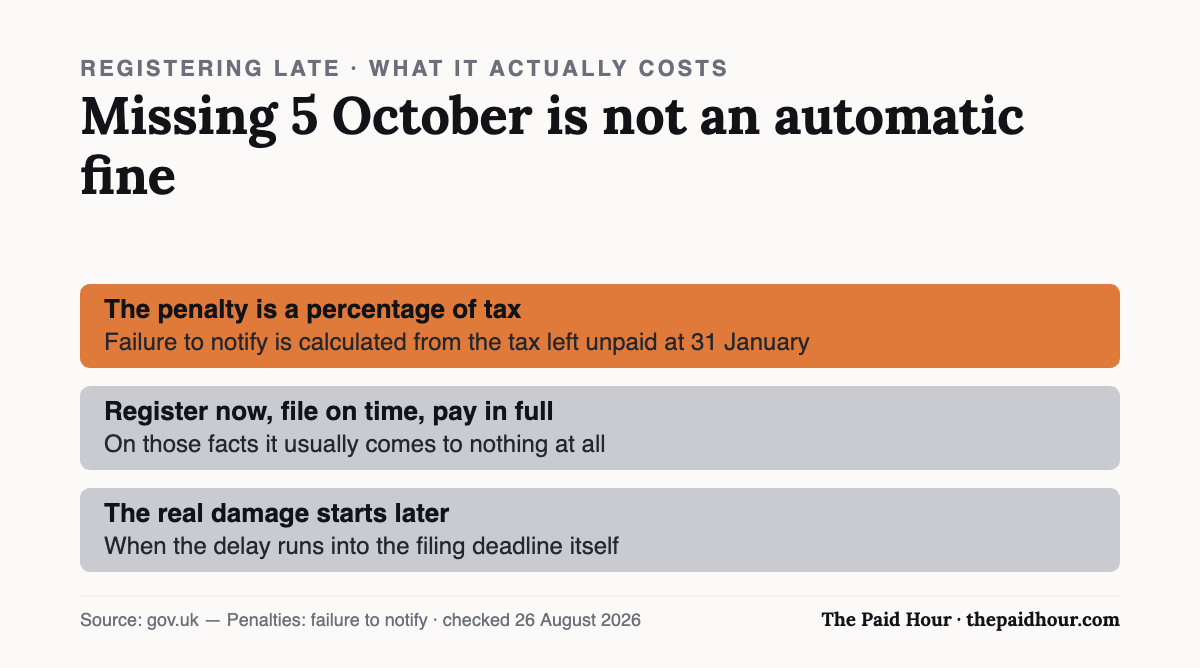
Not a flat fee. HMRC calls it failure to notify, and it is worked out as a percentage of the tax still unpaid at 31 January. Non-deliberate cases sit in a 0% to 30% band; deliberate and concealed ones run from 30% to 100%. Register, file and pay in full on time and there is often nothing for the percentage to bite on.
Is registering self-employed late the same as filing late?
No, and the confusion costs people real money. Late filing is the flat £100 penalty on an overdue return, and it only applies once you are already registered. Registering self-employed late is the earlier failure rather than telling HMRC you exist by 5 October, and it is charged on tax owed instead of on the calendar.
I am registering self-employed late. What should I do first?
Register now rather than waiting for it to feel less awkward, then file and pay in full by 31 January. Coming forward promptly, cooperating and handing over records is exactly what moves the penalty toward the bottom of the band. The damage compounds when the delay runs into the filing deadline as well.
Had a letter about your Vinted or Etsy sales?
Side Hustle Tax Starter 2026/27. A six-module starter course and six working templates that tell you, in an evening, whether you owe anything at all, and set up the twenty-minute monthly routine that keeps it that way.
- The nine badges of trade as questions you can answer about your own income
- What the platforms send HMRC, the small-seller exemption, and three reply letters for when a letter arrives
- A sales log with a running £1,000 alert, an allowance-versus-expenses sheet, and a tax set-aside calculator at 2026/27 rates
Selling platforms now hand your sales data to HMRC once a year. Selling your own old possessions is never taxable. Buying to resell, making things, or freelancing is. Knowing which side you are on is the whole question.
Buying more than one? All ten 2026/27 courses for £107, against £328 at full price.
Before you register, make sure you are using the right route. sole trader, SA1, or one of the partnership forms.
Sources
- Register for Self Assessment, gov.uk
- Self Assessment tax returns: registering: gov.uk
- Self Assessment tax returns: penalties, gov.uk
- Compliance checks: penalties for failure to notify (CC/FS11), gov.uk
- Penalties: an overview for agents and advisers. Gov.uk
The deadline and penalty mechanics were re-checked against gov.uk on 26 August 2026.
This is general information about how the rules work, not tax advice. The links above go to the primary sources; for your own circumstances, speak to an accountant or contact HMRC directly.