
The one-paragraph answer: You can start trading as a sole trader today, no registration, no forms, nobody’s permission needed. What triggers a legal obligation is money: once you earn more than £1,000 in a tax year, you have to register for Self Assessment, and the deadline is 5 October in the following tax year. Start trading in June 2026 and that date is 5 October 2027, sixteen months later. That gap is exactly why people miss it. Your records, though, need to start on day one, whatever the calendar says.
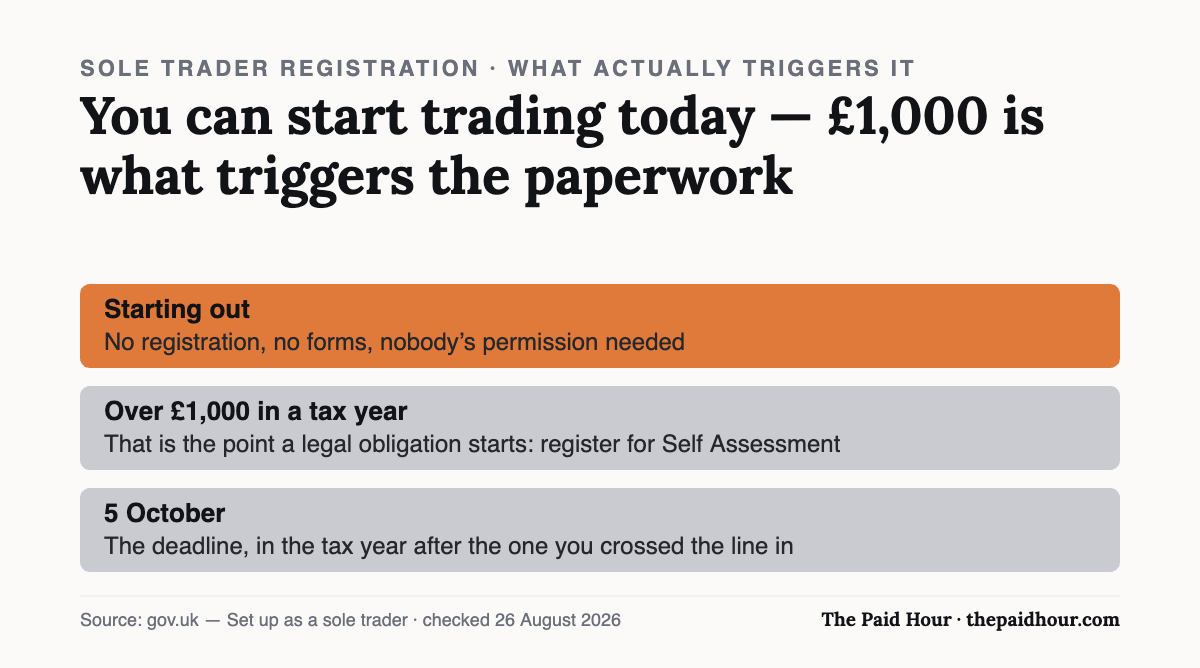
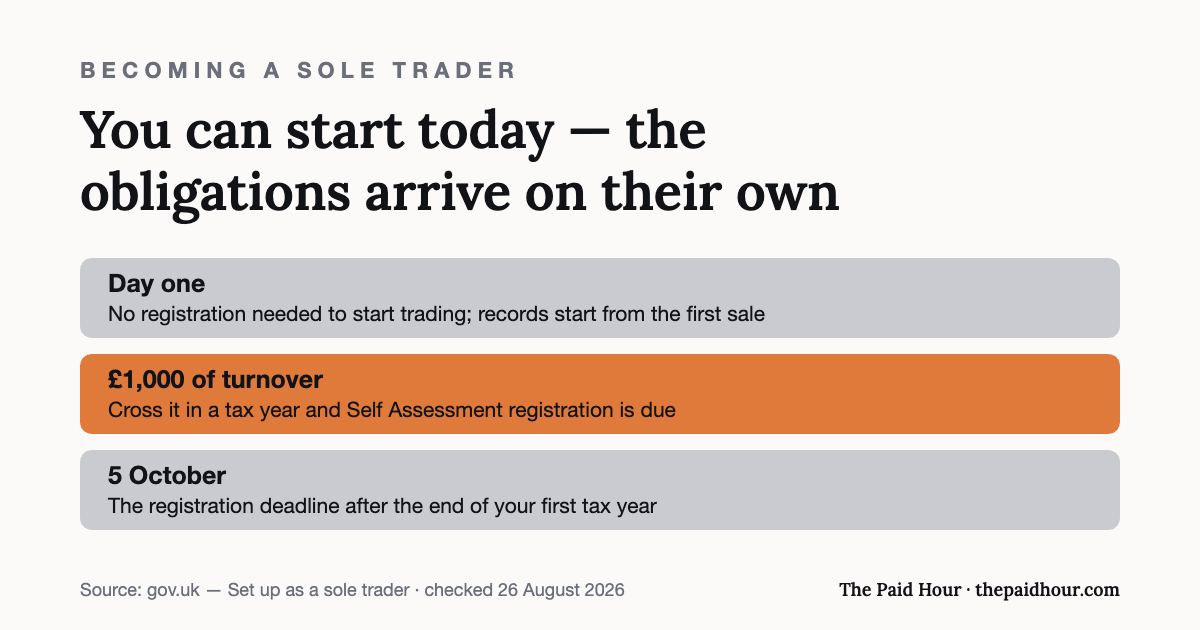
Table of Contents
What a sole trader is
The first thing HMRC sends is your UTR, the 10-digit Unique Taxpayer Reference your Self Assessment files under, usually arriving by post around 15 days after you register. What it is, where it hides when you lose it, and why CIS work is 30% more expensive without it: see the guide to UTR numbers.
It’s the simplest business structure the UK has. You work for yourself, you’re classed as self-employed, you make every decision, and you keep all the profit once tax’s been paid. Most people start here, it’s usually where anyone starts.
You can also be employed and self-employed at the same time, and this causes the most mistakes more than it should. A full-time job and a weekend business aren’t in conflict. They’re just two income sources landing on one tax return.
The one thing worth understanding before you begin is unlimited liability. There’s no legal wall between you and the business, so you’re personally on the hook for whatever it owes. If the business runs up debt, that’s your debt. It’s the real difference between operating as a sole trader and running a limited company, and it starts to matter a lot more once the sums involved get bigger. Business insurance is how most sole traders manage that risk.
You don’t have to register as a sole trader to start
This surprises people every time, so it’s worth just saying plainly: you can start trading immediately, no registration required. Take the job, send the invoice, get paid. There’s no approval step and nothing to sit around waiting for.
What triggers the obligation is money. Once you earn more than £1,000 in a tax year. Running 6 April to 5 April, you must register for Self Assessment. Stay under that, and the £1,000 trading allowance generally means you don’t need to tell HMRC anything at all.
You can also choose to register earlier than you’re required to, and there are genuine reasons to do it: claiming a loss, paying voluntary Class 2 National Insurance to protect your record, or claiming Tax-Free Childcare or Maternity Allowance based on self-employment.
The date that matters: 5 October
This year’s date: if you started working for yourself at any point between 6 April 2025 and 5 April 2026, HMRC needs to hear from you by Monday 5 October 2026. Register through the sole trader route on GOV.UK. The UTR comes by post afterwards, so registering in the last week still leaves you waiting for it. Deadline and the £1,000 rule checked against GOV.UK on 11 September 2026.
The deadline is 5 October in the tax year after the one you started trading in. Worth walking through an example, because the dates land further apart than most people expect.
- June 2026, you start trading.
- 5 April 2027, that tax year ends.
- 5 October 2027, register by here. Sixteen months after your first invoice.
- 31 January 2028, file your first return and pay what’s owed.
Nineteen months pass between doing the work and paying tax on it. Nothing in that stretch feels urgent, and that’s exactly the trap. By the time the deadline shows up, the early months are a year and a half behind you, and the records either exist by then or they don’t.
Miss 5 October and, if your whole bill isn’t paid by 31 January, you may be looking at a failure to notify penalty. It’s calculated from the tax outstanding and can turn up as late as twelve months after HMRC receives your return. The penalties guide covers what that actually costs.
What a new sole trader does on day one
Choose a name
Trade under your own name or pick a trading name, your call. There’s no register to join and nothing to pay, but there are rules about what a sole trader name can and cannot include, and a trading name gives you zero legal protection over it. If the name matters commercially, check nobody’s already trademarked it.
Start keeping records
This is the obligation that kicks in straight away, and it’s the one people skip. HMRC wants records from when you start trading, not from when you register. Sixteen months of bank statements and a shoebox full of receipts makes for a bad January.
The minimum is a record of what came in, what went out, and the evidence behind both. A spreadsheet updated monthly is entirely legal and beats software you never open. What matters is that it exists as you go, not that it’s fancy.
Consider a separate account
Not a legal requirement, HMRC asks for records rather than a second bank account, but it makes the record-keeping dramatically easier in practice. Worth a look at the free options for sole traders.
What comes after registering as a sole trader
Once you’re registered, you file a Self Assessment return every year. HMRC works out your Income Tax and National Insurance from the profit figure you report, you don’t need to calculate either one separately.
- Income Tax on profit above the £12,570 Personal Allowance.
- Class 4 National Insurance at 6% on profits above £12,570.
- VAT if your taxable turnover crosses £90,000 in any rolling 12 months.
- Making Tax Digital for Income Tax, arriving in stages from April 2026.
Depending on what you do, there can be more on top: licences or permits, insurance, data protection registration if you handle personal data, business rates if you rent premises. HMRC has a checker for which of these apply to you.
What to do next
- Start the record now, even if it’s just a spreadsheet with two columns. This is the only item here that can’t be done later.
- Write your 5 October date into a calendar with a reminder a month before. Work out which year it falls in using the table above.
- Register once you pass £1,000, or earlier, if you want voluntary National Insurance or a benefit claim based on self-employment.
- Put money aside from your first invoice onward. Roughly a quarter of profit is a rough but workable starting point until you know your real numbers.
- Read the unlimited liability point again if the business carries any real financial risk.
Registering as a sole trader is only one of four routes, if you also have rental income, or you are joining a partnership, or you already file for another reason, check which Self Assessment registration route you need before you start.
Sources
- GOV.UK: Become a sole trader
- HMRC: Trading allowance and the 5 October deadline
- GOV.UK — Business records if you are self-employed
- GOV.UK, Check what taxes may apply to you as a sole trader
The £1,000 trigger and the 5 October deadline were re-checked against gov.uk on 11 September 2026.
Rules and dates checked 19 August 2026. This is general information, not financial or tax advice.
Not sure the sole trader label even fits your setup? Sole trader vs freelancer vs contractor untangles it, and if 5 October has already slipped past, here is what the late-registration penalty actually is.
Do you actually owe HMRC anything yet?
Side Hustle Tax Starter 2026/27. A six-module starter course and six working templates that tell you, in an evening, whether you owe anything at all, and set up the twenty-minute monthly routine that keeps it that way.
- The nine badges of trade as questions you can answer about your own income
- What the platforms send HMRC, the small-seller exemption, and three reply letters for when a letter arrives
- A sales log with a running £1,000 alert, an allowance-versus-expenses sheet, and a tax set-aside calculator at 2026/27 rates
Selling platforms now hand your sales data to HMRC once a year. Selling your own old possessions is never taxable. Buying to resell, making things, or freelancing is. Knowing which side you are on is the whole question.
Buying more than one? All ten 2026/27 courses for £107, against £328 at full price.
Need this ready-made? → Self Assessment Prep Checklist Pack: every deadline, record and allowance in 9 pages (£7.99, instant download)
Read next
- Already File a Tax Return? You May Still Need to Register Again
- Registering a Partnership by 5 October: The Penalty Every Partner Pays
- Registered Office Address: What It Costs and Who Needs One