
The short version: Nobody auto-enrols the self-employed, so retirement saving runs on two tracks you start yourself. Track one: the State Pension, Class 2 NI is treated as paid once profit passes £7,105, and voluntary top-ups cost £3.65 or £18.40 a week. Track two: a private pension, where £80 in becomes £100 through basic-rate relief, higher earners claim more through Self Assessment, and the ceiling is £60,000 or your earnings, whichever is lower. No products are recommended here, that’s an adviser’s job.
Employees get auto-enrolled into a workplace pension whether they ever think about it or not. The self-employed don’t (auto-enrolment is legally an employer’s duty, and a sole trader has no employer to trigger it (MoneyHelper), how auto-enrolment works). So a self-employed pension is something you set up on purpose, and it’s really two jobs rather than one: keeping your State Pension record intact, and building a private pot with the tax relief that comes attached.
Track one: the State Pension runs on your NI record
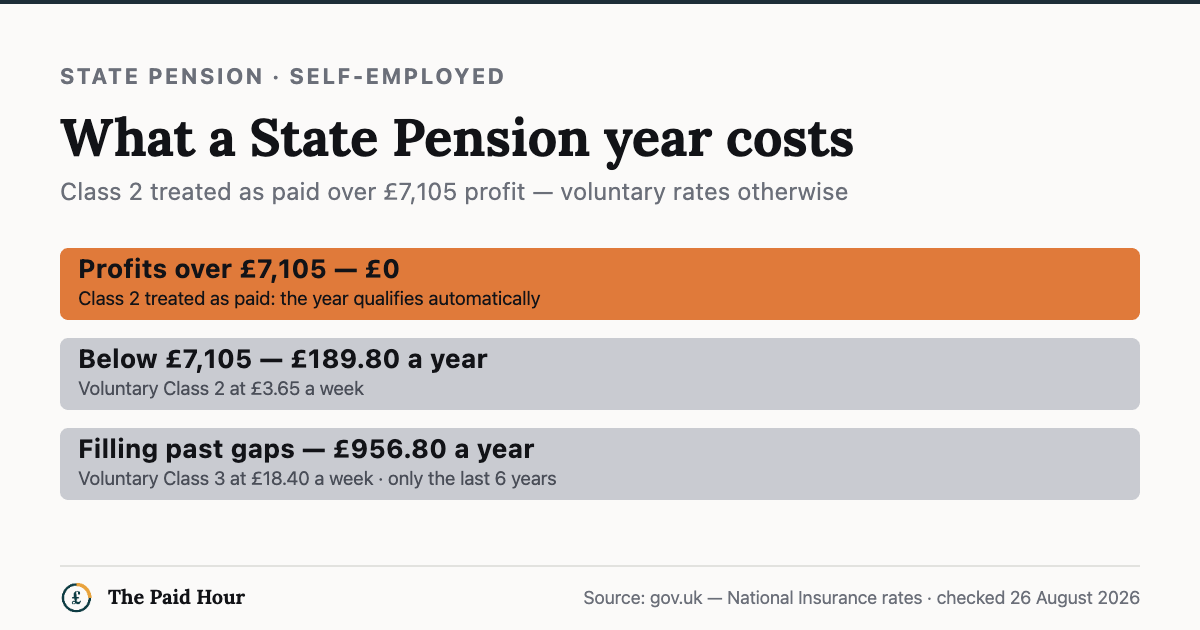
Your State Pension depends on years of National Insurance, and for most working sole traders this now takes care of itself: once profits pass £7,105, Class 2 contributions are treated as paid, a qualifying year for nothing. Below that threshold, you can pay Class 2 voluntarily at £3.65 a week: £189.80 a year. And for past years with holes in them, voluntary Class 3 costs £18.40 a week, about £956.80 a year.
The catch is the clock. Gov.uk: “You can only pay voluntary contributions for the past 6 years”, a 2025/26 gap stays fillable until 5 April 2032, and then it’s gone. If you had low-profit years early on, look at your record sooner rather than later; the window closes behind you a year at a time, whether you check or not. What your record currently adds up to is a two-minute check: the guide to your State Pension forecast walks through it.
A lean year doesn’t have to be a lost year, either. A voluntary £189.80 keeps the State Pension year. And even with no earnings at all, the private side still accepts £2,880, with £720 added on top.
Track two: private pension options and tax relief
There’s no special “self-employed pension” product — the same personal pensions are open to everyone, and with no workplace scheme choosing for you, the choosing is yours. The routes people use: a SIPP (a personal pension wrapper opened directly with a provider, wide control over the investments); a stakeholder pension (capped charges, low minimums, built for small and irregular contributions); or NEST, the government-established master trust, which accepts self-employed members voluntarily (MoneyHelper, pensions for the self-employed).
No provider is named or ranked here, deliberately. Which wrapper suits you turns on contribution size, charges and how hands-on you want to be, a comparison that’s personal, and, where it becomes a recommendation, a regulated one. A financial adviser or MoneyHelper’s free guidance is the route for that.
The tax relief, in numbers
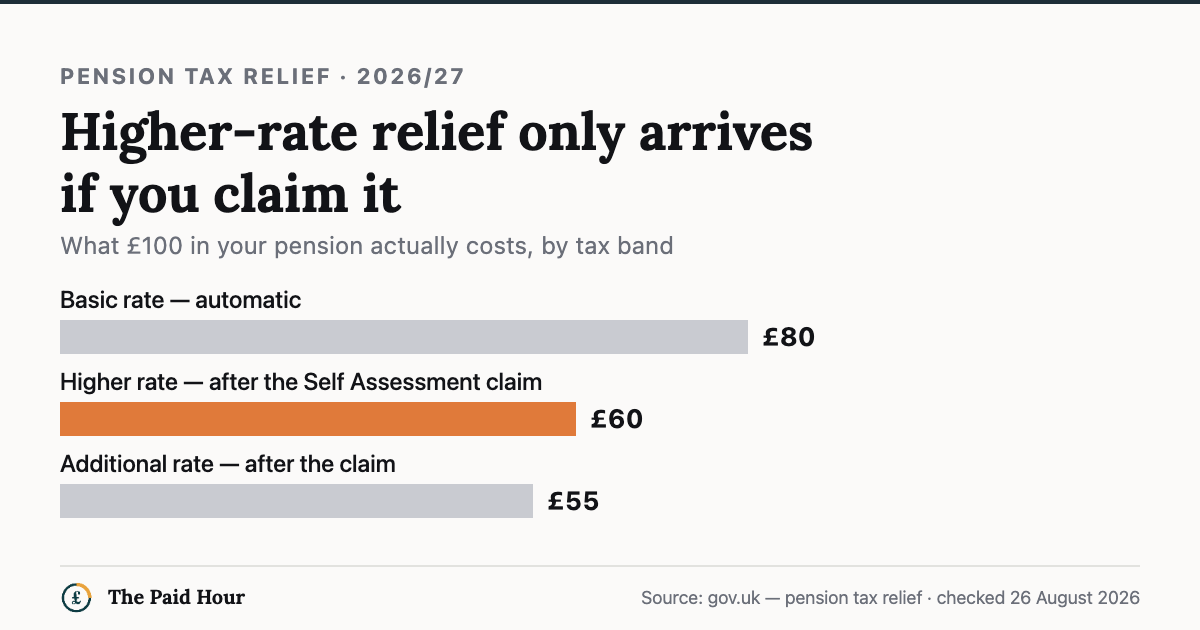
Whichever wrapper you pick, the relief mechanics are the same. Basic-rate relief arrives automatically: the provider claims 20% from the government and adds it to your pot: put in £80, £100 lands. That works even with no earnings at all, on up to £2,880 net (£3,600 gross) a year. Pay higher-rate tax and there’s another 20% with your name on it, but it’s claimed instead of automatic, through the Self Assessment return you already file; additional-rate taxpayers claim a further 25%. In cost terms: £100 of pension ends up costing £80 at basic rate, £60 at higher, £55 at additional, but only if the claiming happens. (One Scottish quirk: 19% starter-rate taxpayers still get relief at 20%, no action needed.)
The ceiling: tax relief covers contributions up to 100% of your earnings or £60,000, whichever is lower, across all your pensions in the year. It can be less (very high incomes taper the allowance, and flexibly drawing from a pension already triggers a lower one), edges worth checking against MoneyHelper’s allowance guide if you’re anywhere near them. For a profit of £30,000, the practical ceiling is simply £30,000. And the allowance runs by tax year, a contribution counts in the year you pay it, which makes March a sensible month to look at how the year went before 5 April closes it.
Where the tax relief actually lands
One distinction saves confusion later. At basic rate, the relief lands in the pension: your £80 becomes £100, and your tax bill doesn’t move. At higher and additional rate, the extra slice you claim lands in your bill: the Self Assessment claim means part of the income that would have been taxed at 40% or 45% is taxed at 20% instead. Same relief on paper, arriving in two different places, and only the automatic half arrives without being asked.
Ready to open one? The steps (the charges checklist, the FCA check, contributions that survive an irregular income), are in the companion guide to setting up a pension when self-employed. And deciding what a monthly contribution can safely be sits right next to your tax pot, budgeting on an irregular income covers that side.
No employer, no sick pay, no pension. Built yours yet?
Pension & Safety Net for the Self-Employed 2026/27. Eight modules and four working sheets that turn “I should sort my pension out” into a plan you can finish in an afternoon, with the tax relief doing a third of the work.
- Your State Pension forecast, qualifying years, and when voluntary Class 2 is worth paying and when it buys nothing
- The Self Assessment step that recovers higher-rate relief, which most people never claim
- Sick pay, income protection and critical illness: what each actually pays, and the underwriting traps for the self-employed
There is no statutory sick pay for the self-employed at all. Higher-rate pension relief is not automatic either. Both are fixable in an afternoon, and both are still costing most freelancers money.
Buying more than one? All ten 2026/27 courses for £107, against £328 at full price.
Sources
- Voluntary National Insurance: rates. GOV.UK
- Voluntary National Insurance: deadlines, GOV.UK
- Self-employed National Insurance rates: GOV.UK
- Tax on your private pension contributions: tax relief — GOV.UK
- The annual allowance, MoneyHelper
- Automatic enrolment: an introduction. MoneyHelper
- Pensions for self-employed people, MoneyHelper
The Class 2 and Class 3 rates, the £7,105 treated-as-paid threshold, the six-year top-up rule, relief-at-source and the £60,000 annual allowance were re-checked against gov.uk and MoneyHelper on 26 August 2026. General information, not financial advice: no pension product or provider is recommended here; for a recommendation matched to you, speak to a regulated financial adviser or use MoneyHelper’s free guidance.