
HMRC compares website costs to a shop window. The cost of constructing the window is capital, the cost of changing the display is revenue. So hosting, domain renewals, content updates and maintenance are ordinary deductible costs. The build is capital, and whether you can deduct a capital build under the cash basis turns on a definition HMRC wrote for intangible assets rather than for websites. That one is worth asking about rather than assuming.
Table of Contents
Are website costs tax deductible? Most of them, straightforwardly. The bit everyone actually wants to know about. The four-figure invoice from whoever built it, is the bit almost nobody answers properly.
HMRC has a good analogy for this and it is worth carrying around.
Website costs and the shop window test
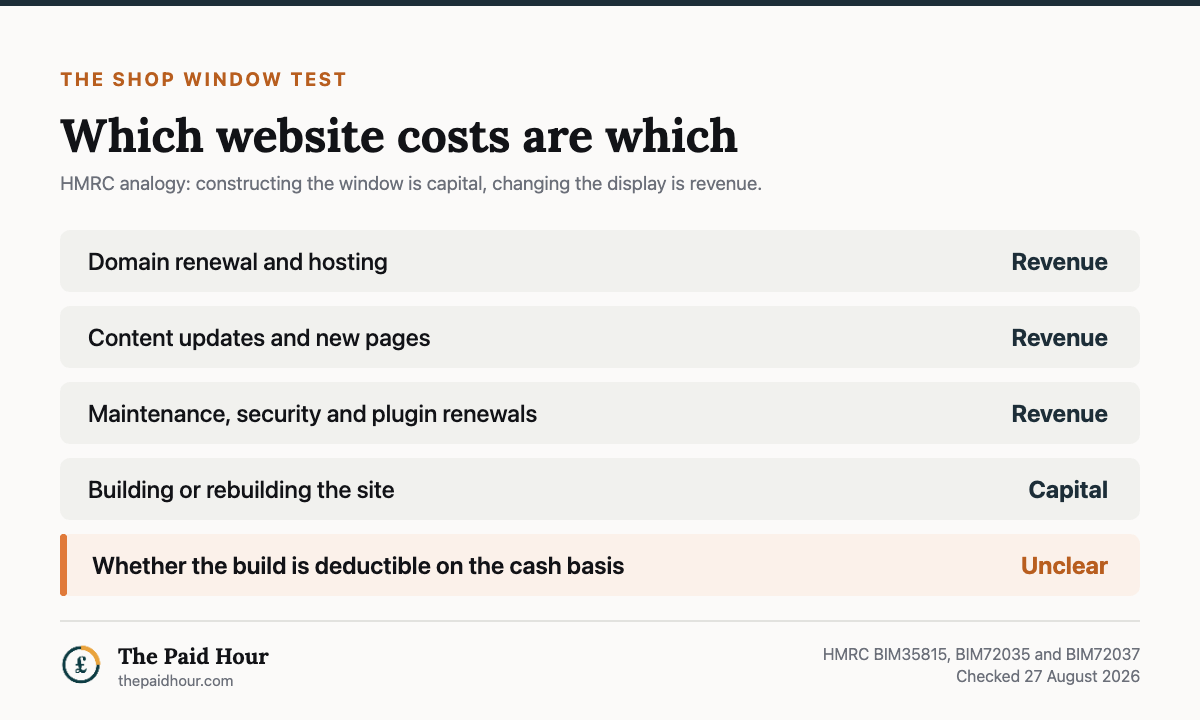
From the Business Income Manual: the cost of a web site is analogous to that of a shop window. The cost of constructing the window is capital; the cost of changing the display from time to time is revenue.
That single sentence sorts most website spending without any further thought. Building the thing is capital. Keeping it going is revenue.
Calling it marketing does not help
People try. The invoice says digital marketing, the bookkeeping says advertising, and advertising is plainly revenue, so the problem appears to solve itself.
HMRC addresses that head on, quoting Lord Morris to the effect that calling something a marketing cost is a neutral, generic description that does nothing to distinguish capital from revenue. What matters is the nature of what was actually bought.
A Google Ads campaign is advertising. A website build is a website build, whichever heading the developer put it under.
There is a second wrinkle here, and it is HMRC’s own. The notes to box 24 of the self-employment pages (advertising and business entertainment) list website costs among the things that belong there, next to newspaper adverts and mailshots. Read alone, that sits awkwardly beside a manual page saying the build is capital.
The reconciliation is that box 24 is describing the ordinary recurring website spending most people have, not a capital build. But it is a neat illustration of why my accountant put it under advertising is not, by itself, an answer to anything.
The website costs you can simply claim
Hosting. Domain registration and renewal. SSL certificates. Plugin and theme subscriptions. The developer’s retainer for fixes and updates. New blog posts, new photography, a page added to reflect a service you now offer.
If you are still setting up, 123 Reg sells the domain, hosting and a matching business email from one UK account. Keep each yearly invoice. That is the record behind this line on your return.
All of that is changing the display. It recurs, it does not create anything lasting, and it goes through as an ordinary running cost alongside the rest of your allowable expenses.
For most sole traders that is the whole answer, because most sole traders spend a few hundred pounds a year keeping a site alive and spent the build money once, years ago.
The build, and the honest state of it
Here is where I part company with most of what is written about this.
The build is capital. HMRC is clear. Under traditional accounting, capital costs are not deducted from profit, so the question becomes whether capital allowances are available. They can be for software: HMRC states that capital allowances are available for capital expenditure on a right to use or otherwise deal with computer software for the purposes of a trade.
Under the cash basis, the default since 2024/25, the logic runs the other way. Capital spending is deductible unless it lands on a short exclusion list, and one of the exclusions is a non-qualifying intangible asset. HMRC defines that narrowly: an intangible asset is non-qualifying unless it has a fixed maximum duration and will cease to exist within 20 years of the date the capital expenditure was incurred.
A website does not have a fixed maximum duration. It does not cease to exist on a date. Read literally, that points towards non-qualifying, and therefore not deductible under the cash basis either.

I am not going to tell you that is the answer, because HMRC has not written that page. The intangibles definition was drafted with licences and rights in mind, not with a WordPress install, and there is a real argument that what you bought was development services and a software right rather than an intangible asset of the kind that definition is aiming at.
What I will say is that website costs are tax deductible, stated flatly, is not a safe thing to build a return on. If the build is a material number for you, put the question to HMRC or an accountant in writing and keep the reply. That costs an afternoon. Getting it wrong costs an enquiry.
Where the line on website costs moves in practice
Two things push a cost from capital towards revenue, and both are about function rather than price.
A change that leaves the site doing what it already did is a display change. New copy, refreshed images, a colour update, a page rewritten. A change that makes the site do something it could not do before. A booking system, a shop, a members’ area, is closer to constructing a new window.
Cost is not the test, though it is a decent early warning. A £4,000 rebuild is not capital because it is £4,000. It is capital because it is a rebuild.
If you built it yourself: the website costs that remain
The good news and the bad news arrive together.
Your own time is not a cost. A sole trader cannot employ themselves, so the four weekends you lost to a theme that would not centre anything have no tax value at all. That is not HMRC being mean. You are taxed on profit, and your labour is what generates the profit rather than a charge against it.
What you paid out is still spending. The theme licence, the plugins, the stock photography, the font, the hosting, the year of a page builder. Those are real costs and they follow the same shop window logic as everything else: the ones that keep recurring are revenue, and the one-off purchases that went into building the thing sit with the build.
HMRC does have detailed guidance on in-house software development, and it works by splitting a project into phases rather than treating the whole thing as one lump. If you are a developer building something substantial for your own business, that guidance is where to start rather than the website page.
Keeping your website invoices HMRC-ready
Itemised invoices, not a single line saying website. A build that separates design, development, content migration and the first year of hosting gives you three revenue lines and one capital one instead of one unanswerable question.
Ask your developer for that split at quote stage. They will not mind, and it is far easier than reconstructing it from a PDF two years later. Then keep it for five years after the filing deadline like everything else, and check the treatment against your disallowable expenses before you file.
Want the whole tax system, not one rule?
HMRC Tax & Expense Mastery 2026/27. Nine modules and eleven working templates that take a UK freelancer from “do I even need to register” to a correct return, with MTD quarters built in.
- Fifteen expense categories, with the trap inside each one (training, clothing, meals, the seven-year pre-trading rule)
- Home and vehicle: flat rate against actual cost, with the £312 break-even worked out and the mileage lock-in rule
- The year-one payments-on-account cash shock, and the routine that stops it landing twice
HMRC does not send a list of what you forgot to claim. Most freelancers leave several hundred pounds of legitimate expenses on the table every single year, and the return still gets filed.
Buying more than one? The Complete Freelancer System, all five for £87, against £193 bought separately.
Sources
- BIM35815: costs of setting up a web site, HMRC Business Income Manual
- BIM35801: capital/revenue divide, computer software, HMRC Business Income Manual
- BIM72035: cash basis, capital expenditure, HMRC Business Income Manual
- BIM72037: cash basis, qualifying intangible assets, HMRC Business Income Manual
- Expenses if you are self-employed, GOV.UK
- BIM35822: in-house software development costs, HMRC Business Income Manual
The shop window analogy and the point about generic descriptions are quoted from HMRC’s Business Income Manual at BIM35815, last updated 3 July 2026. The capital allowances position on software rights is from BIM35801. The cash basis exclusion list is from BIM72035 and the non-qualifying intangible definition from BIM72037, both last updated 4 August 2026.
The reading of how that definition applies to a website is stated in this article as an open question, because HMRC has published no guidance addressing websites under the cash basis. All pages read on 27 August 2026. This is general information about how the rules work, not tax advice. Check your own position with HMRC or an accountant before you file.