
Cash basis vs traditional accounting is a choice most sole traders never make on purpose, HMRC defaults you into one of them, and the difference can change your tax bill.
The short version: Cash basis means you record income when the money lands in your account, so you’re never paying Income Tax on an invoice nobody’s paid yet. Traditional accounting records it on the invoice date instead, which means you can owe tax on money you’re still chasing. Since the 2024/25 tax year, cash basis has been the default for sole traders and partnerships without corporate partners. Traditional accounting is now the thing you have to actively opt into. For most freelancers, staying on the default is the right call.
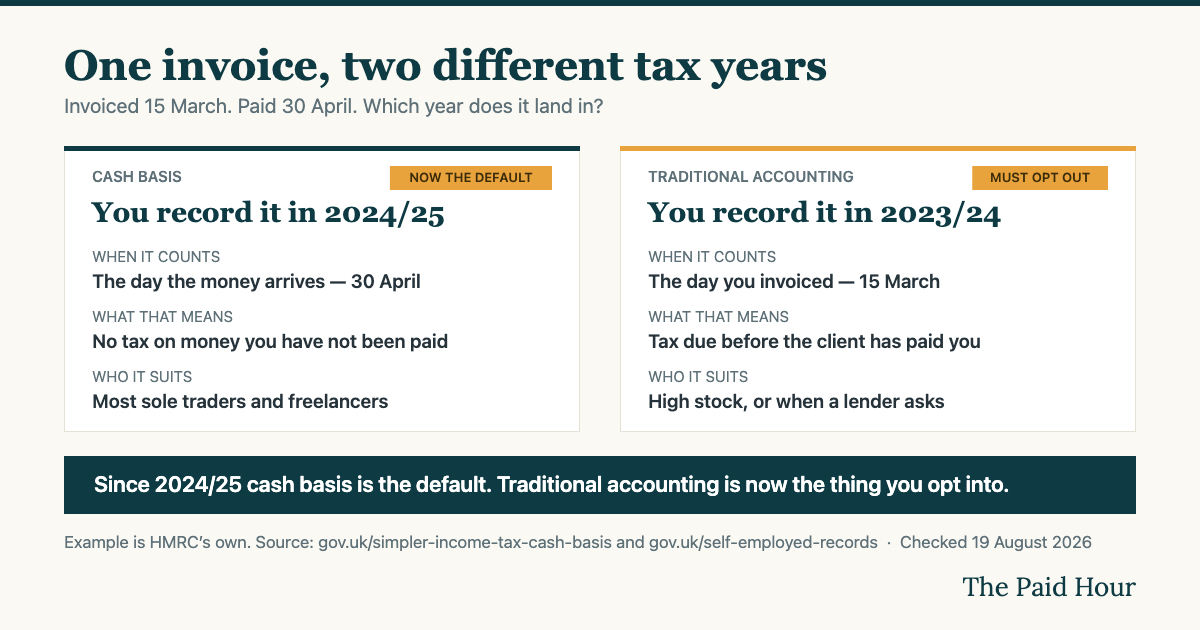
Table of Contents
The default flipped, and nobody sent a letter about it
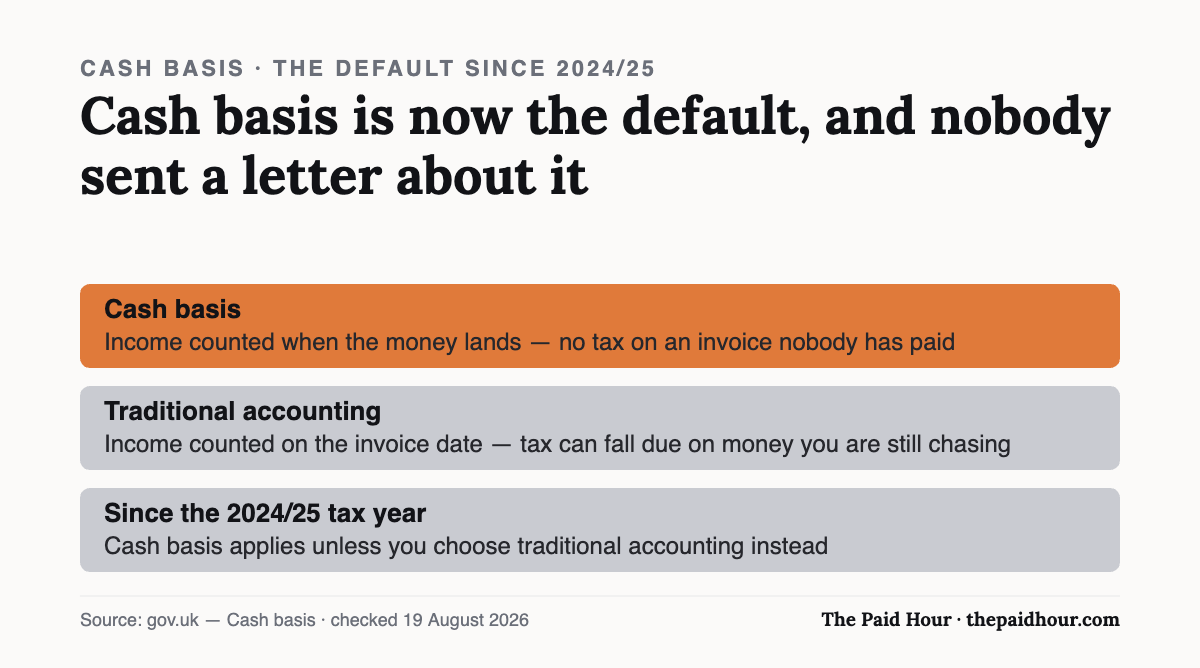
For years traditional accounting was the standard and cash basis was the simplified option you had to elect into. From the 2024/25 tax year, that flipped. Cash basis is now the default, and if you want traditional accounting, you have to opt out of the new normal.
For most freelancers this is good news that arrived without any fanfare. But it’s worth checking what your return actually says, because two groups can get caught out here:
- People who’ve always used traditional accounting and assumed nothing changed. You now have to actively declare it on the return, every year.
- People whose accounting software still defaults to the old setting. Software keeps doing what you told it years ago, it doesn’t know HMRC moved the goalposts.
Cash basis vs traditional accounting: what the difference costs you
Take HMRC’s own example. You invoice a client on 15 March. They pay you on 30 April. The tax year ends on 5 April, sitting right in between.
- Cash basis: the income lands in the year the money arrived. You pay tax on it the following January, a full twelve months after you were paid.
- Traditional accounting: the income lands in the year you raised the invoice. You pay tax on it in the January that falls before the money may even have turned up, if the client’s slow.
Scale that up and it gets uncomfortable fast. A freelancer who invoices £18,000 across the last three weeks of March, on 30-day terms, is (under traditional accounting), declaring £18,000 of income for a tax year in which not one penny of it landed. If the client then pays late, or doesn’t pay at all, the tax is still due on the date the invoice went out.
That’s really the entire argument, and for anyone whose actual problem is clients paying late, it’s a decisive one. Cash basis means you’re never taxed on money you haven’t got.
When traditional accounting is the better answer
HMRC names two situations, and both hold up in practice.
A complex business, especially one carrying a lot of stock. Buy inventory in one year and sell it in the next, and cash basis distorts the picture badly, a big December stock purchase can make an otherwise good year look like a loss. Traditional accounting matches costs to the sales they actually produced.
You need finance. A bank weighing up a loan may ask for accounts on the traditional basis, because those show what you’re owed and what you owe: the debtors and creditors that cash basis simply doesn’t record. If a mortgage or business loan is on the horizon, ask the lender what they expect before you pick a method.
Two smaller points worth knowing. Traditional accounting needs more records, since you’re tracking invoices raised and bills received as well as money moved. And switching between methods can mean making adjustments so income isn’t counted twice, or missed entirely — HMRC’s helpsheet HS222 covers how that works.
Who can’t use cash basis at all
Limited companies are out completely. So are partnerships with a company as one of the partners. It’s built for sole traders and straightforward partnerships, which covers the overwhelming majority of people reading this.
If incorporating is something you’re weighing up, this is one of many differences worth knowing before you decide either way.
Your accounting dates matter too
If you prepare formal accounts, you choose the dates you run them to, usually the same each year. HMRC’s own advice is that life’s easier if those dates match the tax year, 6 April to 5 April, simply because that’s how HMRC calculates the tax.
Run your accounting year to some other date: 31 December, say, and you’ll need to allocate profits across two tax years, which is extra arithmetic every single year for a benefit most sole traders would struggle to name. Starting out? Pick the tax year and skip the maths.
If you don’t prepare formal accounts at all, you’re simply recording income and expenses for each tax year, which is what most freelancers do.
Cash basis vs traditional accounting: what to do next
Whichever side of cash basis vs traditional accounting you land on, the choice isn’t permanent, you can switch later if your circumstances change.
- Check which method you’re actually on. It’s stated on your Self Assessment return. Never thought about it and filed recently? You’re probably on cash basis now.
- Little or no stock, no loan on the horizon? Cash basis is almost certainly right for you. Do nothing.
- Carrying stock or applying for finance? Talk to an accountant before opting out, this is one of the rare decisions where an hour of paid advice pays for itself.
- Check your accounting software’s setting matches what you intend, rather than assuming.
- Align your accounting dates to the tax year if you’re just starting out and still have the choice.
Related: simplified expenses is the other flat-rate simplification available to sole traders, and the two are often used side by side. Allowable expenses covers what you can deduct under either method.
Picking software, or fixing the one you have?
Digital Bookkeeping System (MTD-ready) 2026/27. Seven modules and a seven-sheet toolkit, built around a category-to-tax-box mapping table that makes your quarterly updates fill themselves.
- A software decision sheet costed over three years, split by turnover, VAT status and phone-or-desktop
- The chart of categories mapped to the Self Assessment and MTD boxes, and the three categories never to auto-categorise
- Weekly and month-end cards, an MTD quarter-close checklist, and an export-and-archive index so their cloud is never your only copy
Software is priced monthly, excluding VAT, and you will hold the subscription for years. Pick on the wrong number and the difference over three years is more than every course on this site combined.
Buying more than one? All ten 2026/27 courses for £107, against £328 at full price.
Need this ready-made? → Self Assessment Prep Checklist Pack. Every deadline, record and allowance in 9 pages (£7.99, instant download)
Sources
- GOV.UK: Cash basis
- GOV.UK, Who can use cash basis
- GOV.UK: Business records if you are self-employed, including accounting methods
- HMRC, Helpsheet HS222, calculating taxable profits
Rules checked 19 August 2026. This is general information, not financial or tax advice. Switching accounting method has knock-on effects in the year you switch, take advice if you’re considering it.