
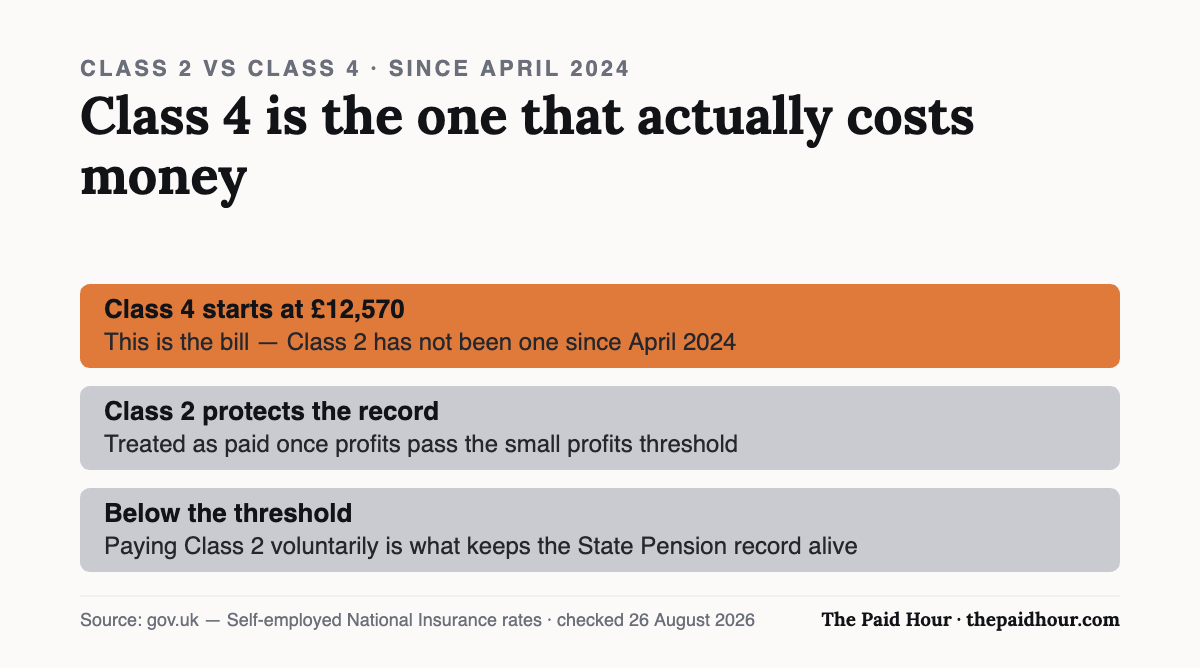
What matters here: Since April 2024 they are no longer two bills. Class 2 is treated as paid once profits pass the small profits threshold, it protects your State Pension record. Class 4 is the one that costs money, starting at £12,570. Below the threshold, paying Class 2 voluntarily is what keeps the record alive.
Class 2 vs Class 4 National Insurance, see them mentioned in the same breath and it’s easy to assume they’re two separate bills you owe every year. For most people that’s no longer true, and a lot of what’s written about Class 2 online is out of date. Here’s exactly what each one is, who pays what, and how they fit together for the 2026/27 tax year.
We’ve already covered the full rates and thresholds in our self-employed National Insurance guide for 2026/27. This post exists to answer the specific question people keep searching: what’s different between Class 2 and Class 4, and do I pay both?
What is Class 2 National Insurance?
Class 2 is the older, flat-rate part of self-employed National Insurance, historically a fixed weekly amount everyone above a certain profit level paid regardless of how much they earned.
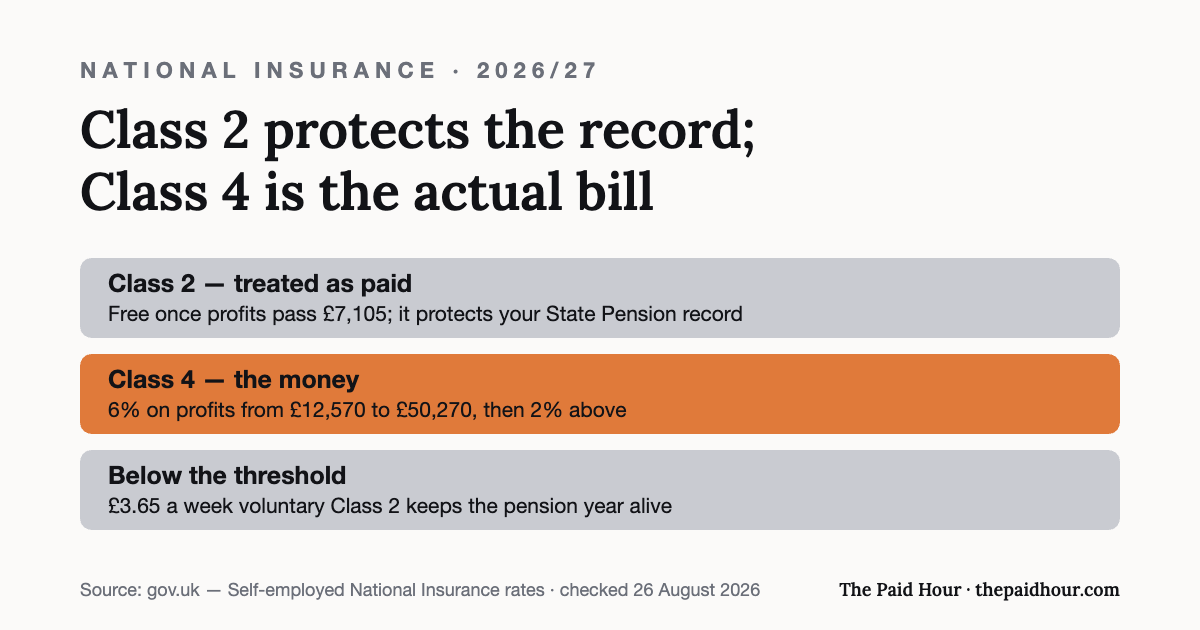
That’s no longer how it works for most people. Since 6 April 2024, if your self-employed profits are above the Small Profits Threshold, you’re not required to pay Class 2 at all. Instead, HMRC treats you as if you’d paid it. You get an automatic National Insurance credit that protects your qualifying years for the State Pension and other contributory benefits, with no payment due (gov.uk: Self-employed National Insurance rates; gov.uk: Autumn Statement 2023 National Insurance factsheet).
This is the single biggest source of outdated information on this topic. A lot of older articles (and some AI-generated summaries) still describe Class 2 as a mandatory £3.45 or £3.65-a-week payment for anyone self-employed. Since April 2024, that’s only true if your profits are below the threshold and you choose to pay voluntarily.
What’s the Small Profits Threshold for 2026/27?
For the 2026/27 tax year, the Small Profits Threshold is £7,105 (gov.uk: Rates and allowances, National Insurance contributions):
- Profits at or above £7,105: you get the Class 2 credit automatically. No payment, no action needed, your qualifying year is protected.
- Profits below £7,105: you don’t owe Class 2, but you can choose to pay it voluntarily at the 2026/27 rate of £3.65 a week if you want to keep building qualifying years toward your State Pension (gov.uk: Self-employed National Insurance rates). This matters most if self-employment is your only income and your profit is low: without those qualifying years, you could end up with gaps in your State Pension record.
What is Class 4 National Insurance?
Class 4 is the percentage-based half of Class 2 vs Class 4 National Insurance, charged on your self-employment profits, and for most self-employed people it’s the only National Insurance they actually pay money towards each year.
For 2026/27, Class 4 applies once your profits exceed the Lower Profits Limit of £12,570, at these rates (gov.uk: National Insurance — how much you pay):
- 6% on profits between £12,570 and the Upper Profits Limit of £50,270
- 2% on profits above £50,270
Unlike Class 2, there’s no credit-only version of Class 4, if your profit is above £12,570, you pay it, calculated as a percentage of that profit, in cash.
Do I pay Class 2 and Class 4 National Insurance at the same time?
Usually not in the way people expect. Here’s how Class 2 vs Class 4 National Insurance interact across the profit range for 2026/27:
| Your annual profit | Class 2 | Class 4 |
|---|---|---|
| Below £7,105 | Nothing due — voluntary £3.65/week if you choose | Nothing due |
| £7,105 to £12,570 | Automatic credit, no payment | Nothing due (below the Lower Profits Limit) |
| Above £12,570 | Automatic credit, no payment | 6% (then 2% above £50,270) |
So for the large majority of self-employed people trading above £12,570 profit, “Class 2 and Class 4” in practice means: Class 2 costs you nothing and just quietly protects your State Pension record, while Class 4 is the real bill, calculated on your profit.
How does Self Assessment collect Class 4 National Insurance?
You don’t need to work out Class 2 vs Class 4 National Insurance by hand. When you complete your Self Assessment tax return, HMRC calculates both automatically from the self-employment profit figure you report, applies the Class 2 credit (or offers the voluntary payment option if your profit is below the threshold), and adds any Class 4 owed to your overall Self Assessment bill, collected alongside your Income Tax by the standard 31 January payment deadline (gov.uk: Self-employed National Insurance rates).
Where this leaves you on Class 4 National Insurance
The short version of Class 2 vs Class 4 National Insurance: Class 2 used to be a flat weekly charge everyone paid; since April 2024 it’s mostly a free credit that protects your State Pension, with a voluntary payment option only if your profit is low. Class 4 is the percentage-based charge that most self-employed people pay in cash, calculated on profit between £12,570 and £50,270 (and above). Self Assessment handles the maths for both. Your job is just to report your profit accurately and pay what’s calculated by 31 January.
For the full rate tables, worked examples, and how this fits with Income Tax, see our self-employed National Insurance guide for 2026/27.
This article is educational and general in nature rather than personalised tax advice. Your National Insurance position depends on your individual circumstances, check your Self Assessment calculation or speak to an accountant if you’re unsure.
Paying higher-rate tax and never claiming the relief?
Pension & Safety Net for the Self-Employed 2026/27. Eight modules and four working sheets that turn “I should sort my pension out” into a plan you can finish in an afternoon, with the tax relief doing a third of the work.
- Your State Pension forecast, qualifying years, and when voluntary Class 2 is worth paying and when it buys nothing
- The Self Assessment step that recovers higher-rate relief, which most people never claim
- Sick pay, income protection and critical illness: what each actually pays, and the underwriting traps for the self-employed
There is no statutory sick pay for the self-employed at all. Higher-rate pension relief is not automatic either. Both are fixable in an afternoon, and both are still costing most freelancers money.
Buying more than one? All ten 2026/27 courses for £107, against £328 at full price.
Sources
- gov.uk: Self-employed National Insurance rates
- gov.uk: National Insurance: how much you pay
- gov.uk: Rates and allowances, National Insurance contributions
- gov.uk: Autumn Statement 2023. National Insurance factsheet
- gov.uk: Voluntary National Insurance contributions, rates
Rates and thresholds re-checked against gov.uk on 26 August 2026.
This is general information about how the rules work, not tax advice. The links above go to the primary sources; for your own circumstances, speak to an accountant or contact HMRC directly.
Related: your State Pension forecast: it shows which years actually counted as qualifying years.