
E-money accounts vs bank accounts sounds like a technicality until something goes wrong, the two are protected in very different ways.
In short: Several of the best-known app-based business accounts are not banks, they are e-money institutions. Your money is protected by safeguarding rather than the FSCS, which changes what happens if the provider fails. Neither is automatically unsafe; the point is to know which one you are holding.
E-money accounts vs bank accounts is a distinction most freelancers never think about until it matters. Plenty of the app-based business accounts popular with sole traders, the ones that market themselves as banking alternatives, aren’t banks at all. They’re electronic money institutions, and the way they protect your money is different.
What makes something an “e-money account”
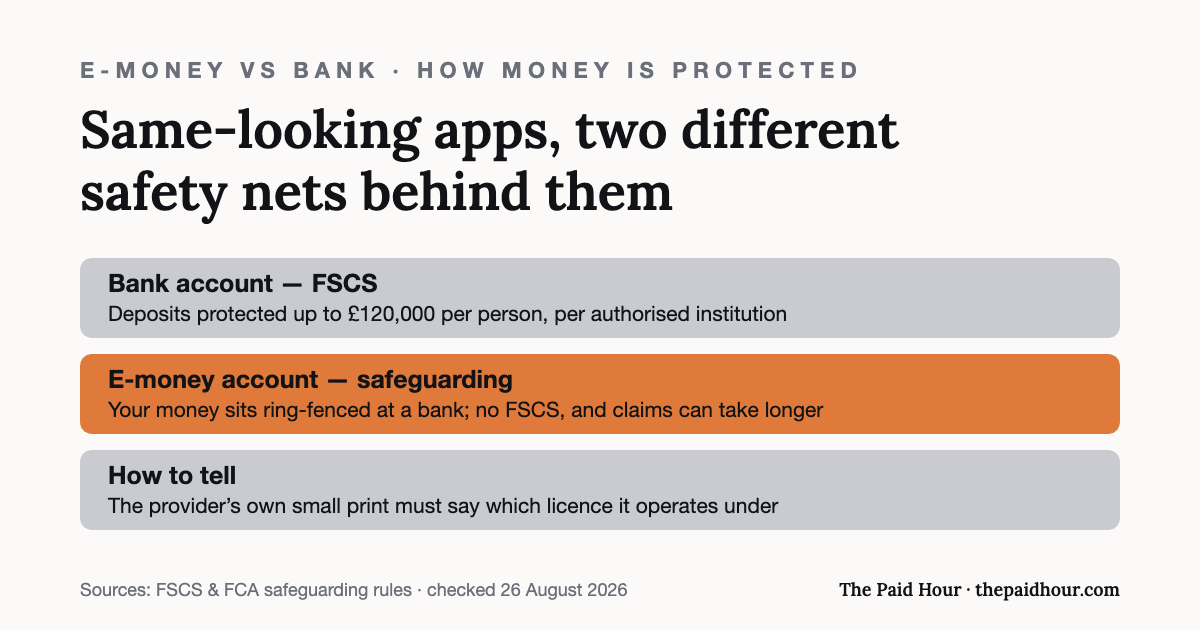
A bank holds a banking licence and can lend out a portion of the deposits it holds, that’s fundamentally how banking works. An electronic money institution (EMI) operates under a different type of authorisation. It can’t lend your money out, and it’s required to keep customer funds separate from its own operational money at all times. On the surface, the day-to-day experience, an app, a card, transfers, payments, looks identical. The protection underneath is where they diverge.
Safeguarding vs FSCS protection
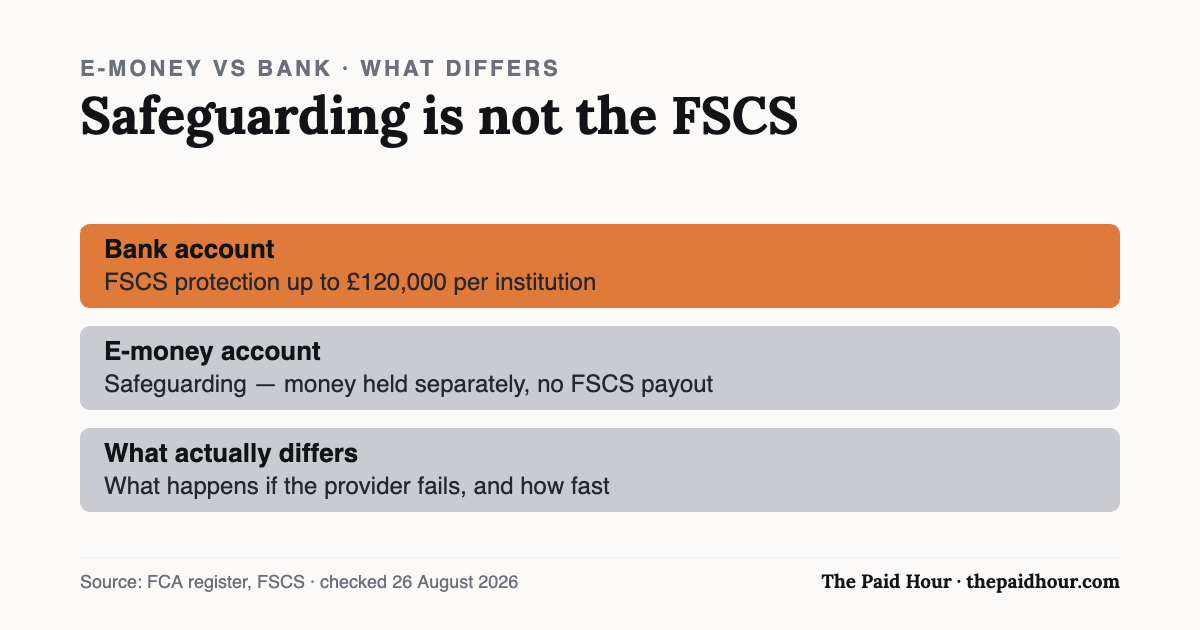
Banks are covered by the Financial Services Compensation Scheme (FSCS), which protects eligible deposits up to £120,000 per person, per institution, with a defined process for prompt repayment if the bank fails. See our full guide to FSCS protection on business accounts for how that works in detail.
E-money institutions use a different system called safeguarding instead. As Wise (itself an EMI), explains on its own site, safeguarded funds are held as cash with regulated banks or in secure liquid assets like short-term government bonds, kept separate from the company’s own money “in line with UK safeguarding rules.” Two things are worth being clear-eyed about:
- Safeguarding has no fixed compensation limit the way FSCS has its £120,000 cap, it’s a regulatory requirement to hold your money separately rather than an insurance scheme with a defined payout.
- If an EMI fails, getting your money back isn’t automatic or necessarily prompt. An administrator has to identify and return safeguarded funds through an insolvency process, which can involve delays or costs: safeguarding, in Wise’s own words, “is not a promise of instant repayment.”
Does this mean e-money accounts are unsafe?
No — safeguarding is a genuine, regulated protection, and plenty of well-established, widely used business accounts operate this way. The point isn’t that one type is automatically safer than the other in every case. It’s that “my money is protected” means something structurally different depending on which type of institution you’re with, and a lot of freelancers assume FSCS-style protection applies everywhere by default, which isn’t accurate.
How to check which one you’re using
- Check your provider’s own terms or FAQ: most e-money institutions state their EMI status and safeguarding approach clearly, since they’re required to.
- Look for phrases like “authorised as an electronic money institution” versus a full banking licence.
- For balances you can’t afford to have delayed or reduced (tax money you’re holding for HMRC is the obvious example), consider whether a traditional bank account with FSCS protection is the safer home for that specific pot, even if you use an e-money account for day-to-day operating cash.
Source: Wise, What is FSCS protection (and how Wise safeguards your money differently), checked 23 August 2026.
Why interest is the other big difference
E-money accounts vs bank accounts isn’t only a safety question, it changes what your balance can actually do for you day to day. E-money institutions are legally required to keep customer funds segregated and can’t lend them out, which is exactly what makes safeguarding work, but it also means most e-money accounts pay no interest on your balance, or only a token amount via a separate linked savings pot. A traditional bank current or business account, backed by FSCS, can offer proper credit interest because the bank is allowed to use deposited funds within its own lending activity.
For a sole trader holding a meaningful tax reserve in their account for months at a time, that’s not a trivial difference, it’s often worth keeping day-to-day spending in a fast, app-first e-money account while parking a larger reserve somewhere that pays interest.
New safeguarding rules from May 2026
The FCA’s overhaul of the safeguarding regime for e-money and payment institutions takes effect from 7 May 2026, tightening how these firms have to protect customer funds: including more frequent reconciliations and stricter audit requirements. It’s a genuine improvement for customers of e-money providers, but it’s worth being clear about what it doesn’t do: it still doesn’t bring e-money balances under FSCS protection. Safeguarding and FSCS remain two different systems, and the May 2026 changes make safeguarding more robust instead of converting it into deposit insurance.
A practical rule of thumb
None of this means avoiding e-money accounts, for day-to-day freelance banking, the app quality, fast card issuing, and multi-currency features many e-money providers offer are useful. The practical approach most readers land on: use an e-money account for operational spending and invoicing, and keep larger reserves. Your tax pot in particular, somewhere with proper FSCS protection. See our FSCS protection on business accounts guide for how to check which category a specific provider falls into before deciding where to park larger sums.
E-money accounts vs bank accounts: quick answers
Which is safer for a large tax reserve? Weighing e-money accounts vs bank accounts for a big balance, a full bank with FSCS protection is the safer default; e-money accounts vs bank accounts differ most exactly at this point, safeguarding versus deposit insurance.
Which is better day to day? For everyday spending and invoicing, e-money accounts vs bank accounts often favours the e-money side, faster onboarding, better apps, instant card issuing.
Can I use both? Yes, and many freelancers do, the e-money accounts vs bank accounts question doesn’t need a single winner; splitting spending and reserves across both plays to each one’s strength.
What this means on e-money accounts vs bank accounts: neither is universally “better”: knowing which one you’re holding your money in, and matching that to how much you’re keeping there, is the whole point of understanding e-money accounts vs bank accounts in the first place.
The line is worth checking rather than assuming: FSCS deposit protection applies to money held at an authorised bank, up to the published limit, and it is the scheme that pays out if the firm fails. Safeguarding is a different mechanism with a different outcome, and the difference only becomes visible on the worst day.
Want to pay yourself a salary from irregular income?
Freelancer Money System 2026/27. Seven modules and five working sheets that pay you a predictable monthly amount out of unpredictable income: the account structure, the percentages, and where every pot should sit.
- A salary set from your trailing twelve-month low, not the average, with the calculator that finds it
- The day-it-lands allocation split, so tax and costs are moved before you can spend them
- The written drought plan for a bad quarter, the FSCS licence checker, and the surplus waterfall for a good year
Normal budgeting assumes a payday. Freelance income does not have one. The fix is not discipline, it is structure, and structure is a one-afternoon job.
Buying more than one? All ten 2026/27 courses for £107, against £328 at full price.
Sources
The FSCS limit and the safeguarding distinction were re-checked against fscs.org.uk and the FCA’s published rules on 26 August 2026.
This is general information, not financial advice. Pricing and terms are the provider’s own and change, check the linked pages before you rely on them.
Knowing where your provider sits in the e-money accounts vs bank accounts split takes five minutes to check and matters a lot more than it sounds like it should.