
Straight answer: Paying a subcontractor is legal and normal, the risk is status. If HMRC decides your “subcontractor” was really an employee, the unpaid tax and NI land on you rather than them. The label in the contract does not decide it; how the work runs does.
Hiring a subcontractor as a sole trader usually happens gradually, one project gets too big to handle alone, and you bring someone else in to help. The part that catches a lot of people isn’t finding the person, it’s getting their employment status right. Call someone a subcontractor when HMRC would call them an employee, and the tax bill for that mistake can land on you.
Why the label you use doesn’t decide the answer
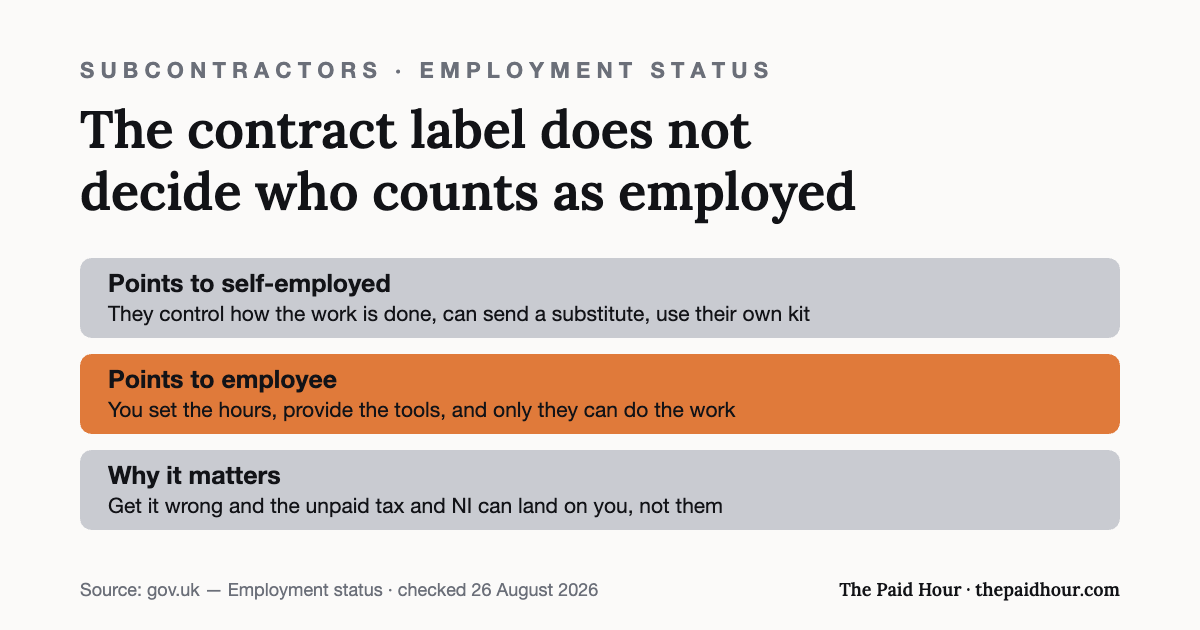
Calling someone a “subcontractor” in a contract doesn’t automatically make them one for tax purposes. HMRC looks at how the working relationship actually functions, not just what it’s labelled. According to gov.uk, someone is probably self-employed if most of the following are true:
- They put in bids or give quotes to get the work, rather than simply being assigned it
- They’re not under your direct day-to-day supervision while working
- They submit invoices for the work they’ve done
- They’re responsible for paying their own National Insurance and tax
- They don’t get holiday or sick pay from you when they’re not working
The more of these that are true, the safer the self-employed classification. If you’re setting someone’s hours, providing their equipment, and they can’t send someone else to do the work in their place, that starts looking a lot more like employment, whatever the contract calls it.
What goes wrong if you get it wrong
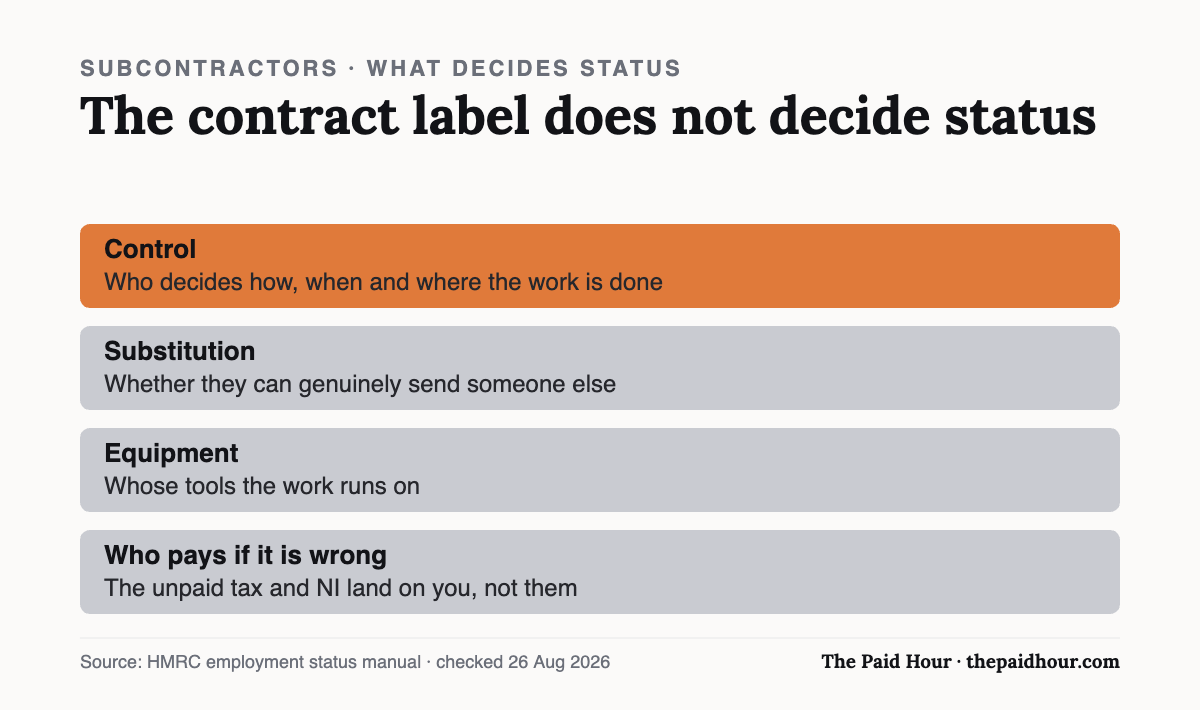
Gov.uk is direct about the consequence: “individuals and their employers may have to pay unpaid tax and penalties, or lose entitlement to benefits, if their employment status is wrong.” If HMRC decides someone you’ve treated as a subcontractor was really an employee, you can end up liable for PAYE income tax and National Insurance that should have been deducted, plus penalties on top, backdated, potentially, over however long the arrangement ran.
Checking before you start rather than after
HMRC provides an online employment status tool specifically so you can check before a dispute arises instead of after. It’s worth running an honest answer through it before the working relationship begins, rather than assuming a contract that says “self-employed” is enough on its own. Keep a record of the result, if your working relationship matches what you described, that record is useful evidence later if HMRC ever asks.
If you’re hiring subcontractors in construction
There’s an extra layer if the work is construction-related: the Construction Industry Scheme (CIS) has its own registration and deduction rules for contractors paying subcontractors. See our guide to the Construction Industry Scheme if that applies to you. CIS obligations sit on top of the general employment-status question, not instead of it.
This is general guidance on how employment status works rather than a substitute for checking your specific arrangement, if there’s real ambiguity, it’s worth a proper check with an accountant before you start paying someone as a subcontractor.
Source: gov.uk, Employment status: self-employed and contractor, checked 23 August 2026.
Using HMRC’s CEST tool before hiring a subcontractor
HMRC’s Check Employment Status for Tax (CEST) tool is free and gives you HMRC’s own assessment of whether someone should be treated as employed or self-employed for a specific engagement, based on questions about control, substitution, and mutuality of obligation. It’s not the final legal word: genuine facts on the ground override whatever the form says, but running it before you start paying a subcontractor, and keeping the result on file, gives you something concrete to point to if HMRC ever questions the arrangement later.
As a sole trader hiring a subcontractor, this record matters more than it might seem — CEST is designed with hirers in mind precisely because the financial risk of getting it wrong sits with you instead of the person you’ve hired.
Paperwork worth keeping when hiring a subcontractor
- A written contract that reflects the real working relationship, not just a label, describing genuine substitution rights and lack of day-to-day control if that’s how the arrangement works.
- Your CEST result, dated, alongside the answers you gave.
- Invoices from the subcontractor showing their own business details, not a payslip-style document.
- Evidence they work for other clients too, where that’s the case, a single ongoing client with no substitution rights is one of the strongest indicators HMRC looks for when reviewing status.
Getting this right isn’t about avoiding tax, it’s about making sure the paperwork matches the reality of the working relationship, which is the thing HMRC checks first.
The short version
Hiring a subcontractor as a sole trader comes down to one question that decides everything else: does the working relationship look self-employed, or does it look like employment with an invoice bolted on. Get that right, keep the paperwork to prove it, and the rest: CIS if it applies, contracts, invoices, follows naturally.
Common questions about hiring a subcontractor
Can a sole trader legally hire a subcontractor? Yes, hiring a subcontractor as a sole trader is completely normal and doesn’t require registering as an employer, provided the person is self-employed rather than a disguised employee.
Do I need insurance when hiring a subcontractor as a sole trader? Public liability cover is worth checking on both sides (yours and theirs), particularly if the subcontractor’s work could affect a client’s property or a third party.
What’s the biggest mistake people make hiring a subcontractor as a sole trader? Treating the label on the invoice as sufficient proof of status, rather than the actual day-to-day working relationship, which is what HMRC looks at first.
The same question decides your insurance position. If the working relationship looks like employment, employers liability cover becomes compulsory, whatever the invoice calls them.
Bringing in a subcontractor for the first time?
First Hire & Subcontracting 2026/27. Nine modules and five working sheets covering subcontractor, employee or agency on one table, the contract chain, status evidence, CIS, and the true cost of employee number one.
- The full cost-of-hire calculator: employer NI, pension, holiday, equipment and your own time, line by line
- A subcontractor status evidence file, so the arrangement survives an HMRC challenge
- The CIS monthly cycle, a new-starter checklist, and the fork decision sheet
Disguised-employment risk runs both ways: at you from your client, and at you from the person you engage. The paperwork is cheaper than the argument.
Buying more than one? All ten 2026/27 courses for £107, against £328 at full price.
Sources
The status factors were re-checked against gov.uk’s employment-status guidance on 26 August 2026.
This is general information about how the rules work, not tax advice. The links above go to the primary sources; for your own circumstances, speak to an accountant or contact HMRC directly.