
The one-paragraph answer: The FSCS protects eligible deposits up to £120,000 per person, per authorised institution, up from £85,000 since 1 December 2025. As a sole trader, your business and personal money at the same bank share one limit. And some app-based “business accounts” sit outside the FSCS entirely.
If your business bank fails, how much of your money comes back? The answer changed in December 2025, and it’s not as simple as “up to £120,000” for every account that calls itself a business bank account.
The current FSCS protection limit: £120,000
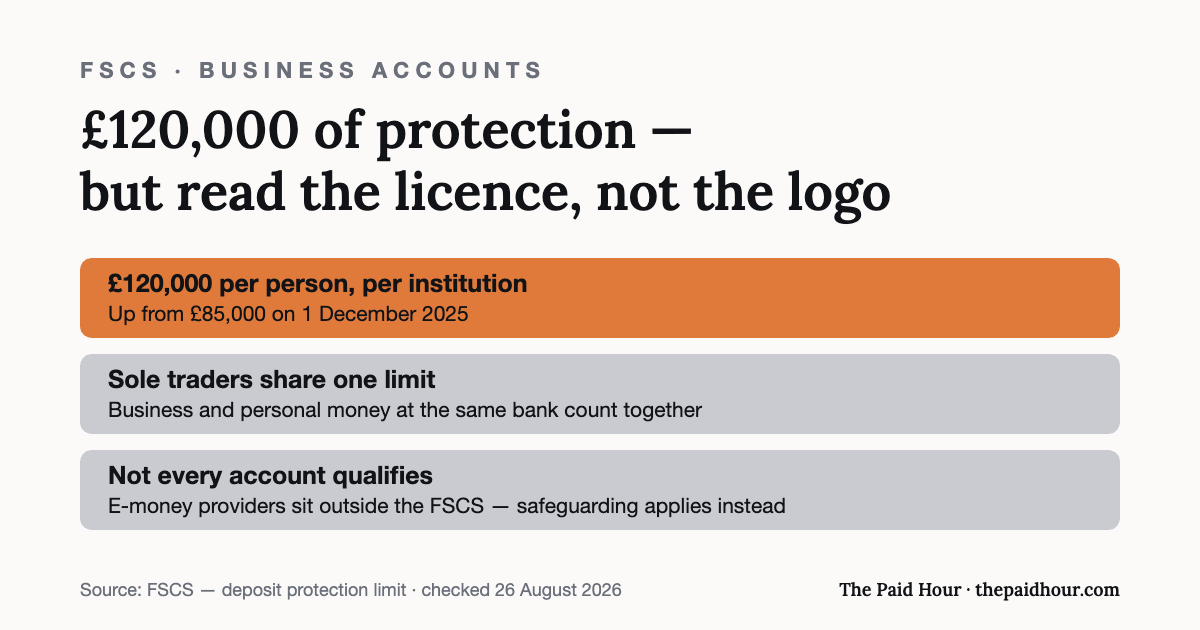
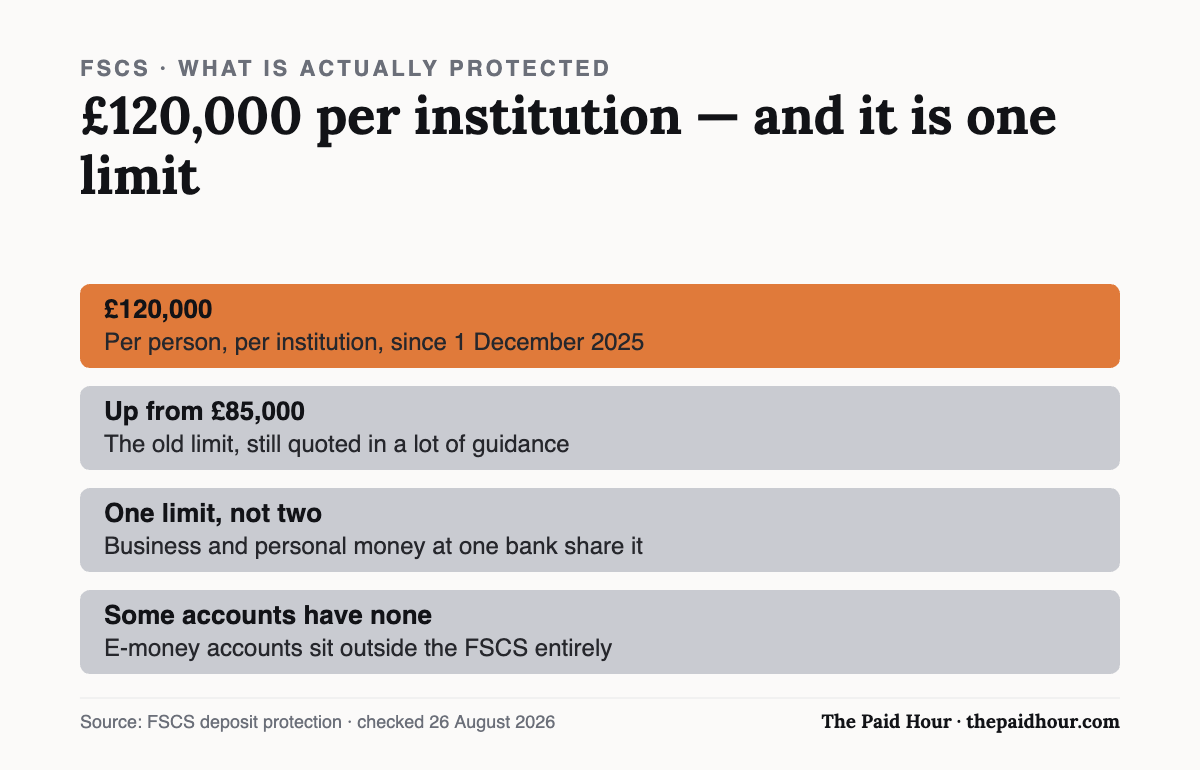
The Financial Services Compensation Scheme (FSCS) protects eligible deposits up to £120,000 per person or entity, per authorised institution. That’s up from £85,000, following an increase that took effect on 1 December 2025. If your bank or building society fails, FSCS aims to automatically refund covered deposits within seven working days.
There’s also extra short-term cover (up to £1.4 million for up to six months), for temporary high balances from specific events like selling a home or receiving an inheritance. That’s unlikely to be relevant to most freelancers’ day-to-day business banking, but worth knowing it exists.
How FSCS protection applies if you’re a sole trader
This is the detail that catches sole traders out. If your personal current account and your business account sit at the same bank, they’re not protected separately, they’re added together and capped at a single £120,000 limit as one person’s total exposure to that institution. Keep both a personal and business account at the same high-street bank with combined balances over £120,000, and the excess isn’t protected.
Limited companies are treated differently: a company gets its own separate £120,000 protection, distinct from the director’s personal accounts. Partnerships get a single £120,000 claim for the partnership as a whole rather than one per partner.
The catch: not every “business account” is FSCS-protected
This is the part worth checking before you assume you’re covered. FSCS protection applies to deposits held with banks, building societies and credit unions authorised by the Prudential Regulation Authority. A number of newer, app-based business account providers popular with freelancers, Tide among them, operate under an e-money licence rather than a full banking licence. E-money institutions aren’t covered by FSCS in the same way. Instead, they’re required to “safeguard” customer funds by holding them separately from the company’s own money, which is a different (and generally weaker) protection than FSCS deposit insurance.
That doesn’t automatically make an e-money account unsafe, but it does mean the “up to £120,000 protected” claim doesn’t apply to it in the way it does to a bank account. If you’re keeping meaningful balances (tax money set aside for HMRC, for instance), it’s worth checking your specific provider’s FCA status instead of assuming.
A worked FSCS protection example
Say you’re a sole trader with £40,000 sitting in your personal savings account and £90,000 in your business current account, both at the same high-street bank. Added together, that’s £130,000 at one institution: £10,000 above the £120,000 limit. If that bank failed, the extra £10,000 wouldn’t be protected. Move the business balance to a separate banking group, and both pots would be protected in full, because they’d each sit under a different institution’s £120,000 limit.
A limited company owner in the same situation is treated differently: the company’s £90,000 gets its own £120,000 allowance, separate from the director’s personal £40,000, so nothing would be at risk either way.
What FSCS protection means in practice
- Check whether your business account provider holds a full banking licence or an e-money licence, most providers state this clearly in their terms or FAQs.
- If you hold a personal and business account at the same bank, add the balances together when working out how much is protected.
- For balances that regularly sit close to or above £120,000 (including tax money you’re setting aside), consider spreading funds across separate banking groups rather than assuming one institution covers everything.
See our guide on the best business bank accounts for UK sole traders for how the main providers compare on fees and features, not just protection.
Source: FSCS deposit limit increase page, checked 23 August 2026. Confirm your specific provider’s licence type and current FSCS status directly before relying on this for large balances.
Spreading money across banks to increase FSCS protection
Because FSCS protection on business accounts is per authorised firm rather than per account, the only way to increase your effective coverage is to hold money with separate banking licences. Two accounts at the same bank, even under different brand names, often sit under one licence: several well-known “challenger” brands are actually trading names of a single authorised institution behind the scenes, so check the FCA Financial Services Register instead of assuming two different logos means two different licences.
For a sole trader holding a tax reserve well above £120,000, splitting savings across two or three separately licensed banks is the straightforward way to keep the whole balance protected, rather than leaving a six-figure tax pot concentrated in one place.
Temporary high balances: the FSCS protection exception
FSCS protects “temporary high balances” above the normal £120,000 limit (up to £1.4 million), for up to six months, for specific events like selling a property, an inheritance, or a large one-off business transaction such as a client settlement or the sale of the business itself. This isn’t automatic for every big invoice; it’s aimed at exceptional, one-off amounts rather than ordinary trading income, so a large but routine client payment sitting in your account isn’t covered by this exception the same way.
Common mistakes with FSCS protection
- Assuming a personal account and a sole trader business account at the same bank get separate £120,000 limits, they don’t, they share one pot.
- Not checking whether a “business bank account” from a fintech is FSCS-protected at all, versus safeguarded under e-money rules.
- Holding large reserves with two brands that turn out to share the same underlying banking licence.
- Forgetting that FSCS covers you per person, per licensed firm — a limited company’s protection is separate from its director’s personal FSCS coverage, which matters if you’re weighing sole trader vs limited company for a growing cash reserve.
If you’re choosing where to bank in the first place, our best business bank accounts for UK sole traders roundup flags which providers are full banks versus e-money institutions, which is the detail that determines whether FSCS protection on business accounts applies at all.
The provider this question comes up about most is Wise, an e-money account instead of a bank, which is exactly the distinction this page covers. The full Wise Business review goes deeper.
Where should the tax money actually live?
Freelancer Money System 2026/27. Seven modules and five working sheets that pay you a predictable monthly amount out of unpredictable income: the account structure, the percentages, and where every pot should sit.
- A salary set from your trailing twelve-month low, not the average, with the calculator that finds it
- The day-it-lands allocation split, so tax and costs are moved before you can spend them
- The written drought plan for a bad quarter, the FSCS licence checker, and the surplus waterfall for a good year
Normal budgeting assumes a payday. Freelance income does not have one. The fix is not discipline, it is structure, and structure is a one-afternoon job.
Buying more than one? All ten 2026/27 courses for £107, against £328 at full price.
Sources
The £120,000 limit and its start date were re-checked against fscs.org.uk on 26 August 2026.
This is general information, not financial advice. Pricing and terms are the provider’s own and change, check the linked pages before you rely on them.