
The short version: Bank with NatWest, RBS, Ulster Bank or Mettle? Use FreeAgent, it comes free with those accounts and it’s the full product. Paying full price, it’s FreeAgent at £19 against Xero Ignite at £18, and Ignite’s 20-invoice-a-month cap is the real fork in the road. Pay FreeAgent annually and it comes out cheaper than Xero over a year rather than dearer.
Table of Contents
Update, 7 September 2026: Xero put its UK prices up on 1 September. Ignite went to £18, Grow to £39. The figures below are the new ones; see what’s changing and what it’ll cost you.
Disclosure. Some links here are affiliate links and we may get paid if you sign up. The recommendation below actually sends a large share of readers toward the option that pays us nothing, because for them it’s free. See our affiliate disclosure.
These two get pitted against each other constantly in FreeAgent vs Xero for sole traders comparisons, and most miss the one fact that decides it for the majority: who you bank with.
The decision, in one line
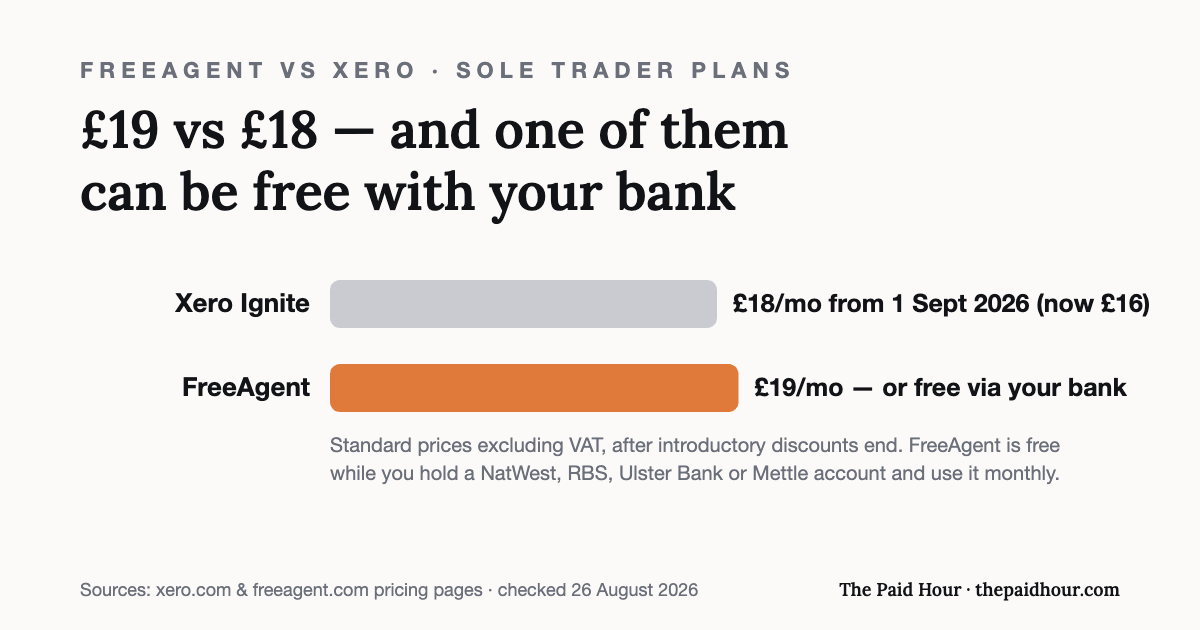
If you bank with NatWest, Royal Bank of Scotland, Ulster Bank or Mettle, use FreeAgent. It comes with those accounts at no cost, it’s the full product rather than some stripped-down version, and no amount of feature comparison beats free. NatWest Group owns FreeAgent, which is exactly why the offer exists (the free route’s exact terms). Not with any of them yet? The guide to business bank accounts for UK sole traders covers what moving to Mettle involves, and the condition attached to the free FreeAgent.
Bank anywhere else, and the answer gets less obvious, it comes down to how many invoices you send.
What they cost
First-year totals including the introductory discount. Prices excluding VAT.
On monthly billing, Xero Ignite wins, but only by £12 a year since the 1 September rise. Before it, the gap was £36. A gap that small shouldn’t decide anything, especially given the catch attached to it.
Pay annually and the price answer flips
Every comparison of these two, this one included until now, quotes monthly prices. Neither company minds that, because monthly is where Xero looks cheaper. FreeAgent will also bill a sole trader once a year, at £190: £15.83 a month in effect, against £19 paid monthly. Xero’s UK pricing page lists monthly prices only, and its own FAQ headed “Can I pay the subscription annually?” answers by describing monthly invoicing.
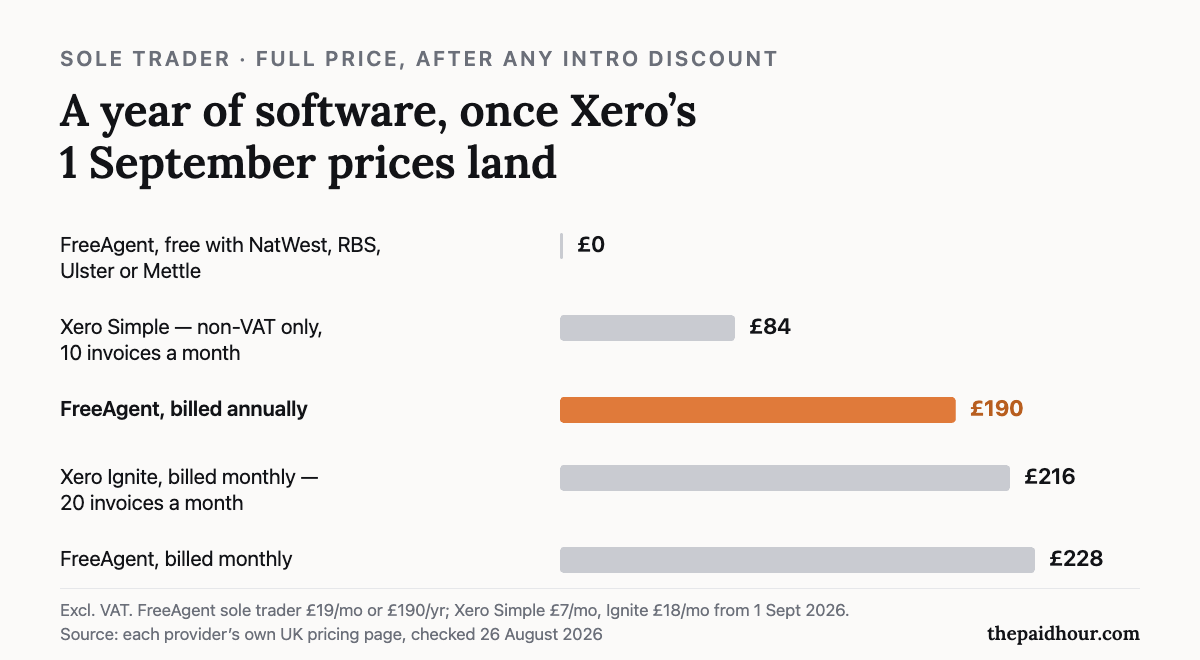
So over a full year at full price: FreeAgent annual £190, Xero Ignite £216. FreeAgent is the cheaper one, by £26 a year, having been the dearer one by £24 on the monthly figures the moment before.
Two honest caveats before anyone commits £190 in one go. Annual billing means paying up front for a tool you may want to leave, and for a business with lumpy income that is a real cost instead of a theoretical one. And a £26 difference across twelve months is not a reason to pick accounting software. It is a reason to stop treating the monthly headline as the price.
The row worth noticing is the second one. If you are not VAT registered, Xero Simple is £7 a month: £84 a year, and unchanged on 1 September while every other Xero plan rises. It caps you at 10 invoices a month, half of Ignite’s allowance, which rules out most people reading this. For the ones it doesn’t, it is the cheapest thing either company sells. The full breakdown of what changes on 1 September goes through which plan each rise hits.
The invoice cap is the real fork in the road
Xero Ignite is capped at 20 invoices a month and 10 bills entered. FreeAgent has no such cap on its sole trader plan.
For a consultant with four retainer clients, 20 invoices a month is never going to be an issue, and Ignite is comfortably the cheaper pick. For a photographer, tutor, or anyone billing per session or per job, 20 is a ceiling you’ll hit in a busy month, and the next Xero plan up, Grow, is £39 a month. That’s £468 a year against FreeAgent’s £228.
So the honest version is: Xero’s cheaper right up until it suddenly isn’t. Count your invoices from the last three months before you decide anything.
Where FreeAgent is better
FreeAgent was built around UK sole traders, and it shows. The dashboard estimates your Self Assessment liability as the year goes on, so the January bill is a number you’ve been watching rather than a shock. For a freelancer with no accountant, that one feature alone is worth more than most of the spec-sheet differences.
It also files MTD quarterly updates directly, without needing bridging software.
Where Xero is better
Xero’s the more capable platform, and it’s the one your accountant is most likely to already work in. It has a much larger app ecosystem, better multi-currency handling on the upper plans, and more headroom if the business grows into something with employees and stock. If there’s any chance you’ll incorporate or hire in the next few years, Xero’s the less disruptive path.
A note on both
Both sit on HMRC’s compatible software list for Making Tax Digital for Income Tax, so neither choice creates a compliance headache. Not sure whether MTD applies to you yet? The guide to what Making Tax Digital changes covers the thresholds.
And go into the introductory offers with your eyes open. An 80% discount is real money, but you’re choosing software you’ll likely be using for a decade. Compare the year-two prices, not the year-one ones.
So which wins?
- NatWest, RBS, Ulster Bank or Mettle customer? FreeAgent. Free, and not a compromise.
- Under 20 invoices a month, banking elsewhere? Xero Ignite. Cheaper, more room to grow.
- More than 20 invoices a month? FreeAgent. Xero’s next tier costs nearly twice as much.
- Have an accountant? Ask which they use, and just use that. It’ll save you both more than the price difference.
Neither’s a bad product. The mistake people actually make isn’t picking the wrong one: it’s picking on the headline discount and discovering the limit six months later.
Where to sign up
FreeAgent
Free and not a compromise if you bank with those. Also the cheaper choice above 20 invoices a month, where Xero’s next tier costs nearly twice as much.
Visit FreeAgentXero
Xero Ignite is cheaper with more room to grow, but the invoice cap is hard, so check it against your real monthly volume before you commit.
Visit XeroStill working out what Xero even is? Read what Xero does first.
Want month-end done in thirty minutes?
Digital Bookkeeping System (MTD-ready) 2026/27. Seven modules and a seven-sheet toolkit, built around a category-to-tax-box mapping table that makes your quarterly updates fill themselves.
- A software decision sheet costed over three years, split by turnover, VAT status and phone-or-desktop
- The chart of categories mapped to the Self Assessment and MTD boxes, and the three categories never to auto-categorise
- Weekly and month-end cards, an MTD quarter-close checklist, and an export-and-archive index so their cloud is never your only copy
Software is priced monthly, excluding VAT, and you will hold the subscription for years. Pick on the wrong number and the difference over three years is more than every course on this site combined.
Buying more than one? All ten 2026/27 courses for £107, against £328 at full price.
Sources
- FreeAgent pricing
- Xero UK pricing plans
- HMRC — Choose the right software for Making Tax Digital for Income Tax
Both providers’ prices re-checked against their own pricing pages on 26 August 2026. Xero’s increase took effect on 1 September 2026.
Need an invoice that’s already sorted?
Editable, HMRC-compliant invoice templates, no subscription.
Browse templates