
There are two versions of the FreeAgent question, and they have different answers.
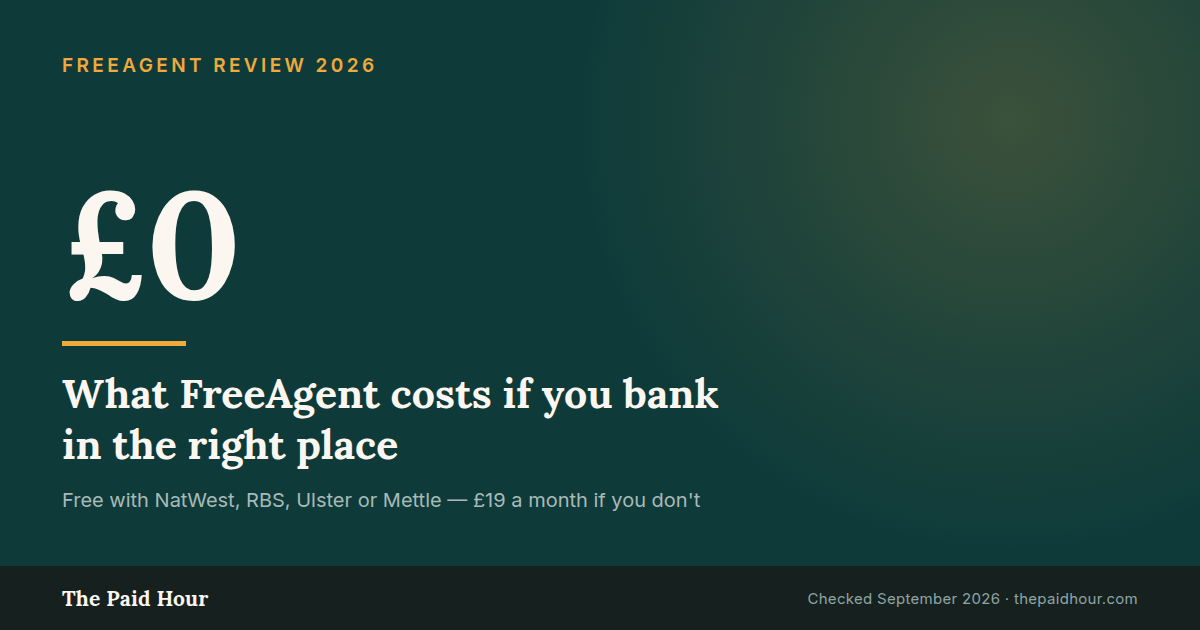
If you bank with NatWest, Royal Bank of Scotland, Ulster Bank or Mettle, FreeAgent costs you nothing and the only sensible question is whether it does what you need. If you do not, you are looking at £19 a month plus VAT as a sole trader, and it has to earn that against cheaper competitors.
Disclosure: the FreeAgent link below runs through our own redirect so we can see what readers click. FreeAgent’s programme pays us nothing in cash — there is no commission riding on this verdict either way. See our affiliate disclosure.
FreeAgent pricing in 2026
FreeAgent prices by business type rather than by feature tier, which is unusual and mostly a good thing — a sole trader is not paying for payroll modules they will never open.
| Plan | Monthly | First 6 months | Annual |
|---|---|---|---|
| Sole Trader | £19 | £9.50 | £190 (£95 intro) |
| Partnership or LLP | £27 | £13.50 | £270 (£135 intro) |
| Limited Company | £33 | £16.50 | £330 (£165 intro) |
| Landlord | £10 | £5 | £100 (£50 intro) |
Two add-ons sit outside those prices: Smart Capture Unlimited at £5 a month, and an Amazon connection at £6 a month.
The annual plans are worth a moment. Sole Trader at £190 a year against £19 a month is a £38 saving — real, but not enormous, and it locks you in for twelve months. Take the monthly plan for your first year and switch to annual once you know you are staying.
The free route, and its conditions
FreeAgent is owned by NatWest Group, which is why the free access exists and why it is worth understanding the exact terms rather than the headline.
NatWest, Royal Bank of Scotland and Ulster Bank business accounts: free for as long as you keep the account.
Mettle: free, but conditional — Mettle has to be your primary account and you need at least one transaction a month.
That Mettle condition is the one that catches people. Opening a Mettle account, moving nothing through it and expecting free accounting software does not work. Our post on whether FreeAgent is really free goes through the arrangement in more detail.
Worth thinking about the tail risk too. Free software tied to a bank account means switching banks has a software cost attached. That is not a reason to avoid it — it is a reason to notice it before you build three years of records inside it.
What FreeAgent is good at
It was built for small UK businesses, not scaled down to them. That shows. The tax timeline on the dashboard tells you what is due and when, in plain language, rather than making you go and calculate it. For a sole trader who does not think in accounting terms, that is genuinely the difference between using the software and avoiding it.
Self Assessment is built in. Not a bolt-on, not an export you hand to someone else. You can prepare and file from inside it.
Time tracking and project profitability are included rather than gated behind a higher tier, which is exactly the wrong way round in several competing products, where projects sit near the top of the price ladder.
The interface is calm. Fewer options, better defaults, less of the enterprise-grade clutter that makes bigger packages exhausting for one-person businesses.
Where it falls short
It does not scale. If you are heading toward multiple entities, a payroll of any size, or complex stock, FreeAgent is not where you end up. That is a design choice, not a defect, but it means a growing business faces a migration eventually.
Multi-currency handling is thinner than the bigger platforms. If a meaningful share of your invoicing is in euros or dollars, test it properly during the trial rather than assuming.
Fewer integrations. The app ecosystem around it is smaller than Xero’s by a wide margin. For most sole traders that is irrelevant; if you rely on a specific tool talking to your books, check it exists first.
At £19 plus VAT it is not cheap for anyone paying full price. That is £22.80 a month in real money if you cannot reclaim the VAT — £273.60 a year to keep the books of a one-person business.
FreeAgent against the alternatives
The closest comparison for most readers is Xero, and the two products have genuinely different personalities — FreeAgent is simpler and more opinionated, Xero is more capable and more work. Our head-to-head on FreeAgent versus Xero for sole traders is the direct comparison.
Below FreeAgent’s price point sit several capable UK options, some free. If cost is the deciding factor, start with our roundup of accounting software for UK freelancers and our guide to free accounting software for sole traders.
Check the MTD position for your situation
Making Tax Digital for Income Tax changes what your software has to do, and the requirements differ depending on your income sources. Do not take any vendor’s compatibility claim at face value, check it against HMRC’s own list.
Our guides to HMRC-recognised MTD software and MTD for Income Tax explain how to check and what quarterly updates actually involve.
Verdict
Banking with NatWest, RBS, Ulster or Mettle? Use it. Free, competent, built for exactly your situation, and there is no realistic argument for paying for something else instead.
Paying full price? It is a good product at a slightly uncomfortable price. What you are buying is a tool that makes tax feel manageable rather than one that gives you the most features per pound. For a sole trader who has been avoiding their books, that is worth paying for. For someone who is already comfortable with spreadsheets and just needs MTD compliance, cheaper options will do the job.
Try the free trial before committing either way, and use it on real transactions rather than a demo.
See current FreeAgent plans and pricing
Common questions
How much is FreeAgent for a sole trader?
£19 a month excluding VAT, or £9.50 for the first six months on the introductory rate. Annually it is £190, with an introductory £95 first year.
Is FreeAgent free with a bank account?
Yes with NatWest, Royal Bank of Scotland and Ulster Bank business accounts, for as long as you keep the account. Also free with Mettle, provided Mettle is your primary account and you make at least one transaction a month.
Can I file my Self Assessment from FreeAgent?
Self Assessment preparation and filing are built into the product rather than sold as an add-on, which is one of its stronger arguments over cheaper bookkeeping-only tools.
What happens to my data if I leave my NatWest account?
The free access is tied to holding the account, so closing it moves you onto a paid plan. Factor that in before you build years of records inside software you are getting for free through a bank.
What the VAT does to those prices
FreeAgent quotes excluding VAT, which is standard for business software and easy to skim past.
If you are VAT registered you reclaim it and the headline is your real cost. If you are below the VAT registration threshold, you cannot, so add 20% to everything.
That makes the Sole Trader plan £22.80 a month in actual money, or £273.60 a year. The Limited Company plan is £39.60 a month, £475.20 a year. Both are perfectly defensible numbers for software you use daily — they are just not the numbers on the pricing page.
Who FreeAgent is actually built for
A one-person or two-person UK business, doing service work, invoicing in sterling, with no stock and no staff. Inside that box it is excellent and the simplicity is the feature.
Outside it, the simplicity starts costing you. A business with employees, inventory, or a second trading entity will find the ceiling faster than expected, and moving accounting software mid-life is a chore nobody enjoys, as our guide to switching accounting software sets out.
Pick software for where you will be in three years, not where you are this month.
Want month-end done in thirty minutes?
Digital Bookkeeping System (MTD-ready) 2026/27. Seven modules and a seven-sheet toolkit, built around a category-to-tax-box mapping table that makes your quarterly updates fill themselves.
- A software decision sheet costed over three years, split by turnover, VAT status and phone-or-desktop
- The chart of categories mapped to the Self Assessment and MTD boxes, and the three categories never to auto-categorise
- Weekly and month-end cards, an MTD quarter-close checklist, and an export-and-archive index so their cloud is never your only copy
Software is priced monthly, excluding VAT, and you will hold the subscription for years. Pick on the wrong number and the difference over three years is more than every course on this site combined.
Buying more than one? All ten 2026/27 courses for £107, against £328 at full price.
Sources
- FreeAgent — pricing (checked 26 August 2026)
This is general information about FreeAgent, not financial or tax advice. Every price and limit above links to the provider’s own page, with the date it was checked; terms change, so confirm on the live page before you sign up. For your own circumstances, speak to an accountant.