
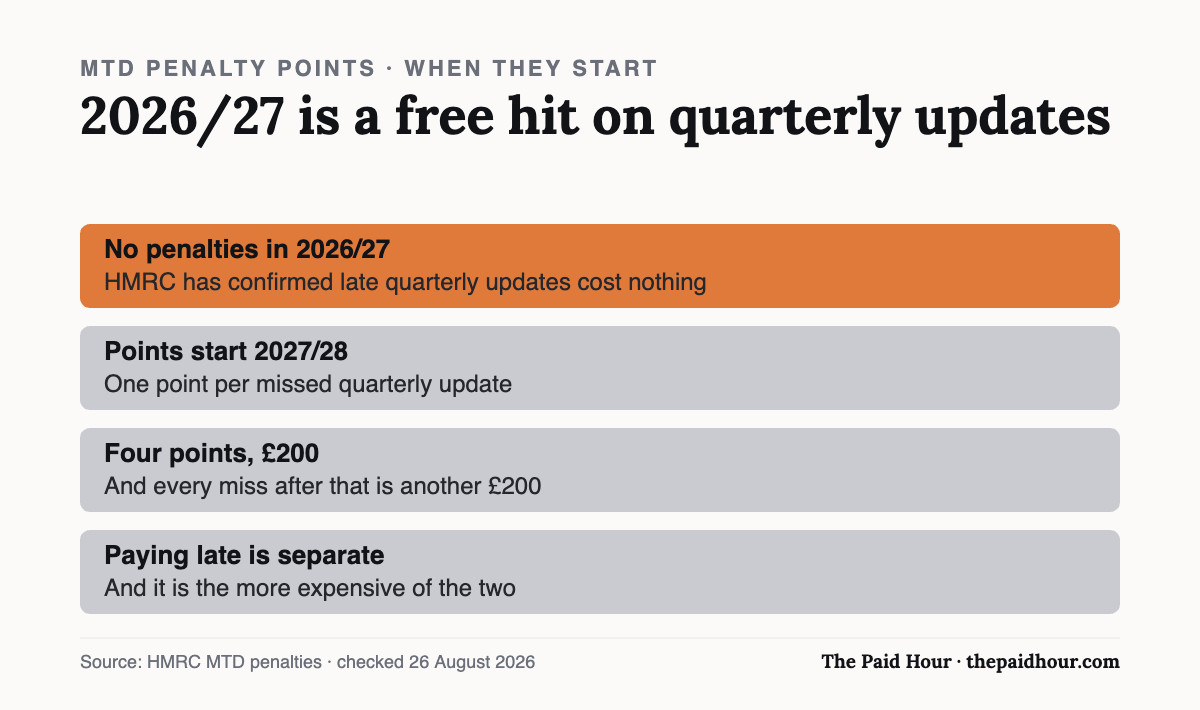
Quick answer: If you miss an MTD for Income Tax deadline in 2026/27, a missed quarterly update costs you nothing, HMRC has confirmed there are no penalties for late quarterly updates in the first year. Only the tax return deadline earns penalty points. Penalty points on quarterly updates begin with the 2027/28 tax year. Four points triggers a £200 penalty, and every miss after that is another £200. Paying late is penalised separately, and it is the more expensive of the two.
Table of Contents
Miss an MTD for Income Tax deadline and what happens next depends almost entirely on which year you are in. That is the part most coverage of the new system gets wrong, and it is worth getting straight before you worry about a fine that cannot yet apply to you.
The penalty system itself works like points on a driving licence rather than a flat fine. It is forgiving of one slip and expensive about a habit. But the first year runs under different rules.
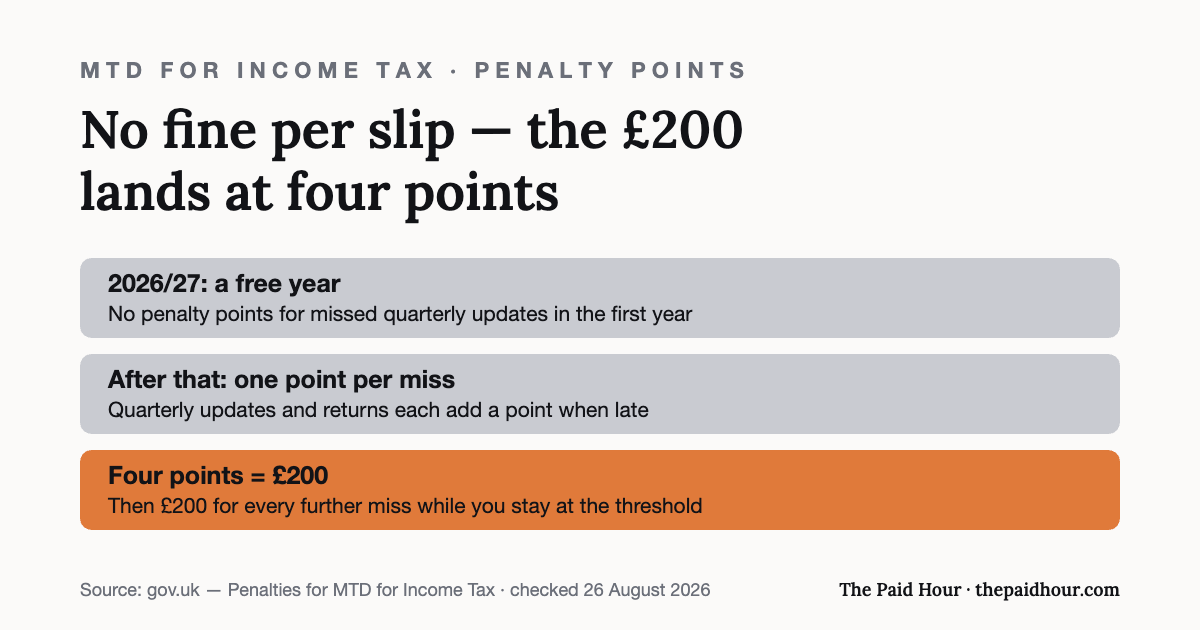
2026/27 is a free hit: no penalty points on quarterly updates
HMRC’s guidance is unambiguous: “There are no penalties for missing a quarterly update deadline for the 2026 to 2027 tax year.” The points rule is written the same way. You get a point “for each quarterly update (for tax years after 2026 to 2027) or tax return deadline you miss”.
Read the bracket. In 2026/27 the only deadline that can earn you a point is the tax return, due 31 January 2028. Miss the update due 7 August 2026, or the ones on 7 November 2026 and 7 February 2027, and you get nothing on your record for it.
The first quarterly update that can cost you a point is 7 August 2027: the one covering 6 April to 5 July 2027, in the 2027/28 tax year. The full run of dates is in the guide to MTD quarterly update deadlines, and they sit alongside everything else in the 2026/27 tax year calendar.
None of which is a reason to skip them. Each update is cumulative from 6 April, so a quarter you never filed is still sitting there waiting to be reported, and a year of unfiled updates is a year of bookkeeping you have not done. The free hit is on the penalty, not on the work.
How the penalty points work
- One point per missed submission deadline.
- At four points, a £200 penalty. Then £200 again for every further submission deadline you miss, no more points needed, just the charge.
- Below four points, HMRC removes each point automatically 24 months after the deadline that earned it.
- At or above four points, nothing expires on its own. You clear the lot only by filing on time for 12 months and by submitting every outstanding update and return from the previous 24 months.
That last condition is the sting. Once you are at the threshold, a clean 12 months is not enough by itself, the backlog has to be cleared too, and one more missed deadline inside that 12-month run starts the clock again.
A worked example, with the first-year rule
Take someone who is in the £50,000 cohort and has a bad two years. Every deadline below is missed.
| Deadline missed | What it was | Points | Running total |
|---|---|---|---|
| 7 Aug 2026 | Q1 update, 2026/27 | 0 | 0 |
| 7 Nov 2026 | Q2 update, 2026/27 | 0 | 0 |
| 7 Feb 2027 | Q3 update, 2026/27 | 0 | 0 |
| 7 May 2027 | Q4 update, 2026/27 | 0 | 0 |
| 7 Aug 2027 | Q1 update, 2027/28 | 1 | 1 |
| 7 Nov 2027 | Q2 update, 2027/28 | 1 | 2 |
| 31 Jan 2028 | Tax return for 2026/27 | 1 | 3 |
| 7 Feb 2028 | Q3 update, 2027/28 | 1 | 4 — £200 |
| 7 May 2028 | Q4 update, 2027/28 | — | Another £200 |
Four missed quarterly updates in the first year, and the submission penalty is zero. The same four in the second year, plus one late return, and it is £400 and climbing. Nothing about the behaviour changed. Only the calendar did.
Late payment is a bigger risk than penalty points
Points cover submissions. Paying late is charged separately, and it does not get a first-year holiday in the way quarterly updates do.
| How late the payment is | 2026/27 | 2027/28 onwards |
|---|---|---|
| 1 to 15 days | No penalty | No penalty |
| 16 to 30 days | 3% of the tax owed at day 15, or nothing if it is your first year | 4% of the tax owed at day 15 |
| 31 days or more | 3% at day 15 plus 3% at day 30, then 10% a year charged daily | 4% at day 15 plus 4% at day 30, then 10% a year charged daily |
In your first year under the new penalties you get 30 days from the payment due date to either pay in full or contact HMRC and set up a payment plan. Do one of those and the 3% at day 16 does not apply.
The 10% annual charge from day 31 is the number to be frightened of. On a £6,000 bill left unpaid for a year, that is roughly £600 on top of two 3% charges of £180 each, and none of it is a penalty point, so none of it is covered by keeping your submissions tidy.
Are penalty points better or worse than the old Self Assessment penalties?
Under the old regime, one day late meant an automatic £100 whether or not you owed anything. Three months late added £10 a day up to £900. At six months and again at twelve, 5% of the tax due or £300, whichever was greater.
So the answer depends on what kind of late you are. One slip is far cheaper now: a single missed return costs a point rather than £100. A pattern is worse, because points do not expire once you hit the threshold and each further miss is a flat £200. The system was designed to stop punishing the person who was ill for a fortnight and start punishing the person who is never on time. On that measure it works.
You have already picked up penalty points. Now what?
File it. Because each quarterly update is cumulative from 6 April, the next one you send carries the missing figures anyway, so the gap closes itself the moment you submit. There is no amendment to make and no form to chase.
If it is the payment you have missed instead of the submission, contact HMRC before day 30 rather than waiting to find the money. A payment plan agreed inside that window is the difference between owing the tax and owing the tax plus a percentage that compounds daily.
MTD quarters coming and the books are a shoebox?
Digital Bookkeeping System (MTD-ready) 2026/27. Seven modules and a seven-sheet toolkit, built around a category-to-tax-box mapping table that makes your quarterly updates fill themselves.
- A software decision sheet costed over three years, split by turnover, VAT status and phone-or-desktop
- The chart of categories mapped to the Self Assessment and MTD boxes, and the three categories never to auto-categorise
- Weekly and month-end cards, an MTD quarter-close checklist, and an export-and-archive index so their cloud is never your only copy
Software is priced monthly, excluding VAT, and you will hold the subscription for years. Pick on the wrong number and the difference over three years is more than every course on this site combined.
Buying more than one? All ten 2026/27 courses for £107, against £328 at full price.
Sources
- gov.uk — Penalties for Making Tax Digital for Income Tax
- gov.uk, Send quarterly updates for Making Tax Digital for Income Tax
- gov.uk. Find out if and when you need to use Making Tax Digital for Income Tax
- gov.uk, Self Assessment tax returns: penalties
- HMRC news, 23 July 2026: Deadline approaches for first Making Tax Digital quarterly update
The points system and 2026/27 grace year were re-checked against gov.uk on 26 August 2026.
Every rule and figure above was checked against gov.uk on 25 August 2026. This is general information about how the penalties work, not tax advice. For your own circumstances, speak to an accountant or contact HMRC directly.
Work out your own numbers. Our free UK freelancer tax calculator gives you the 2026/27 Income Tax and Class 4 National Insurance on your profit, plus the amount to set aside each month.