
TaxScouts is now Taxfix, same company, same UK-based accountants, new brand after joining the wider Taxfix group. If you are reading older TaxScouts reviews or hunting for a TaxScouts discount code, that rename is the first thing worth knowing. This review covers what Taxfix charges now, what a real accountant does at each tier, and how that price compares against what HMRC charges you for getting it wrong.
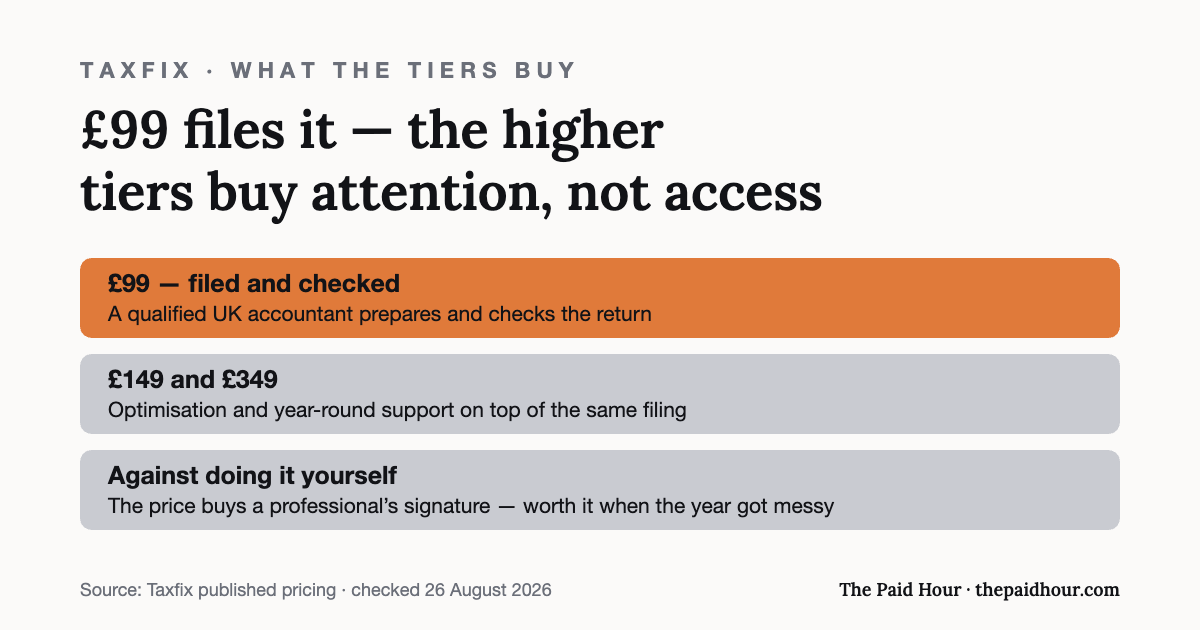
Quick answer: Taxfix files your Self Assessment for £99 at the entry tier, with a qualified UK accountant preparing and checking it, rising to £149 and £349 for optimisation and year-round support. Those are promotional prices and the page does not state VAT. It is worth paying if your return has any complexity in it, a return filed a year late costs at least £1,600 in HMRC penalties alone.
Table of Contents
What it costs
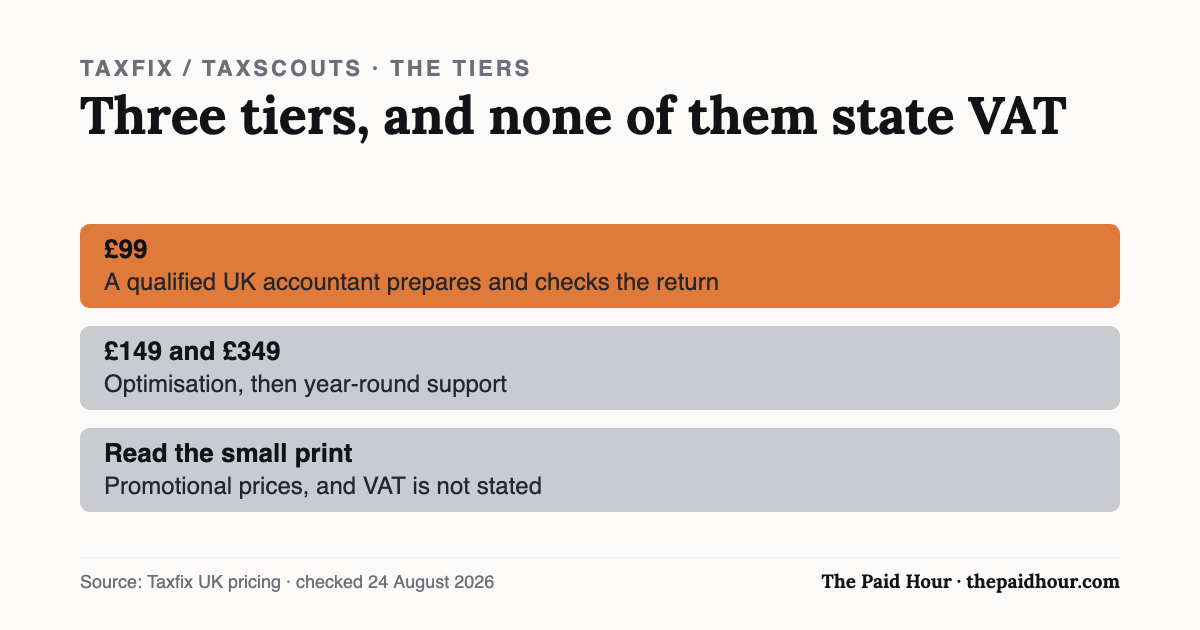
Taxfix runs three tiers for a Self Assessment return, currently shown at a discount against a standing price.
| Tier | Standing price | Current price |
|---|---|---|
| Prepared & Filed Accurately | £169 | £99 |
| Filed, Optimised & Protected | £249 | £149 |
| Filed + a Year-Round Tax Partner | £499 | £349 |
Two things the pricing page does not tell you, and both matter. The discounted figures are promotional, so treat them as this month’s price rather than the price, check the live page before you commit. And the page does not state whether these figures include VAT, which on a £349 tier is a £70 question. Ask before you pay if it matters to you.
The fee is per return instead of per year of advice, except on the top tier where the year-round element is the thing you are buying.
What you actually get for that
Every tier includes a qualified accountant who prepares and files the return on your behalf, plus what Taxfix calls an Accuracy Guarantee. Taxfix describes its accountants as 100% UK-based, hand-vetted, accredited by the major UK accounting bodies and carrying at least five years of industry experience, from a pool of roughly 150 practitioners. Those are the company’s own descriptions rather than an independent audit, and they are worth reading as such.
That is the real difference from software-only options such as GoSimpleTax. Software applies rules to the numbers you type in. It cannot tell you that the number you typed in is the wrong number, or that you have missed a relief entirely. A person can.
The middle tier adds a tax optimisation review and support if HMRC comes back with questions. The top tier turns the relationship into a retainer rather than a one-off filing, useful if your position changes during the year instead of only in January.
What getting it wrong costs
The case for paying anyone is easier to judge with HMRC’s own penalty ladder in front of you. Miss the filing deadline and the charges stack:
- £100 immediately, even if you owe no tax at all
- After three months, £10 a day, up to a maximum of £900
- After six months, a further 5% of the tax due or £300, whichever is greater
- After twelve months, another 5% or £300, whichever is greater
A return filed a year late therefore costs at least £1,600 in filing penalties before any tax is paid. Paying late is charged separately, at 5% of the unpaid tax at 30 days, six months and twelve months, plus interest on the balance throughout.
Set against that, £99 is not really a fee for arithmetic. It is a fee for the return going in on time and being right. Our guide to Self Assessment late filing penalties works through the same figures in more detail.
Who this suits
If your return involves anything beyond straightforward sole-trader income and standard expenses (several income streams, property income, a first year of trading, a year you left employment mid-way), paying for a qualified accountant to look at it is a reasonable trade against the cost of getting it wrong.
If your situation is simple, one self-employment income and a handful of allowable expenses, you may not need to pay anyone at all. Our first Self Assessment guide and the trading allowance explainer cover what a straightforward return involves.
First-time filers consistently underestimate the gathering, not the maths. Finding your UTR number, pulling bank interest figures, getting Class 2 and Class 4 National Insurance right: that is where the hours and the errors go, and it is the part an accountant removes.
Not the same as their referral scheme
Worth flagging so you do not go hunting for a code that does not apply to you. Taxfix runs a customer invite scheme, which gives a referred person a discount, and that is a separate thing from the promotional pricing above. If you find a TaxScouts-branded discount code online, it is most likely tied to the old brand and the old scheme rather than a live rate — TaxScouts is now Taxfix, same company, and the pricing page is the only reliable source for what you will actually pay.
For the record: The Paid Hour has no commercial relationship with Taxfix. Nothing on this page is a paid placement, and there is no affiliate link to it.
The honest Taxfix verdict
Taxfix is worth paying for specifically because a qualified person reviews your return rather than a calculator applying the rules you entered. That is the whole value proposition, and at £99 it is priced roughly at the cost of one missed deadline.
For a nervous first filer, or anyone whose year has any complexity in it, that is cheap insurance. For a simple return you have filed before, it is a convenience instead of a necessity, and the honest advice is to try it yourself once before paying someone to do it for you.
Filing it yourself this year?
HMRC Tax & Expense Mastery 2026/27. Nine modules and eleven working templates that take a UK freelancer from “do I even need to register” to a correct return, with MTD quarters built in.
- Fifteen expense categories, with the trap inside each one (training, clothing, meals, the seven-year pre-trading rule)
- Home and vehicle: flat rate against actual cost, with the £312 break-even worked out and the mileage lock-in rule
- The year-one payments-on-account cash shock, and the routine that stops it landing twice
HMRC does not send a list of what you forgot to claim. Most freelancers leave several hundred pounds of legitimate expenses on the table every single year, and the return still gets filed.
Buying more than one? The Complete Freelancer System, all five for £87, against £215 at full price.
How this review was put together. This is a documentation-based review. The figures come from Taxfix and TaxScouts’s own published pricing and help pages and, where relevant, HMRC’s software lists, checked on the date shown at the end of the article. It does not rest on a paid account or on running the product with live client data, and where a point comes from the provider’s marketing rather than something independently checkable, the text says so.
Sources
- Taxfix, UK Self Assessment tiers, prices and accountant claims
- HMRC. Self Assessment late filing and late payment penalties
- HMRC, Self Assessment deadlines
Prices and claims checked 24 August 2026 on Taxfix’s own pricing page; the pricing shown there is promotional and time-limited, and the page does not state VAT treatment. Descriptions of Taxfix’s accountants are the company’s own. Penalty figures are HMRC’s. This is general information, not tax advice.