
Before you read on: Your UTR, Unique Taxpayer Reference, is the 10-digit number HMRC files your tax under. It arrives automatically, usually by post around 15 days after you register for Self Assessment, and lives in the HMRC app, your Personal Tax Account and on old HMRC letters. A lost one can be recovered. A missing one costs money on a building site: CIS deductions run at 30% instead of 20% without it.
Table of Contents
A UTR number is the one reference every UK freelancer and sole trader eventually gets asked for. By HMRC, by an accountant, or by a contractor who can’t pay you properly without it. It stands for Unique Taxpayer Reference, though HMRC letters sometimes just say “tax reference”, and it is neither your National Insurance number nor your tax code. Here’s what it actually is, how it arrives, where it hides when you lose it, and the one situation where not having it takes 30% off your invoices.
What a UTR number is
Ten digits, issued once. HMRC assigns a UTR when you register for Self Assessment and uses it to match returns, payments and letters to your record, it’s the reference on previous tax returns and other documents from HMRC. Come back after a year off and you reactivate the same record; the number doesn’t change. A limited company gets its own, separate Corporation Tax UTR when the company is formed, and a partnership has a partnership UTR on top of each partner’s personal one.
It sits alongside two references it constantly gets confused with. Your National Insurance number identifies you across the whole state system. Your tax code is an instruction to an employer or pension provider about how much tax to collect, and it moves around. The UTR is narrower than both: it’s the filing reference for Self Assessment, and it doubles as your payment reference when you pay your Self Assessment bill.
How do you get a UTR number?
You don’t apply for one. You register as a sole trader for Self Assessment, and the UTR is what comes back, there is no separate UTR application for individuals. The same applies to landlords and anyone else who files a return.
The reverse is also true: never file, never need one. An employee on PAYE alone has no UTR and that’s normal. A first freelance invoice, a first rental year, a first CIS job, those are what trigger it.
The deadline is the part people miss. If you need to file for the 2025/26 tax year, you must tell HMRC by 5 October 2026: later than that and you could get a penalty. Registering early buys slack for the postal wait that follows, and everything after registration is walked through in your first Self Assessment as a freelancer. Running a limited company instead? The Corporation Tax UTR can be requested online, and HMRC posts it to the address registered with Companies House.
How long does a UTR number take to arrive?
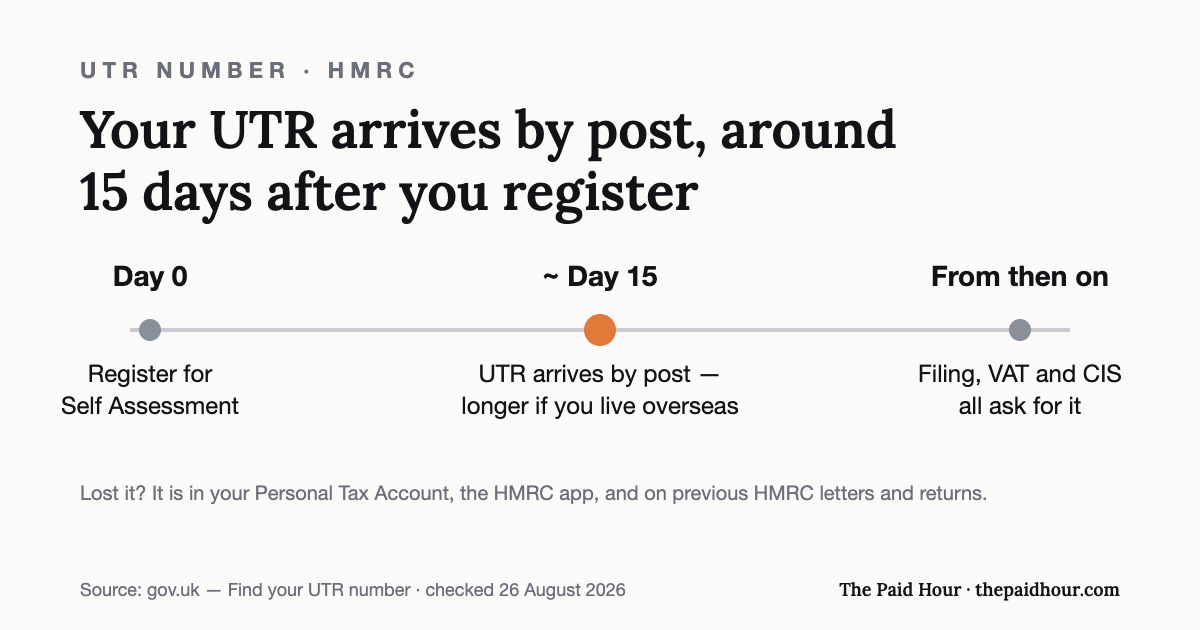
HMRC’s own line, re-checked today: “You’ll usually get your UTR by post around 15 days after you register.” It takes longer if you live overseas. Treat it as an estimate rather than a promise — HMRC publishes a check-when-to-expect-a-reply tool if the wait is dragging on. And if the number is needed for something with its own clock, CIS verification say, the buffer belongs in your plan, not in HMRC’s estimate.
Where to find your UTR, and how to recover a lost one
Three places, in order of speed: the HMRC app, your Personal Tax Account, and any previous tax returns or HMRC documents, notices to file, payment reminders, the welcome letter from when you registered. On paper it usually sits near the top of the page.
If none of those turn it up, contact HMRC’s Self Assessment team and ask. Gov.uk publishes no turnaround time for recovering a lost UTR, so treat it as a this-week job rather than a deadline-day one. A company’s UTR can be re-requested online. And don’t guess or recycle: a UTR from an old partnership or a dissolved company points at a different tax record instead of your current one. Be tight with it, too. HMRC, your accountant and a verifying contractor are the only people with any business asking for it, so treat an unexpected text or email wanting your UTR with suspicion.
On a building site, a UTR is worth 10% of every invoice
CIS, the Construction Industry Scheme, is where this stops being paperwork. Before a contractor first pays you, they verify you with HMRC using your UTR and National Insurance number, and the details must exactly match what you registered with. Registered and verified, the standard deduction from your labour payments is 20%. Unregistered, it’s 30%: on a £2,000 labour invoice, £600 held back instead of £400, before the money reaches you. Gross payment status, for those who qualify, takes deductions to zero.
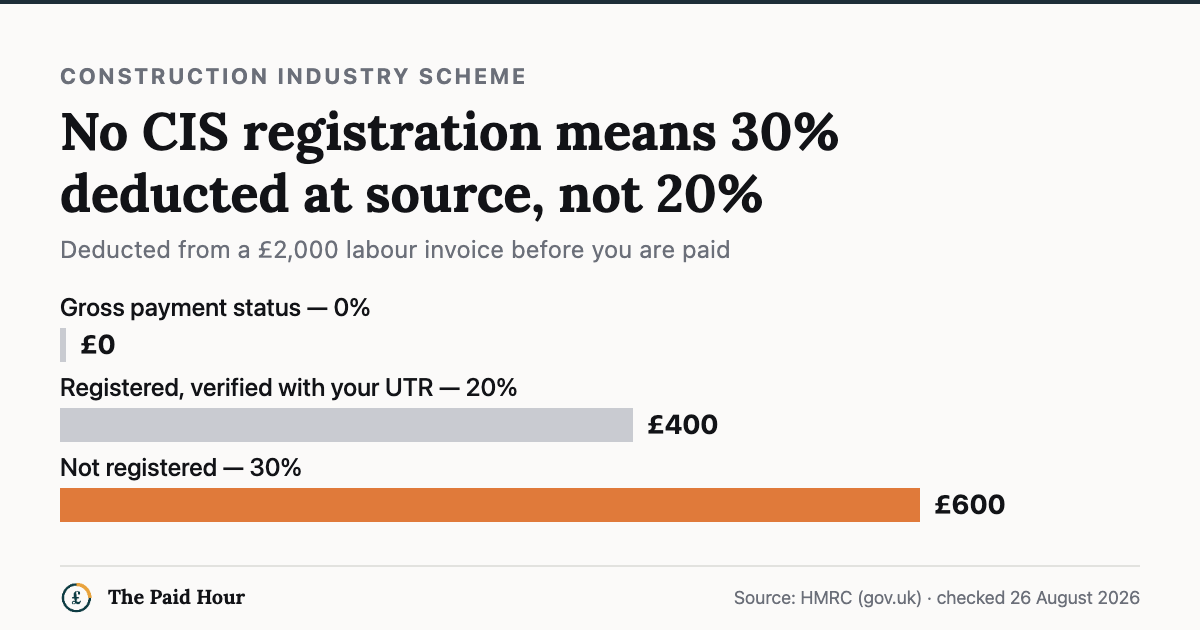
The extra 10% isn’t lost for good, deductions count as advance payments towards your tax and National Insurance bill, so it washes through when you file. But until you file, it’s your cash flow funding the wait. Ten percent of every invoice is an expensive price for not having a ten-digit number ready.
VAT, CIS, and the order to do things in
VAT registration asks for it too, the VAT1 form wants your Self Assessment or Corporation Tax UTR as part of the application. So for a new sole trader the sequence is fixed: Self Assessment first, wait out the fortnight, then VAT if turnover demands it or CIS, with the number in hand. Trying to run those registrations in the other order is how people end up stuck at 30% deductions while a letter crosses the country.
Do you actually owe HMRC anything yet?
Side Hustle Tax Starter 2026/27. A six-module starter course and six working templates that tell you, in an evening, whether you owe anything at all, and set up the twenty-minute monthly routine that keeps it that way.
- The nine badges of trade as questions you can answer about your own income
- What the platforms send HMRC, the small-seller exemption, and three reply letters for when a letter arrives
- A sales log with a running £1,000 alert, an allowance-versus-expenses sheet, and a tax set-aside calculator at 2026/27 rates
Selling platforms now hand your sales data to HMRC once a year. Selling your own old possessions is never taxable. Buying to resell, making things, or freelancing is. Knowing which side you are on is the whole question.
Buying more than one? All ten 2026/27 courses for £107, against £328 at full price.
Having a UTR is not the same as being registered for what you are doing now. Which Self Assessment registration route you need covers when you have to register again.
Read next
- How to File Self Assessment as a Freelancer, Step by Step
- SA1, CWF1 or SA400? Which Self Assessment Registration Route You Need
- Tax Year Dates 2026/27: Every Deadline UK Freelancers Need
- UK Freelancer Tax Calculator 2026/27
- Already File a Tax Return? You May Still Need to Register Again
UTR number: common questions
How many digits is a UTR number?
Ten. HMRC describes the Unique Taxpayer Reference as “a 10-digit number”. It never changes, even if you stop trading and register again years later.
How long does it take to get a UTR number?
You will usually get your UTR by post around 15 days after you register for Self Assessment, and longer if you live overseas. Register well before the 5 October deadline for the tax year you need to file for — leaving it to January is what causes late-filing penalties.
Where can I find my UTR number?
In your Personal Tax Account, in the HMRC app, or on previous tax returns and other documents HMRC has sent you.
Does everyone have a UTR number?
No. HMRC issues one when you register for Self Assessment. If you are employed and taxed entirely through PAYE, you will not have one. A limited company has a separate Corporation Tax UTR, which the director can request online.
Is a UTR the same as a tax reference number?
Not necessarily. “Tax reference” is used loosely. Your UTR is your Self Assessment reference. The employer PAYE reference printed on a payslip or P60 is your employer’s number rather than yours, and a company’s Corporation Tax UTR is different again from the director’s personal UTR.
Checked against GOV.UK — Find your UTR number on 2 September 2026.
Sources
- Find your UTR number, GOV.UK
- Find a lost UTR number: GOV.UK
- Check how to register for Self Assessment — GOV.UK
- CIS: verify subcontractors, GOV.UK
- CIS: make deductions and pay subcontractors. GOV.UK
- What you must do as a CIS subcontractor: GOV.UK
- VAT1 notes (HMRC (PDF)), GOV.UK
The 15-day estimate, the lost-UTR routes, the CIS deduction rates and the 5 October deadline were re-checked against gov.uk on 26 August 2026. General information about how the rules work, not tax advice, the links above go to the primary sources; for your own position, speak to an accountant or contact HMRC.