
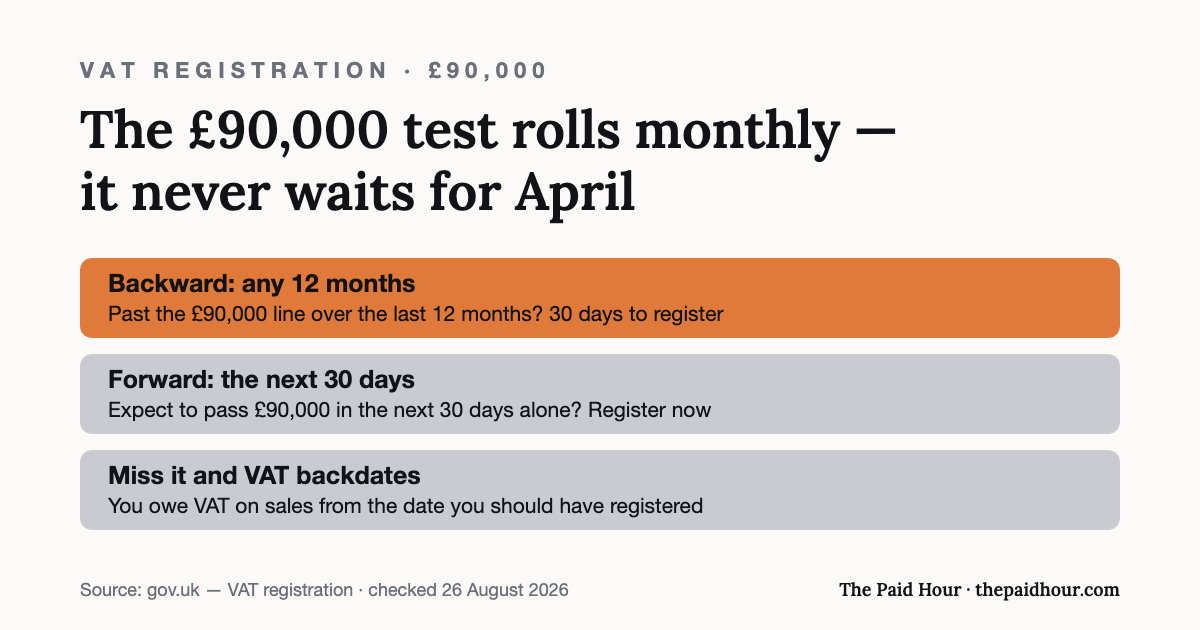
Straight answer: The VAT registration threshold is £90,000. You have to register for VAT the moment your taxable turnover for any rolling 12 months tips past £90,000, or the moment you can see it’s going to, within the next 30 days. The word that causes the most mistakes is “rolling.” It’s not your tax year. It’s not your accounting year. It’s a test against the VAT registration threshold you’re supposed to run every single month, using the 12 months right behind you. Miss it, and you owe VAT on everything you sold from the date you should have registered, out of money that’s already gone.
Table of Contents
The VAT registration threshold is rolling, not your tax year, and that catches almost everyone
Most people assume £90,000 gets measured against something neat, like the tax year or whatever period their accounts run to. It doesn’t work that way. HMRC looks at the last 12 months, counted from wherever “today” happens to be.
Take a designer billing £80,000 across a tax year, sounds comfortably under, right? Not necessarily. If £30,000 of that landed in the final quarter, and the quarter before that (technically in the previous tax year) brought in £65,000, there’s a 12-month window straddling April where the total comes to £95,000. The threshold got crossed inside that window. What either tax year adds up to is irrelevant.
Which is really just a long way of saying: check your trailing 12 months at the end of every month. Two minutes in any accounting tool, or a spreadsheet column if you’d rather. It’s the only way to see the line coming instead of finding out after you’ve crossed it.
Two ways to cross the VAT registration threshold, two deadlines
Looking back. If your taxable turnover for the trailing 12 months goes over £90,000, you must register within 30 days of the end of the month you crossed it. Your effective date of registration lands on the first day of the second month after that.
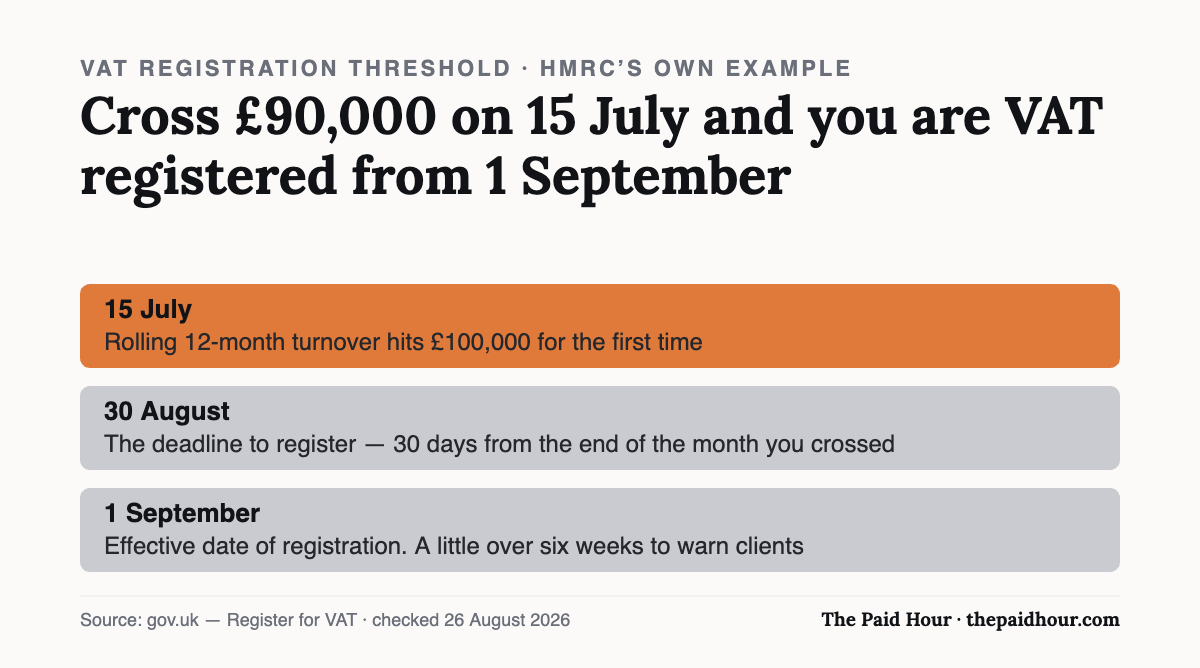
HMRC’s own example: on 15 July, your 12-month turnover hits £100,000 for the first time. Register by 30 August. You’re VAT registered from 1 September. That’s a little over six weeks, enough time to tell clients their prices are about to change.
Looking forward. This one’s harsher and far fewer people know about it. If you realise your turnover is going to go over £90,000 within the next 30 days, you have to register by the end of that 30-day window, and your effective date is the day you realised it instead of the day the money lands.
HMRC’s example: on 1 May you sign a £100,000 contract, to be paid at the end of May. You must register by 30 May. You’re VAT registered from 1 May, the day you signed, not the day you got paid. Anything you invoice in between falls inside your VAT registration.
The practical upshot: if you’re about to sign something that pushes you over, sort the VAT question before you sign rather than after. The moment the pen goes down, the clock’s already running and it started behind you.
What counts as taxable turnover for the VAT registration threshold
Taxable turnover is everything you sell that isn’t VAT exempt or out of scope, and it’s a wider net than most people expect. It includes:
- zero-rated goods: yes, 0% still counts towards the threshold
- reduced-rated and standard-rated goods
- goods you hired or loaned to customers
- business goods you used for personal reasons
- goods you bartered, part-exchanged or gave as gifts
- services from businesses abroad that you had to “reverse charge”
- goods and services under the domestic reverse charge
- building work over £100,000 your business did for itself
The zero-rated point is the one that catches a lot of people. Selling at 0% VAT is not the same thing as selling something exempt, zero-rated sales count in full towards the £90,000, every time.
You don’t need to register at all if everything you sell is VAT exempt or out of scope.
What it costs if you cross it late
Register late, and you have to pay VAT on everything you sold from the date you should have registered. A penalty can come on top, depending on the amount and how late you are.
Read that first sentence again, because it’s the entire risk in one line. You didn’t charge those clients VAT. You still owe it. On £40,000 of sales made during the months you should’ve been registered, that’s up to £6,666 of VAT coming straight out of money you already invoiced, got paid, and spent, unless every one of those clients is willing to accept a late VAT-only invoice after the fact, which plenty won’t.
That’s the actual argument for running the rolling check every month, not just when it occurs to you.
Three ways out of the VAT registration threshold
None of these is the same as changing how you account for VAT once you are registered. That is a separate decision, and the VAT Flat Rate Scheme is the version most sole traders look at first.
- Registration exception. Went over temporarily: one unusual contract, and you expect to drop back under? You can apply for an exception. HMRC considers it and writes back to confirm. Say no, and it registers you anyway.
- Exemption from registration. If most of what you sell is zero-rated, you can ask HMRC for permission not to register at all. You have to ask, it’s not automatic.
- Voluntary registration. You can register below £90,000 by choice. It lets you reclaim VAT on business purchases, and some freelancers do exactly that when their clients are all VAT-registered businesses who don’t care about the extra 20%. If your clients are consumers instead, voluntary registration makes you 20% more expensive overnight.
What to do if you are close to the threshold
- Run the rolling 12-month total at the end of every month — any accounting tool will do it, so will a spreadsheet column.
- Set your own alarm at £75,000 rather than £90,000. Gives you room to plan instead of scramble.
- Before signing anything large, check whether it tips you over within the next 30 days. That’s the trigger that backdates your registration.
- Decide your pricing before you’re forced to. Adding 20% onto consumer prices and absorbing 20% yourself are two very different businesses to run.
- Think you’ve already missed it? Get advice quickly, the bill only grows with every sale you make in the meantime.
Related: if you’re approaching the threshold you’re probably already inside Making Tax Digital, and it’s worth checking which software actually handles VAT returns before you need it in a hurry.
Watching the £90,000 line?
First Year of VAT 2026/27. Eight modules and a four-sheet toolkit that take you from monitoring the threshold to filing a correct first return, without a penalty.
- A rolling twelve-month threshold monitor that warns you before you cross, including the overseas purchases that count
- The flat-rate-versus-standard calculator with the limited cost trader test built in, on your own figures
- Pre-registration reclaims, the twelve mandatory invoice fields, and the price-rise letters for B2B and B2C clients
The £90,000 test runs on any rolling twelve months, not your tax year, and services you buy from overseas count towards it. Plenty of freelancers register late without ever noticing they crossed.
Buying more than one? All ten 2026/27 courses for £107, against £328 at full price.
Sources
- GOV.UK. Register for VAT: when to register
- GOV.UK, VAT exempt and out of scope goods and services
- GOV.UK: Apply for an exception from registering for VAT
- GOV.UK, Late registration penalty (VAT Notice 700/41)
The threshold and both tests were re-checked against gov.uk on 26 August 2026.
Threshold and rules checked 19 August 2026. This is general information, not financial or tax advice. VAT registration has real consequences for pricing and cash flow. Worth talking through with an accountant before you cross the line.