
Straight answer: Simplified expenses are HMRC’s flat rates: from 6 April 2026, mileage is 55p a mile for the first 10,000 business miles (then 25p), and working from home is £10, £18 or £26 a month by hours, with a 25-hour minimum to use it at all. Fixed amounts instead of receipts, and the mileage rise is the news.
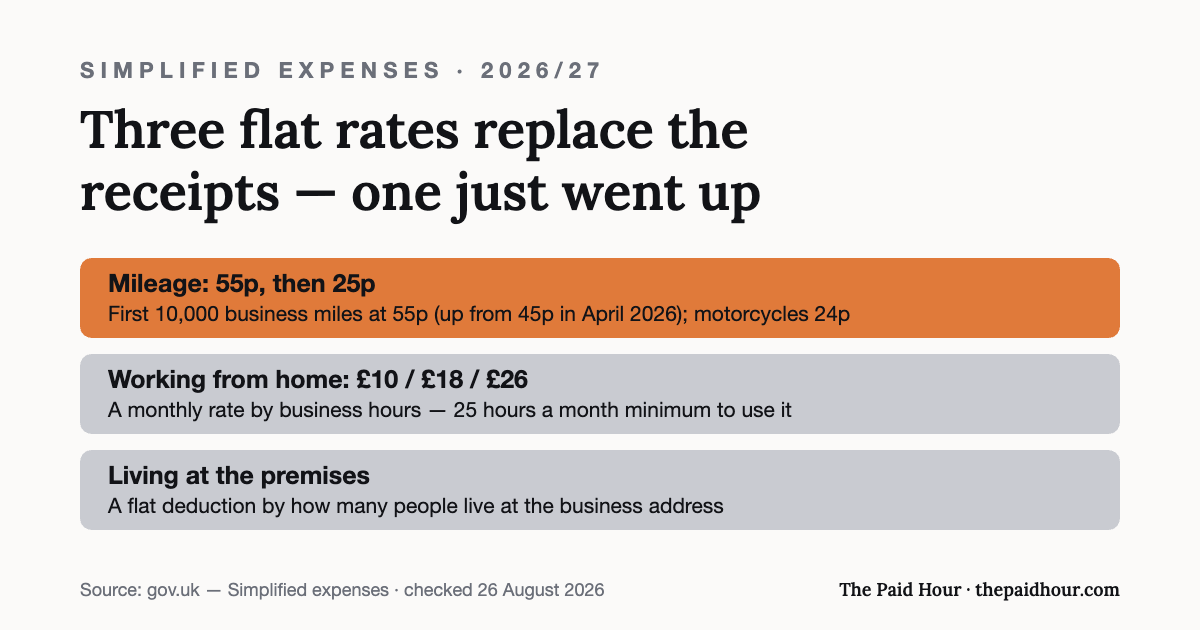
Simplified expenses flat rates let sole traders claim a fixed amount instead of working out actual costs. From 6 April 2026 the mileage rate rose to 55p a mile for the first 10,000 business miles, up from 45p, the first change in years, and worth an extra £1,000 of deduction to anyone doing 10,000 miles. After 10,000 miles it stays at 25p, motorcycles at 24p. Working from home is £10, £18 or £26 a month depending on hours, and you need at least 25 hours a month at home to use it at all.
Table of Contents
Simplified Expenses Flat Rates: The Mileage Rate Went Up and Almost Nobody Noticed
The 45p rate had gone unchanged for so long it had basically become one of those numbers people quote from memory. From 6 April 2026 it’s 55p for the first 10,000 business miles in the tax year.
HMRC’s own worked example, on 11,000 business miles:
- 10,000 miles × 55p = £5,500
- 1,000 miles × 25p = £250
- Total claim: £5,750
Under the old rate the same journeys were worth £4,750. Still working from the 45p figure in your spreadsheet? You’re handing back £1,000 of deduction. Roughly £260 of tax and Class 4 National Insurance for a basic-rate sole trader.
The rate covers everything to do with running the vehicle: fuel, insurance, servicing, repairs, and the cost of buying it. You can’t claim those separately on top.
What the mileage rate doesn’t cover
Two things you can still claim alongside it: other travel, such as train journeys, and parking. Parking’s the one people leave on the table.
Two vehicles you can’t use it for: anything designed for commercial use, black cabs, hackney carriages, dual-control driving instructor cars, and any vehicle you’ve already claimed capital allowances on, or included as an expense when working out profits.
And one rule that catches a lot of people: once you use the flat rate for a particular vehicle, you have to keep using it for that vehicle for as long as it’s in the business. You can’t switch to actual costs in a year when the gearbox goes. Different vehicles can use different methods, just not the same vehicle across different years.
Working from home: the 25-hour gate
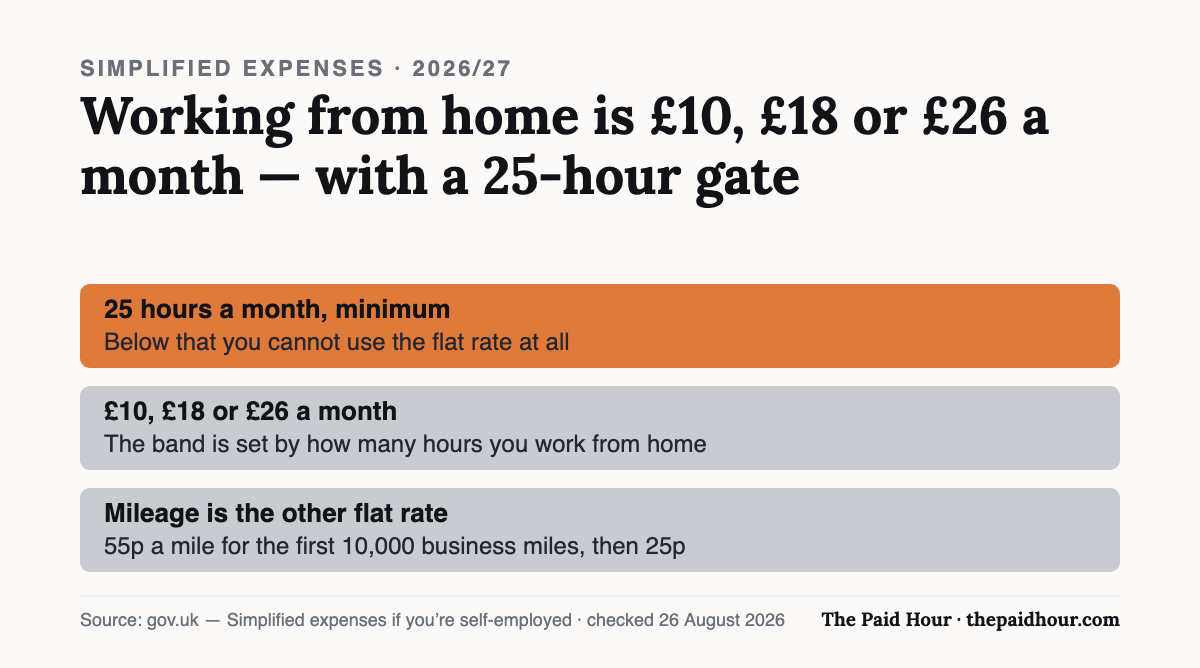
The home flat rate saves you working out what proportion of your gas, electricity and council tax is business use. The rates are per month, based on hours worked at home:
| Hours of business use per month | Flat rate per month |
|---|---|
| 25 to 50 | £10 |
| 51 to 100 | £18 |
| 101 and more | £26 |
Below 25 hours a month, you can’t use this method at all. That’s not a smaller rate, it’s no rate. Occasional home working means working out actual costs, or claiming nothing.
The rates are also monthly and variable, so you count each month separately. HMRC’s example: ten months at 40 hours and two months at 60 hours gives (10 × £10) + (2 × £18) = £136 for the year.
Note the ceiling. Even at 101+ hours a month: effectively full time at home, the most you can claim is £312 a year. For anyone with a dedicated room and a real share of the bills, working out actual costs will often beat that comfortably. The flat rate buys simplicity rather than generosity.
Phone and internet are never included, by the way. They sit outside the flat rate entirely, and you claim the business proportion of those bills by working out the actual cost. Forgetting this is probably the most common way people under-claim.
Who can use simplified expenses at all
- Sole traders: yes
- Business partnerships with no company partners: yes
- Limited companies: no
- Partnerships involving a limited company: no
It’s also optional, and it only covers three things: vehicles, working from home, and living at your business premises. Everything else — stock, software, professional fees, subcontractors, marketing, has to be worked out at actual cost regardless. See what counts as an allowable expense for the rest. These simplified expenses flat rates are open to sole traders and most partnerships rather than limited companies.
The third category, living at your business premises, applies to a small group, guest houses, pubs with accommodation, care homes. Instead of splitting the bills, you deduct a flat amount for your own private use based on how many people live there.
How to decide
HMRC publishes a simplified expenses checker that compares the flat rate against actual costs. It takes a couple of minutes and settles the argument with real numbers instead of instinct. Run the numbers before assuming actual costs win.
As a rough guide from the arithmetic above:
- Mileage: at 55p, the flat rate now beats actual costs for most people running an ordinary car and doing moderate business mileage. It’s far less obviously right if you’ve just bought an expensive vehicle you could claim capital allowances on instead.
- Home: the flat rate suits people who work at home part of the week and don’t want the admin. Full-time at home with a dedicated room? Run the actual-cost calculation before settling for £312.
Whichever you choose, keep the records: business miles driven, hours worked at home each month, and how many people live at any business premises. The flat rate removes the receipts, not the record-keeping.
What to do with this
- Update 45p to 55p wherever it’s written down, spreadsheet, accounting software, invoice template.
- Start logging miles now if you’re not already. Reconstructing a year of journeys in January is how people end up guessing, and guesses are what HMRC challenges.
- Count your home hours honestly against the 25-hour gate.
- Claim phone and internet separately. They’re not in the flat rate.
- Run HMRC’s checker once and then stop thinking about it for the year.
Related: your expense total decides your profit, and your profit decides what National Insurance you owe and which Income Tax band you fall into.
Running everything on flat rates? Worth asking whether you need accounting software at all yet.
Want the whole tax system, not one rule?
HMRC Tax & Expense Mastery 2026/27. Nine modules and eleven working templates that take a UK freelancer from “do I even need to register” to a correct return, with MTD quarters built in.
- Fifteen expense categories, with the trap inside each one (training, clothing, meals, the seven-year pre-trading rule)
- Home and vehicle: flat rate against actual cost, with the £312 break-even worked out and the mileage lock-in rule
- The year-one payments-on-account cash shock, and the routine that stops it landing twice
HMRC does not send a list of what you forgot to claim. Most freelancers leave several hundred pounds of legitimate expenses on the table every single year, and the return still gets filed.
Buying more than one? The Complete Freelancer System, all five for £87, against £215 at full price.
Need this ready-made? → UK Sole Trader Expense Tracker (Excel), HMRC expense categories pre-built (£5.99, instant download)
Sources
- GOV.UK. Simplified expenses if you are self-employed
- GOV.UK, Simplified expenses: vehicles and mileage rates
- GOV.UK: Simplified expenses: working from home
- GOV.UK, Simplified expenses checker
- GOV.UK. Expenses if you are self-employed
The mileage rates were re-checked against gov.uk on 26 August 2026.
Rates checked 19 August 2026 and apply to the 2026/27 tax year. This is general information, not financial or tax advice.