
What matters here: Whether you can write off unpaid invoices was decided long before the client stopped answering, by which accounting basis you are on. On the cash basis, the default since 2024/25, you are only taxed on money that arrives, so an invoice you were never paid was never income and there is nothing to write off. On traditional accounting you were taxed when you raised it, and box 27 gives that tax back once the debt is bad. Either way you are not out of pocket twice; the difference is whether anything appears on the return.
A client has gone quiet, then gone. The invoice is months old and you have stopped expecting it. The obvious next question is whether you can at least get the tax back.
For most sole traders now, the answer is that there is no tax to get back, and that is good news wearing an unhelpful disguise.
On the cash basis, unpaid invoices leave nothing to write off
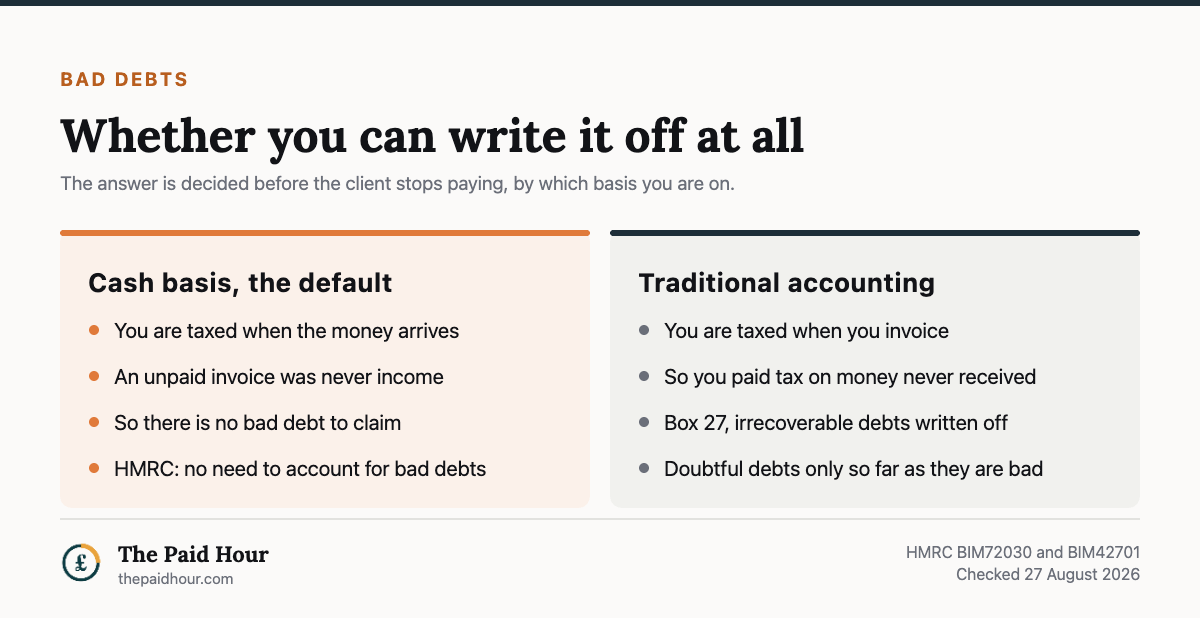
The cash basis counts income when it lands in your account. Raising an invoice does nothing to your taxable profit; being paid does.
So an unpaid invoice never entered the calculation. HMRC puts it in one line: businesses using the cash basis will not need to account for bad and doubtful debts. There is no relief because there was no tax.
People find this unsatisfying, and the reason is emotional rather than arithmetic. A write-off feels like getting something for the loss. It is not. It is a refund of tax you should never have paid. If you never paid it, there is nothing to refund, and you are in exactly the position the write-off would have put you in.
What you have actually lost is the work. No part of the tax system compensates for that, on any basis.
On traditional accounting, unpaid invoices go in box 27
Accruals accounting recognises income when you invoice. That means a January invoice never paid still went into last year’s profit and you paid tax on it.
The correction is a deduction for the irrecoverable debt, which goes in box 27 of the self-employment pages. Section 35 of ITTOIA 2005 is the provision, and HMRC’s manual sets out what it will accept.
Unpaid invoices: bad, doubtful, and the difference
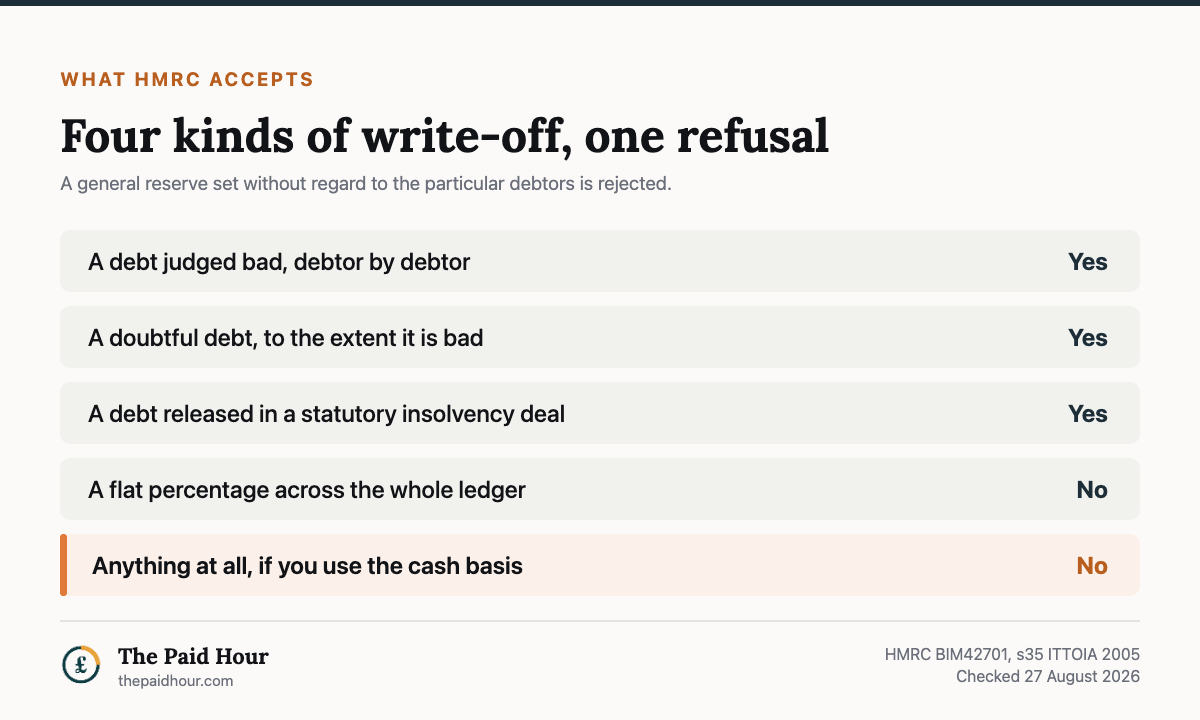
A bad debt is deductible in full. A doubtful debt is deductible to the extent estimated to be bad, which is a more precise instruction than it first appears.
Where a debtor is bankrupt or insolvent, HMRC frames it as the whole debt except anything you can reasonably expect to receive. So if the administrator has indicated 20p in the pound, you write off 80% and wait for the rest.
And there is one thing HMRC explicitly will not take. A general reserve calculated as a percentage of your ledger, made without regard to the circumstances of the particular debtors, is not a deduction. The starting point it does accept is the amount reserved in your own books, provided this is based on a separate valuation of each debt.
Debtor by debtor, in other words, with a reason attached to each. Five percent across the board is a policy, not a judgement.
When are unpaid invoices actually bad debts?
There is no date at which an invoice turns. It is a judgement about recoverability, and the evidence for it is what you did about it.
A debt you chased through reminders, a formal demand and a refusal to engage looks bad. A debt you invoiced once and never mentioned again looks like a debt you have not tried to collect, and that is a harder position to hold if anyone asks. The practical steps are in chasing unpaid invoices.
There is also a hard outer limit worth knowing, because it is not a tax rule at all: the limitation period for chasing a debt. Once that has run, the debt is unenforceable, which settles the recoverability question fairly conclusively.
If they pay you afterwards
It happens more often than you would expect. An administrator makes a distribution, or a client reappears two years later with a conscience.
Money recovered after a write-off goes back into your profits in the year you receive it. That is not a penalty; it is the other half of the same correction. You got relief on the assumption the money was gone, and it turned out not to be.
On the cash basis this needs no thought at all. The payment is income when it arrives, whenever that is.
What about the VAT on unpaid invoices?
If you are VAT registered and used the standard method, you will have paid over VAT on that invoice as well, and there is separate relief for that with its own conditions and its own time limits. It is not part of the income tax write-off and it does not happen automatically.
Two different reliefs, two different rules, two different deadlines. If both apply, deal with them separately rather than assuming one covers the other.
What to keep on unpaid invoices
The invoice, the chasing trail, and one line per debt saying why you concluded it was bad and when. That last item is the whole file, HMRC’s test is a separate valuation of each debt, and a note written at the time is that valuation.
Keep anything from an insolvency practitioner, including the estimated dividend, since that is what fixes the doubtful part. And if you are on the cash basis, keep the record anyway. An unpaid invoice still tells you something about who you should be taking work from. More on the paperwork in what a UK invoice must include, and on the interest you were entitled to in late payment interest.
Client gone quiet on an invoice?
Late Payment Recovery & Legal Safeguards. The seven-stage escalation ladder with dates, every letter written for you, an interest calculator that adds what the law owes you, and the Money Claim Online walkthrough with real fees.
- Reminder letters for stages one to four, then a Letter Before Action that complies with the Pre-Action Protocol (company and individual versions)
- Auto-calculating statutory interest and compensation statement: £40 to £100 per invoice plus interest at base rate plus 8%
- Payment plan with a default clause, particulars of claim wording, hearing bundle index, and the client scorecard that fires slow payers
A solicitor charges around £40 plus VAT for a single letter before action. This is every letter in the sequence, the interest you are legally entitled to claim, and the court route, for one fee.
Buying more than one? The Complete Freelancer System, all five for £87, against £215 at full price.
If the client has gone into administration or liquidation, chasing stops working the normal way. Here is where your unpaid invoice ranks when a client goes bust and what you can still claim.
Sources
- BIM42701: bad and doubtful debts, overview, HMRC Business Income Manual
- BIM72030: cash basis, expenses overview, HMRC Business Income Manual
- Cash basis: overview, GOV.UK
- Self-employment (full) SA103F and notes, GOV.UK
- Expenses if you are self-employed: legal and financial costs, GOV.UK
The statement that cash basis businesses will not need to account for bad and doubtful debts is quoted from HMRC’s Business Income Manual at BIM72030, last updated 21 May 2026. The bad and doubtful debt conditions, the insolvency wording and the rejection of a general percentage reserve are from BIM42701, last updated 4 August 2026, which cites section 35 ITTOIA 2005. The VAT bad debt relief mentioned here has its own separate conditions and time limits which are not covered on this page. All pages read on 27 August 2026. This is general information about how the rules work, not tax advice. Check your own position with HMRC or an accountant before you file.