
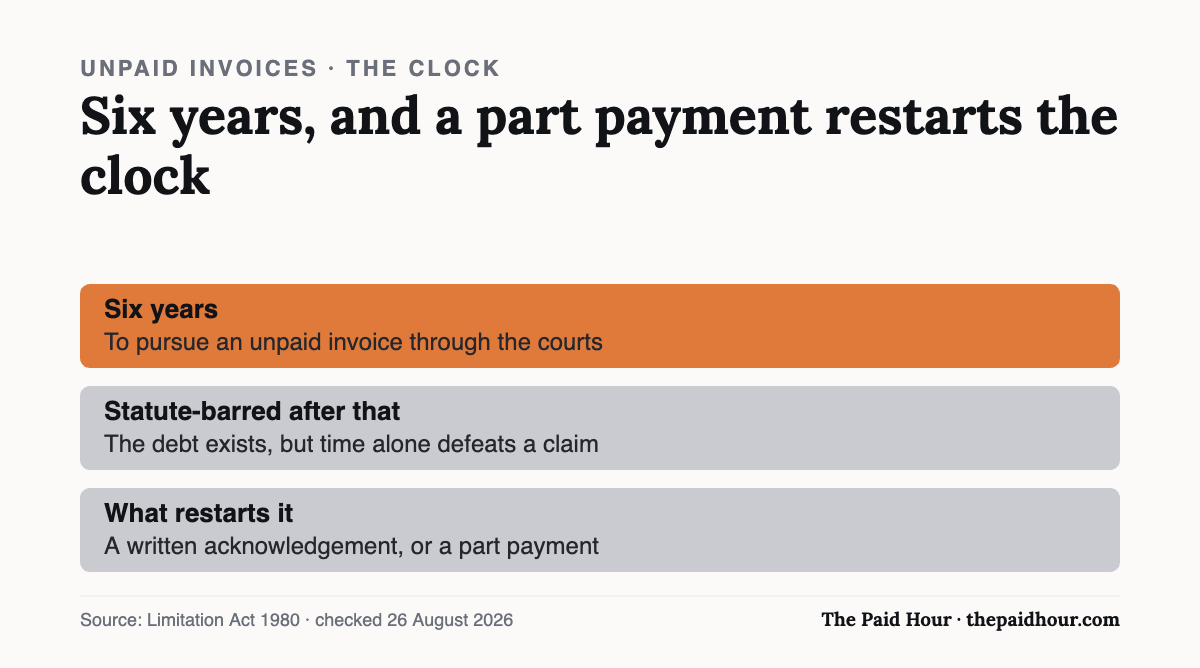
Before you read on: In England, Wales and Northern Ireland you can pursue an unpaid invoice through the courts for six years from the date it fell due. After that the debt is statute-barred, it still exists, but the client can defeat a claim on time alone. A written acknowledgement or a part payment within those six years restarts the clock from that date. In Scotland the period is five years.
Table of Contents
How long can you chase an unpaid invoice? Most guides on chasing unpaid invoices focus on the first 90 days: reminder emails, late payment interest, maybe a solicitor’s letter. Nobody talks much about what happens if a client still hasn’t paid a year later. Or three years later. There’s a real legal cut-off, and once you pass it, the debt doesn’t just get harder to collect, it becomes legally uncollectable through the courts.
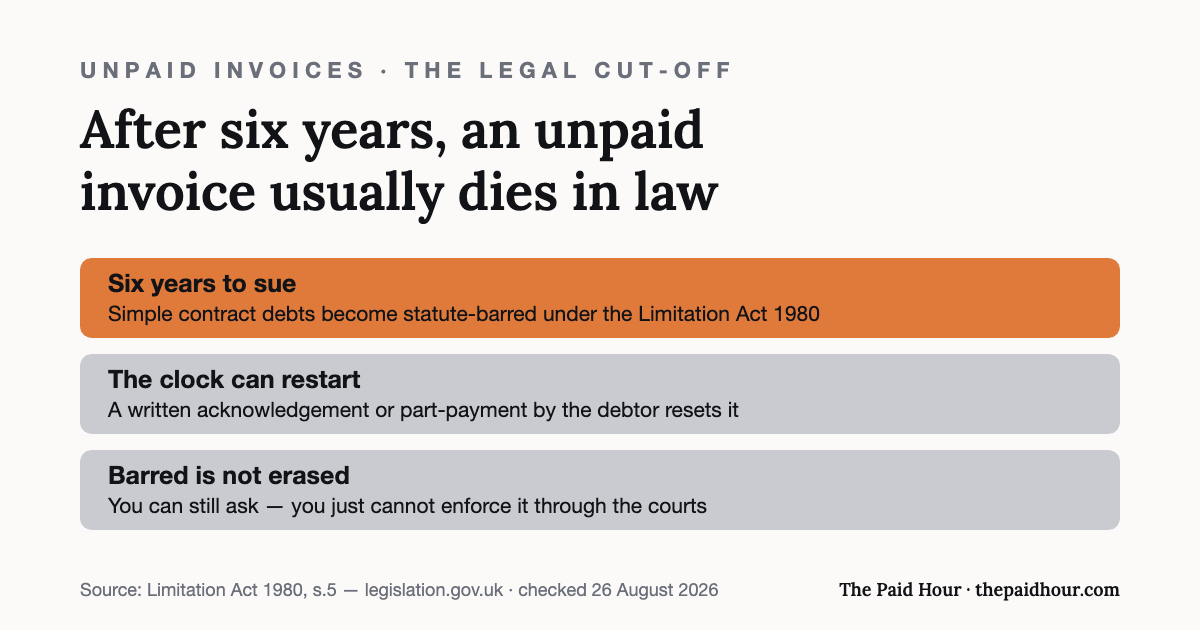
The six-year rule on an unpaid invoice
Under the Limitation Act 1980, a simple contract debt in England and Wales, which is what an unpaid invoice normally is. Can be pursued through the courts for up to six years. After that, the debt is described as “statute-barred”: it still technically exists, but a court claim can be defended successfully on the basis that too much time has passed, regardless of whether the client owes the money.
The same six-year period applies in Northern Ireland. Scotland is different: there the rule is the five-year “short negative prescription” under the Prescription and Limitation (Scotland) Act 1973, so a Scottish client’s unpaid invoice runs out a year sooner than an English one. The six years generally runs from the date the debt became due, usually your invoice due date, not the invoice issue date, if your payment terms set a later deadline.
What can reset the clock on an unpaid invoice
The six-year period isn’t always a straight countdown from the original due date. It can restart if the debtor does something that amounts to acknowledging the debt in writing, or makes a partial payment against it, but only if that happens within the original six years. HMRC’s own manual puts it plainly: once the debtor acknowledges the debt in writing or part-pays inside the limitation period, “the time limits start to run again from the date of acknowledgement or the date of payment.”
An acknowledgement that arrives after the six years have already run out revives nothing. A client emailing “we know we owe you this, we’ll sort it next month” can, in effect, reset the clock, which is one reason it’s worth keeping any written acknowledgement of a late invoice on file, even an informal one.
Why this matters before you hit the limit rather than after
In practice, almost no freelancer should be planning around a six-year window. An invoice that’s still unpaid after 90 days is already a serious collection problem, and the practical value of debt goes down the longer it sits, clients close businesses, directors become harder to trace, and evidence gets harder to pull together the further back it goes. The six-year rule matters less as a strategy and more as a backstop worth knowing about: if you’re sitting on an old unpaid invoice you’d assumed was a write-off, it’s worth checking the date before assuming there’s nothing left to do.
A worked example
Say you invoiced a client £1,800 in March 2021, with 30-day payment terms, so the debt fell due in April 2021. If nothing has happened since then, no payment, no written acknowledgement, no correspondence, the six-year limitation clock runs out around April 2027. Once that date passes, you can still ask for the money informally, but you’d lose the ability to win a County Court claim if the client simply argued the debt was statute-barred.
Now change one detail: suppose that same client emailed you in January 2024 saying “sorry, this slipped through the net, we’ll get it paid.” That written acknowledgement restarts the six-year period from January 2024, giving you until roughly January 2030. It’s a small detail that makes a real difference to whether an old invoice is still worth pursuing formally, which is exactly why it’s worth checking your email history before writing an old debt off as a lost cause.
What to do with an unpaid invoice that’s getting old
- Work through the ordinary escalation first: our guide to chasing unpaid invoices in the UK covers the sequence. Then send a formal written demand referencing the specific invoice number, amount, and original due date: this creates a clear paper trail if you do end up in court.
- Consider Money Claim Online for straightforward debts under £10,000 instead of instructing a solicitor, which is often disproportionate for freelancer-sized invoices.
- Add statutory late payment interest and compensation where it applies, see our guide on what UK freelancers can legally charge for late payment for the actual rates.
- Don’t let a debt drift past the six-year mark by accident, if court action is on the table, get it moving well before the limitation period runs out, since court processes themselves take time.
So, how long can you chase an unpaid invoice in practice? Right up to the six-year cut-off, provided you’ve kept the paperwork that proves the debt was owed and when it fell due.
This is general information about how the limitation period works rather than legal advice for a specific dispute — for anything contested, or a debt worth pursuing formally, it’s worth a short conversation with a solicitor before you file a claim.
The same six-year window works in both directions. It is why professional indemnity cover has to be kept for six years after you stop trading.
Client gone quiet on an invoice?
Late Payment Recovery & Legal Safeguards. The seven-stage escalation ladder with dates, every letter written for you, an interest calculator that adds what the law owes you, and the Money Claim Online walkthrough with real fees.
- Reminder letters for stages one to four, then a Letter Before Action that complies with the Pre-Action Protocol (company and individual versions)
- Auto-calculating statutory interest and compensation statement: £40 to £100 per invoice plus interest at base rate plus 8%
- Payment plan with a default clause, particulars of claim wording, hearing bundle index, and the client scorecard that fires slow payers
A solicitor charges around £40 plus VAT for a single letter before action. This is every letter in the sequence, the interest you are legally entitled to claim, and the court route, for one fee.
Buying more than one? The Complete Freelancer System, all five for £87, against £215 at full price.
Sources
- Limitation Act 1980, section 5, actions founded on simple contract
- Limitation Act 1980, section 29. Fresh accrual of action on acknowledgment or part payment
- HMRC, IHTM28384: statute-barred debts and the Limitation Act 1980
- Prescription and Limitation (Scotland) Act 1973, section 6: five-year prescription
- GOV.UK, Make a court claim for money
Reviewed 26 August 2026, the six-year limitation window and the statutory interest mechanics are as linked in the sources. The six-year rule is sourced to the Limitation Act 1980, s.5, linked above; verified when this guide was published, 25 August 2026.
Checked against the legislation and HMRC guidance on 25 August 2026. General information about how the limitation period works, not legal advice on a specific dispute, for anything contested, or a debt worth pursuing formally, speak to a solicitor before you file.
Need an invoice that’s already sorted?
Editable, HMRC-compliant invoice templates, no subscription.
Browse templatesRead next
- Letter Before Action: 30 Days or 14, Depending Who Owes
- Small Business Commissioner: Free, 12 Months, Not Binding