
The one-paragraph answer: What a UK invoice must include: a unique number, your name and address, the customer’s name and address, a clear description, both the supply date and the invoice date, and the total. Sole traders must also show their own name alongside any trading name, plus an address where legal documents can be delivered. VAT-registered? A VAT invoice has to show more.
Table of Contents
An invoice isn’t just a formality. It’s the document that starts the payment clock, and a vague one gives a slow payer somewhere to hide. So: how to write an invoice in the UK, what the law demands of it, and what to put on it that isn’t required but gets you paid sooner.
What a UK invoice must include: the legal minimum
The required elements. Source: GOV.UK.
GOV.UK sets out what a UK invoice must include:
- A unique identification number
- Your name, address and contact information
- The name and address of the customer you’re invoicing
- A clear description of what you’re charging for
- The supply date: when the goods or service were provided
- The invoice date
- The amounts being charged
- VAT, if you’re registered
- The total amount owed
Full detail on minimum contents of an invoice. Billing the same client on a schedule? Recurring invoices for retainer clients covers keeping one clean number series while the amount repeats.
How to write a UK invoice: the nine elements, in place
The list above is what the rules say. This is what it looks like on the page, a sole trader, not VAT registered, invoicing a limited company for two pieces of work.
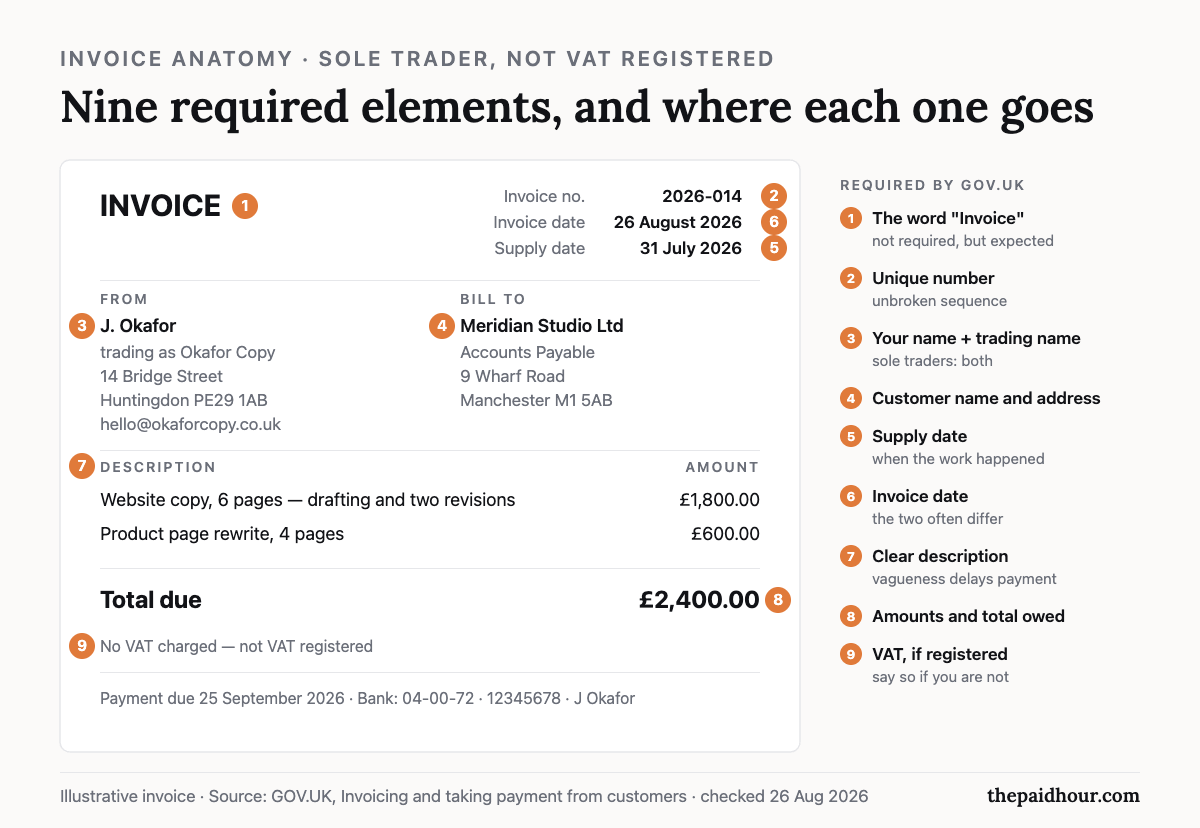
Two things on that specimen are worth pausing on. The supply date and the invoice date are separate fields, and on a job finished in July but invoiced in August they differ, which matters, because the payment clock and your accounting records can hang off different ones. And the description says what was delivered, not “consultancy” or “services rendered”. A finance department that cannot match a line to a purchase order does not query it; it parks it.
If you’re a sole trader
Two extra requirements: your own name as well as any business name you trade under, and an address where legal documents can be delivered.
That address requirement is the one that goes wrong for a lot of people. If you’d rather not put your home address on every invoice, the usual workarounds are a registered-office or virtual-address service, or a PO box that accepts service of documents. Whatever you use, documents have to be able to reach you there.
UK invoice numbering: keep it boring
The number needs to be unique, and the sequence should be unbroken. 2026-001, 2026-002 is fine. Don’t restart at 1 each month, don’t skip numbers, and don’t reuse one after cancelling, raise a credit note instead. Gaps invite questions you won’t enjoy answering two years later.
Not required, but it gets you paid faster
- The due date as an actual date. “Due 18 September 2026” beats “net 30”, which people tend to read as “sometime next month”.
- Bank details, prominently. Sort code, account number, account name. A surprising share of late payments are just a missing account number.
- A purchase order number, if the client uses them. Some finance systems won’t process an invoice without one, and nobody will tell you, it’ll simply sit there.
- A line noting that statutory interest may be charged. It applies regardless, but saying so upfront makes the later conversation easier.
- The word “Invoice” at the top. Obvious, and still missing from plenty of them.
When to send a UK invoice
The day the work is delivered. If the contract’s silent, payment is due 30 days from the later of delivery or the customer receiving the invoice, so every day you delay sending is a day added to your own wait.
Send it to the person who pays, not just the person who hired you. Ask for the accounts email at the start of the job rather than after the first chase.
If you don’t put a due date on it, when do they have to pay?
Thirty days. GOV.UK is blunt about it: unless you agree a payment date, the customer must pay within 30 days of getting the invoice or the goods or service, whichever comes first. There is no grace period hiding behind that, and no requirement that you chased them first.
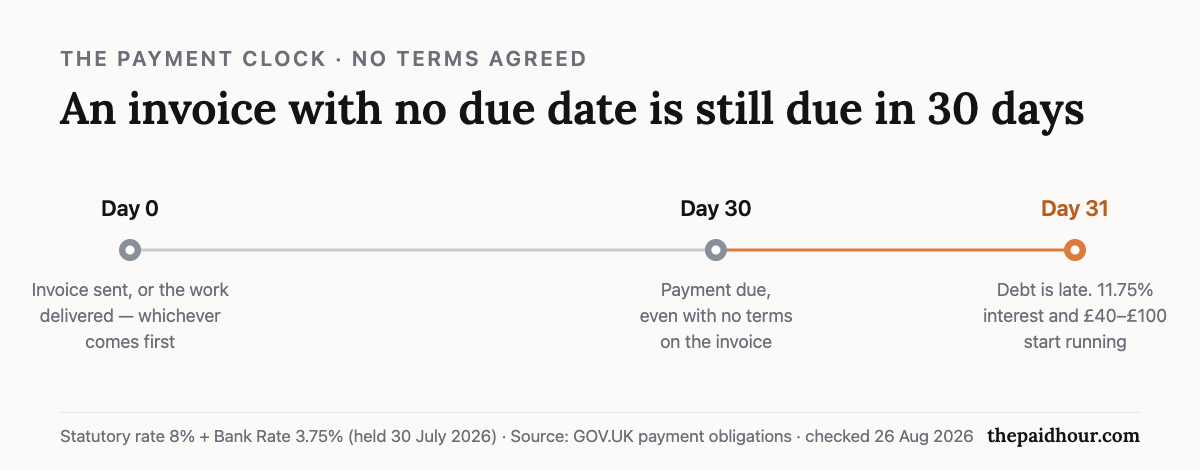
So an invoice with no terms on it is not an invoice with no deadline. It is an invoice with a deadline the client did not choose. That is the opposite of what most freelancers assume, and it is why the “I never specified, so I can’t really complain” instinct is wrong. Once the 30 days pass, the debt is late, and statutory interest and fixed compensation start running whether you claim them or not.
Put a real date on anyway. Not because the law needs it, but because “Due 25 September 2026” removes the one excuse that costs nothing to use.
Keeping UK invoice records
Copies of invoices raised and received need to be kept for at least five years after the 31 January filing deadline for that tax year. If Making Tax Digital applies to you, they need to be digital, in compatible software, see what Making Tax Digital changes.
And when an invoice does go past its due date, you’ve got more use than most freelancers use, see what you can legally charge on a late payment.
Your MTD ITSA start date is decided by an earlier tax year’s qualifying income. Source: HMRC, checked 19 August 2026.
If most of your admin is invoices rather than accounts, an invoicing-first tool can carry it, the FreshBooks review covers the best-known one.
One thing the legal minimum does not spell out: a deposit is its own payment and needs its own invoice with its own number. What that invoice has to show, and when the money counts for tax, is in invoicing deposits and part-payments.
If you are thinking of adding a card fee to the total, check who you are billing first: surcharging a consumer for a normal card has been unlawful since 2018. The rule, and what each processor actually takes, is in card payments for freelancers.
Need an invoice that has every mandatory field?
HMRC-compliant invoice templates. Five editable, HMRC-compliant invoice designs, each with the mandatory fields, bank details block and payment terms laid out so nothing gets queried.
- Every field a UK invoice must legally carry, already in place
- Editable in minutes, no subscription, yours to keep
- Five designs, from plain to corporate, for £13.49 as a set or £4.49 each
- Free download: Cross-Border Invoice Wording Pack
A missing field is the most common reason an invoice gets “queried”, and a queried invoice goes to the back of the payment run.
Want the invoicing system as well as the document? The Freelance Ops Playbook covers proposals, contracts, onboarding and chasing, with 18 templates, for £35.
Need this ready-made? → 5 HMRC-ready UK invoice templates (editable): £4.99 each
Sources
- GOV.UK — Invoicing and taking payment from customers: what invoices must include
- GOV.UK, Payment obligations
The required-fields list re-checked against gov.uk on 26 August 2026.
Checked against GOV.UK guidance on what a UK invoice must include, 19 August 2026. General information, not legal or tax advice.
Read next
- Proforma Invoice: Not an Invoice, and No 30-Day Clock
- VAT Invoices: What Changes Once You Register
- Invoicing Deposits: Refundable Is Still Taxable
- Recurring Invoices for Retainer Clients: Set Up Right