
Table of Contents
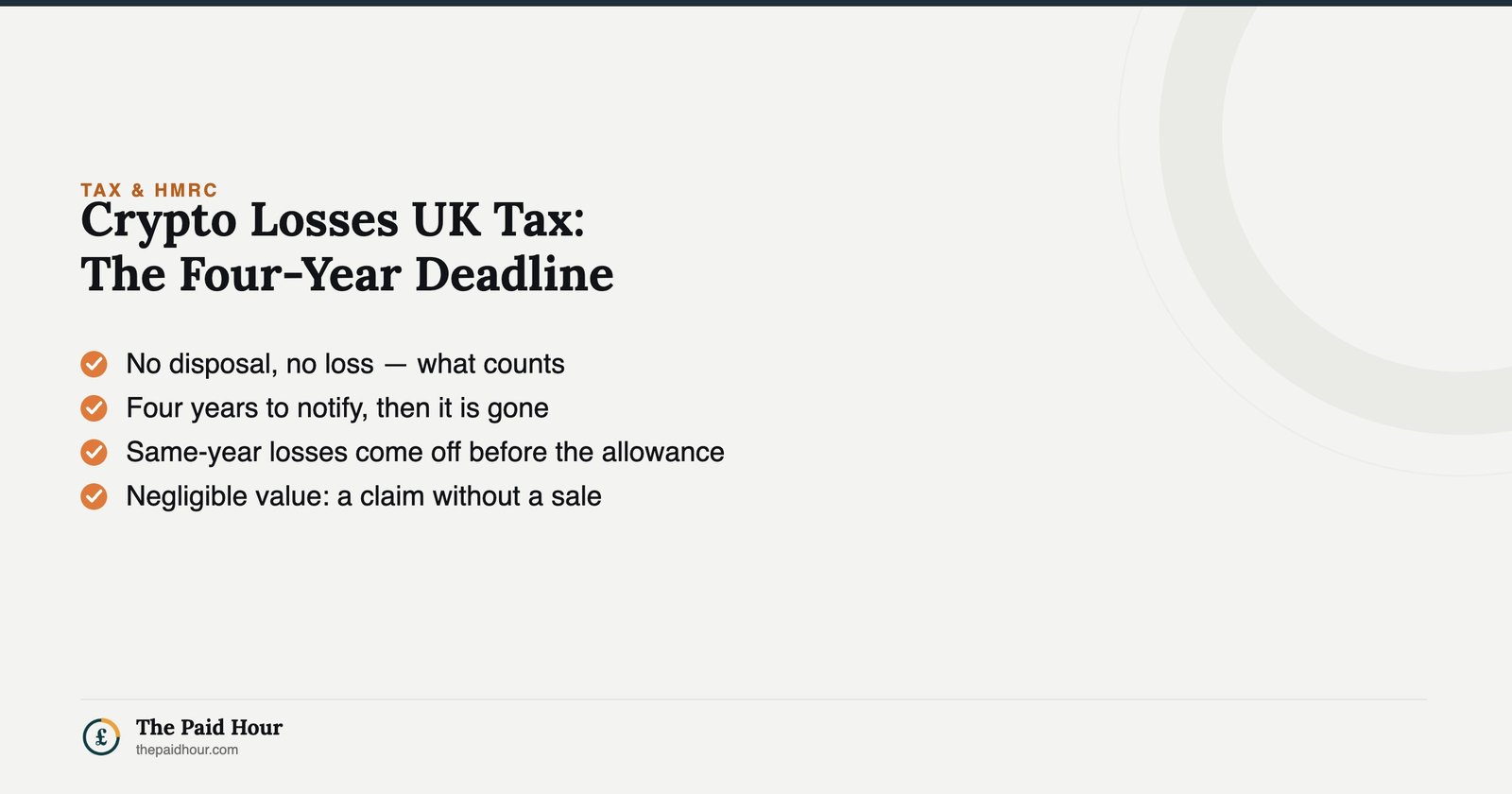
Crypto losses UK tax relief only works if you claim them the right way, miss the four-year window and a genuine loss simply stops counting.
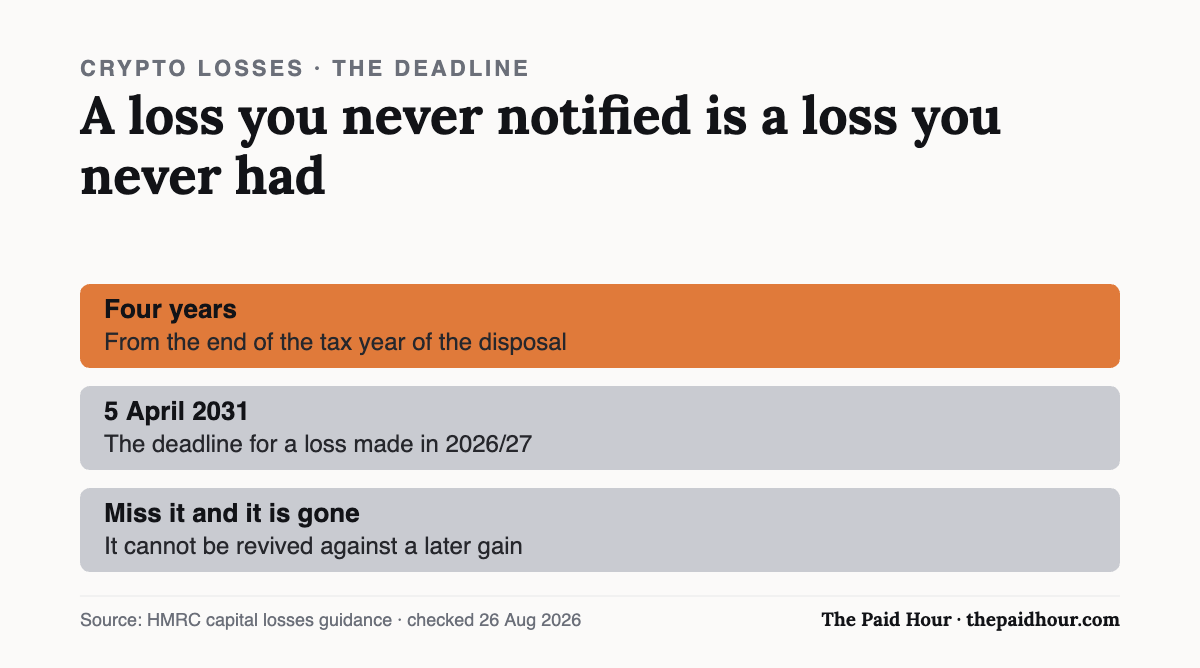
Before you read on: A crypto loss is only worth something if you tell HMRC about it, and you have four years from the end of the tax year of the disposal to do it. Miss that and the loss is gone, it cannot be revived against a later gain. A loss made in 2026/27 has to be notified by 5 April 2031.
Most people treat a crypto loss as money gone and never mention it again. How crypto losses are taxed in the UK is closer to how a loss on shares is taxed: something you can set against gains, carry forward, and use to shrink a real bill, as long as you notify it in time.
That matters more now than it did. The Capital Gains Tax annual exempt amount is £3,000 for 2026/27, down from over £12,000 a few years ago, so gains that used to vanish under the allowance now produce a bill. An unclaimed £5,000 loss is up to £1,200 of tax paid for no reason.
Crypto losses need a disposal
No disposal, no loss, however far the price has fallen. Selling below cost is a disposal. So is swapping one token for another, spending crypto on goods or services, and giving it to anyone who is not your spouse or civil partner. Each of those crystallises a loss the same way it would crystallise a gain. That distinction is exactly where crypto losses UK tax claims go wrong most often.
Holding a coin that is down 95% is not a loss. You still own it. Two things people expect to count and do not: watching the price fall while you hold, and losing access to a wallet. HMRC’s Cryptoassets Manual is explicit that a lost private key is not a disposal on its own, the tokens still exist, you simply cannot reach them.
Crypto losses: the four-year window
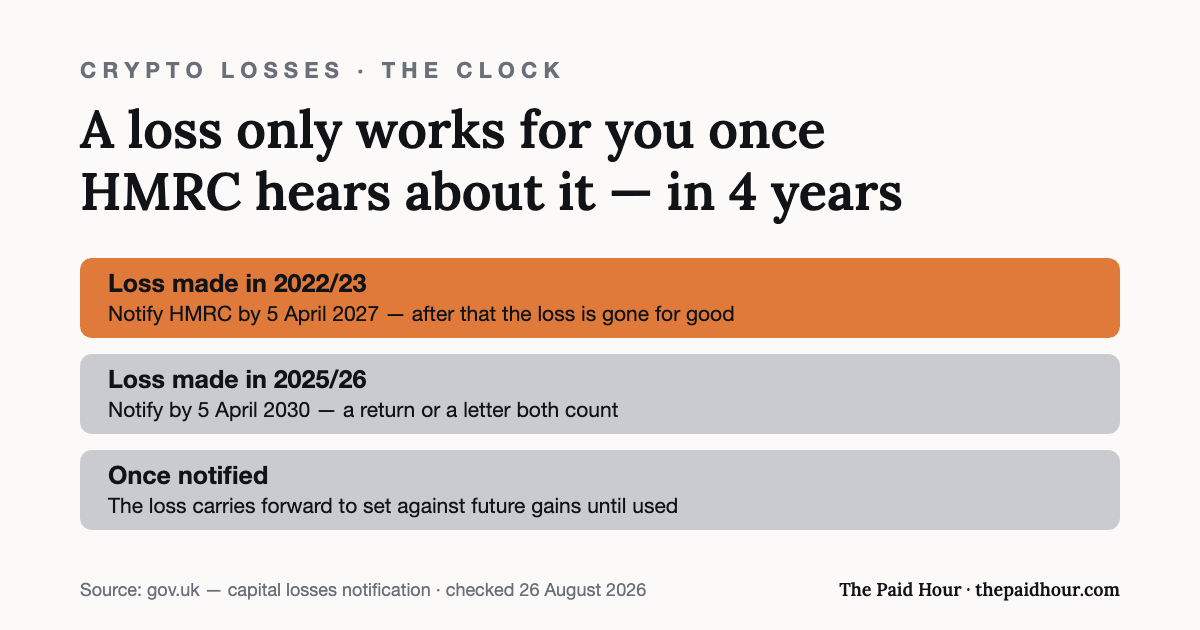
This is where the money actually goes missing. gov.uk sets the limit plainly: “you can claim up to 4 years after the end of the tax year that you disposed of the asset.”
| Tax year of the disposal | Notify HMRC by |
|---|---|
| 2023/24 | 5 April 2028 |
| 2024/25 | 5 April 2029 |
| 2025/26 | 5 April 2030 |
| 2026/27 | 5 April 2031 |
Four years sounds generous, and it is. It is also the single easiest thing to let slide, because a loss in a year with no gains feels like nothing to report. It is not nothing. Notifying is what puts the loss on the record; a loss you never mentioned is not held in reserve, it is simply unclaimed, and the clock runs from that year’s end whether or not you had a gain to use it against.
Claiming crypto losses UK tax relief means putting the loss on the right form. If you already file a return, the loss goes on the Capital Gains pages alongside everything else. If you have never made a gain and are not registered for Self Assessment, HMRC accepts a letter instead.
The order crypto losses are used, which you do not choose
A loss from the same tax year comes off the gain before the annual exempt amount does. You cannot hold it back to protect your allowance. Only what survives that deduction meets the £3,000.
Say you made £8,000 of gains selling ETH in December 2026 and lost £5,000 earlier the same year on a coin that cratered. The loss comes off first: £8,000 minus £5,000 leaves £3,000, which the annual exempt amount covers in full. Nothing to pay. Skip the loss and you are paying 18% or 24% on £5,000 you did not need to declare as taxable.
Losses brought forward from earlier years behave differently, and better. They are only used once current-year gains are already above the allowance, and only down to it, never below. Whatever is left carries forward again to a future year. The four-year clock is about notifying the loss rather than about spending it.
Negligible value claims: a loss without a sale
Most sole traders do not know this exists. If a token you still hold has become worthless (a dead project, a rug pull, an exchange token for a platform that no longer operates), you do not have to find a buyer for something nobody wants in order to claim the loss.
This is one of the more overlooked crypto losses UK tax moves. A negligible value claim asks HMRC to treat the asset as sold and immediately reacquired at its actual value, which can be nil. The claim has to name the asset, the value you are treating it as disposed of for, and the date of the deemed disposal. You can make the claim and report the resulting loss on the same return.
One structural point. Because holdings of the same token sit in a pooled Section 104 holding, the pool is the asset, so a claim covers the whole holding of that token rather than hand-picked units within it.
The bar is “no reasonable prospect of any value”, not “down 90%” and not “I have stopped checking”. A coin that has crashed but still trades somewhere, even at a fraction of a penny, is generally not negligible value. Delisted, gone dark, contract abandoned, that is what the relief is for.
What does not qualify, even though it feels like it should
- Buying high and holding. Nothing has been disposed of, so there is nothing to claim yet.
- Losing the device or the key, without a genuine negligible value case. The tokens still exist and you are still treated as owning them.
- Transfers to a spouse or civil partner. Those happen on a no gain, no loss basis.
- Gifts to family. A loss on a gift to a connected person can generally only be set against gains on transactions with that same person.
Being scammed sits in a murkier category than any of these, and it turns on facts instead of on a rule. Worth an accountant reading the specifics rather than assuming either way.
When it is not a capital loss at all
If you are mining or staking as an actual business rather than a hobby, losses there sit in trading income instead of capital gains. Different rules, different pages of the return, and they can potentially reduce other business profits rather than crypto gains specifically. Which side you are on is decided by the trade test, covered in the guides to crypto mining tax in the UK and crypto tax for sole traders.
Get the category wrong and you end up trying to set a capital loss against Income Tax, which HMRC will reject.
The records a crypto losses claim needs
Exchange statements, wallet addresses, the date of each disposal and the sterling value at that moment. HMRC can ask for evidence of a loss exactly as it can ask for evidence of a gain, and a recollection that it was “around this much” does not survive a question. A running spreadsheet beats a January scramble, the same way it does for any other side income you have to declare.
Three questions about crypto losses before filing
Can a crypto loss reduce my sole trader profits? No. A capital loss reduces capital gains only. It does not touch the Income Tax on your business profits, even in a year the crypto side hurt more than the business did.
Do I report a loss in a year with no gains? Yes, and this is the one most often skipped. Reporting is what starts the clock in your favour.
I already filed without the loss. Now what? A return can usually be amended within twelve months of the filing deadline, a shorter window than the four-year rule. Outside it, notify the loss separately in writing, referencing the year it arose.
Whether a disposal produces a loss at all depends on how it is matched: the same-day and 30-day rules run before the pool average, and a repurchase inside 30 days can erase the loss entirely.
Never actually computed a Section 104 pool?
UK Crypto Tax for the Self-Employed 2026/27. Seven modules and a four-sheet toolkit that computes a Section 104 pool properly and separates what is capital gains from what is income.
- A pool calculator that carries the running average cost and computes the gain on every disposal, same-day and 30-day rules applied first
- The disposals people miss: crypto-to-crypto, spending it, gifting it
- Losses, negligible value claims for dead tokens, and the record pack HMRC expects you to hold for five years and ten months
Under the Cryptoasset Reporting Framework, exchanges have been collecting and reporting UK users’ data since 1 January 2026. The rules did not change. HMRC just stopped having to guess.
Buying more than one? All ten 2026/27 courses for £107, against £328 at full price.
Sources
- gov.uk, Capital Gains Tax: losses
- gov.uk: Capital Gains Tax rates
- HMRC Cryptoassets Manual CRYPTO22400 — losing private keys
- HMRC Cryptoassets Manual CRYPTO22500, negligible value claims
- HMRC Capital Gains Manual CG10308. Time limits for claims
- gov.uk, Self Assessment tax returns: corrections
The four-year notification window was re-checked against gov.uk on 26 August 2026.
Every rule and figure above was checked against gov.uk on 25 August 2026. This is general information about how HMRC treats losses on cryptoassets, not tax advice, and nothing here is investment advice or a recommendation to buy, sell or hold any cryptoasset. For your own circumstances, speak to an accountant or contact HMRC directly.
Whatever your situation, get crypto losses UK tax claims in writing to HMRC before the four-year deadline passes, a verbal mention to your accountant is not the same as a filed claim.