
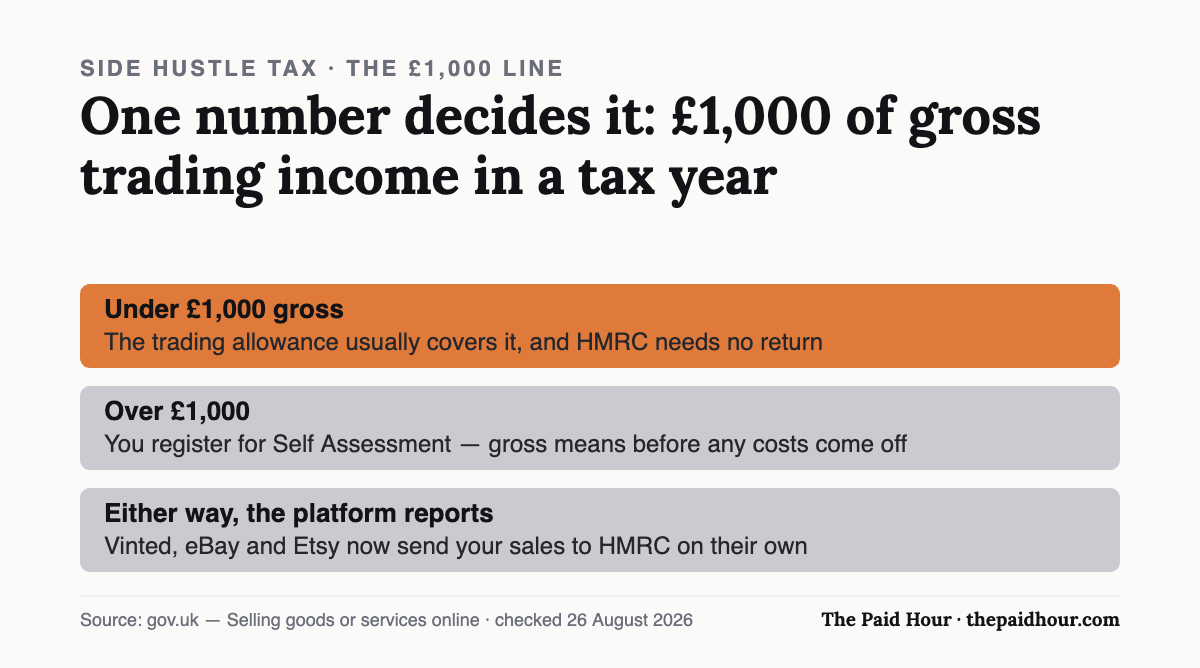
In short: One number decides it: £1,000 of gross trading income in a tax year. Under that, the trading allowance usually covers you and HMRC needs no return. Over it, you register for Self Assessment, and the platforms you sell through now report your sales to HMRC on their own.
Side hustle tax UK rules come down to one number. A 9-5 plus something on the side (reselling, freelance design in the evenings, dog walking at weekends), raises one real question, and it isn’t “is this taxable in theory.” It’s “does my situation, right now, need telling to HMRC.” Here’s the honest, numbers-based answer.
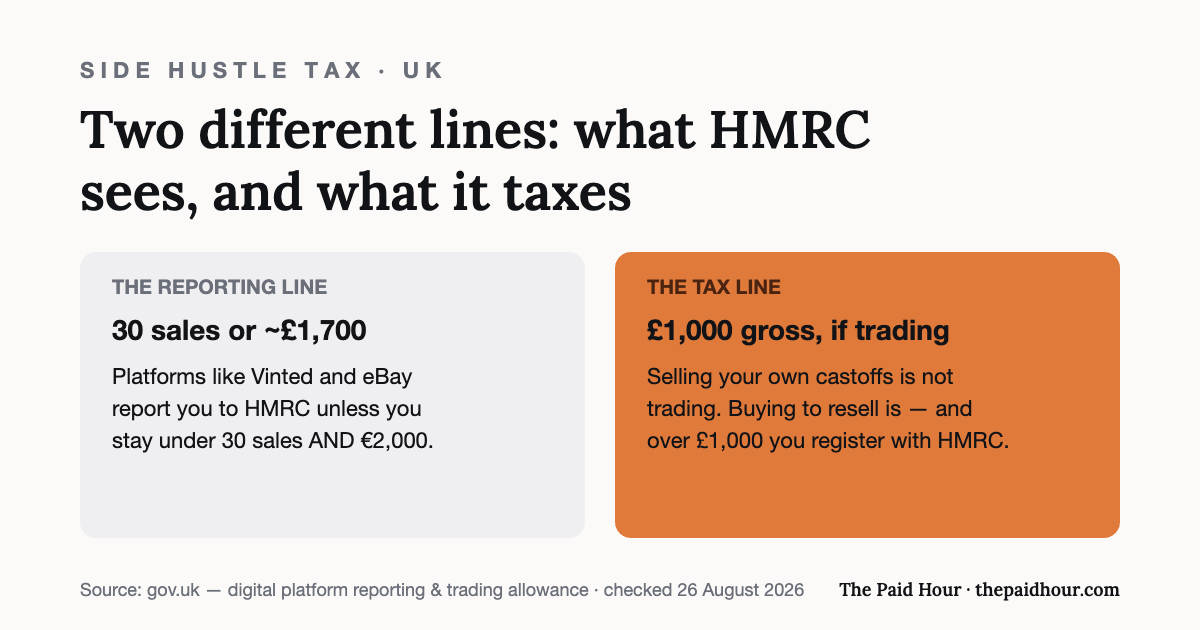
Side hustle tax: do I need to declare my income?
It depends entirely on how much you’re bringing in, gross, before any costs.
If your side income is £1,000 or less in a tax year (6 April to 5 April), you generally don’t need to tell HMRC about it or register as self-employed at all. This is thanks to the trading allowance, a tax-free amount that covers small-scale trading income automatically (gov.uk). We’ve covered exactly how that allowance works, including some edge cases, in our dedicated guide: the £1,000 trading allowance explained. Worth reading if you want the full mechanics rather than just the headline rule.
There are exceptions to that “don’t need to tell HMRC” rule, for example, if you already have other untaxed income above certain limits, or your circumstances mean you’re required to file a return for other reasons. If anything about your situation feels borderline, HMRC’s own guidance is the place to check instead of a guess.
What counts as a “hobby” vs a taxable side hustle?
This is where it usually goes wrong. Occasionally selling a few unwanted items on Vinted or Facebook Marketplace isn’t trading: it’s just decluttering, and it isn’t taxable regardless of amount. But regularly buying or making things with the intention of selling for profit, or regularly offering a service for payment, is trading in HMRC’s eyes, even if you never registered a “business” or called yourself self-employed. The full test HMRC applies is the badges of trade.
HMRC has published specific guidance for people earning through online platforms and casual work to help draw that line (gov.uk). The trading allowance threshold applies either way — the question of hobby vs trade mostly matters for deciding whether the income counts as trading income in the first place, not for changing the £1,000 figure itself.
What happens once side hustle income goes over £1,000?
Once your gross side income for the tax year is more than £1,000, the rules change in two ways:
- You need to register for Self Assessment and declare that income on a tax return. gov.uk is explicit that you must send a return if you were self-employed as a sole trader and earned more than £1,000, before deducting anything you can claim relief on (gov.uk). The standard deadline to notify HMRC is 5 October following the end of the tax year in which you crossed the threshold (gov.uk).
- You get a choice on how to reduce the taxable figure. Once you’re in Self Assessment, you can either deduct the £1,000 trading allowance from your gross income, or deduct your actual business expenses, not both (gov.uk). If your real costs (materials, mileage, software, etc.) come to less than £1,000, taking the flat allowance is usually simpler and more generous. If they’re higher, claiming actual expenses wins. For the full walkthrough of registering and what that first return involves, see your first Self Assessment as a freelancer.
How does a full-time PAYE job change side hustle tax?
This is the part most side hustle guides skip, and it’s the bit that matters if you’re employed and self-employed at once.
Your PAYE job and your side income aren’t taxed as two separate pots. UK Income Tax works on your total taxable income for the year, employment income and self-employment profit are added together, then measured against one Personal Allowance and one set of tax bands. For 2026/27 those bands are: no tax on the first £12,570 (your Personal Allowance, typically used up against your main job), 20% between £12,571 and £50,270, 40% between £50,271 and £125,140, and 45% above that (gov.uk).
In practice, this means:
- Your side hustle profit is very likely to be taxed at your highest existing rate. If your PAYE salary already uses up your Personal Allowance and pushes you into the 20% basic rate band, your side income effectively stacks on top of it, so if it tips you over £50,270 combined, part of it is taxed at 40% rather than 20%.
- Your employer’s PAYE deductions don’t know about your side income. PAYE only accounts for the job it’s attached to. Any extra tax due on top of that, because your side profit pushed your total income higher, or simply because tax wasn’t collected on it another way. Gets calculated and collected through Self Assessment, separately from your payslip. HMRC’s own registration guidance for people with untaxed income specifically addresses this: you register when you have income “that cannot be collected through your PAYE tax code” (gov.uk).
- You’ll also owe Class 2 and Class 4 National Insurance considerations once trading properly, that’s a separate topic from Income Tax and worth checking on its own if your side profit is substantial, but it doesn’t change the £1,000 declaration threshold itself.
The upshot: a £4,000 side income on top of a £45,000 salary isn’t taxed as if it were someone’s only income starting from £0. It’s taxed as if it were the last £4,000 of a combined £49,000, which, depending on exactly where your salary sits, could mean some or all of it lands at 20%, or tips into 40% if the combined total crosses £50,270.
So do you owe anything on a side hustle?
Under £1,000 gross in a tax year: relax, no registration needed in the ordinary case. Over £1,000: register for Self Assessment by 5 October following that tax year, choose the trading allowance or real expenses (whichever reduces your bill more), and remember your side profit sits on top of your salary for tax band purposes, so budget for a bill that HMRC collects separately from your payslip rather than through it. That’s the whole side hustle tax UK picture in one line: one number decides it, and everything else follows from which side of it you land on.
A job plus a side income: where does it land?
Side Hustle Tax Starter 2026/27. A six-module starter course and six working templates that tell you, in an evening, whether you owe anything at all, and set up the twenty-minute monthly routine that keeps it that way.
- The nine badges of trade as questions you can answer about your own income
- What the platforms send HMRC, the small-seller exemption, and three reply letters for when a letter arrives
- A sales log with a running £1,000 alert, an allowance-versus-expenses sheet, and a tax set-aside calculator at 2026/27 rates
Selling platforms now hand your sales data to HMRC once a year. Selling your own old possessions is never taxable. Buying to resell, making things, or freelancing is. Knowing which side you are on is the whole question.
Buying more than one? All ten 2026/27 courses for £107, against £328 at full price.
Need this ready-made? → Self Assessment Prep Checklist Pack: every deadline, record and allowance in 9 pages (£7.99, instant download)
Crossed the £1,000 line? The next step is registering, and which Self Assessment registration route you need shows which HMRC route applies.
If the side hustle went over £1,000 in 2025/26, the date to register by is 5 October 2026. The step-by-step is in how to register as a sole trader with HMRC.
Sources
- Tax-free allowances on property and trading income, gov.uk
- Self Assessment tax returns: who must send a tax return. Gov.uk
- Register for Self Assessment, gov.uk
- Register for Self Assessment if you are not self-employed: gov.uk
- Income Tax rates and Personal Allowances — gov.uk
- Check if you need to tell HMRC about your income from online platforms, gov.uk
The reporting threshold and the £1,000 trading allowance re-checked against gov.uk on 26 August 2026.
This is general information about how the rules work, not tax advice. The links above go to the primary sources; for your own circumstances, speak to an accountant or contact HMRC directly.
Related: the HMRC platform reporting rules. What the marketplaces send HMRC every January, and what it means for you.