
Table of Contents
Crypto pooling rules UK investors run into the moment they sell only part of a holding, HMRC decides which coins you’re deemed to have sold rather than you.
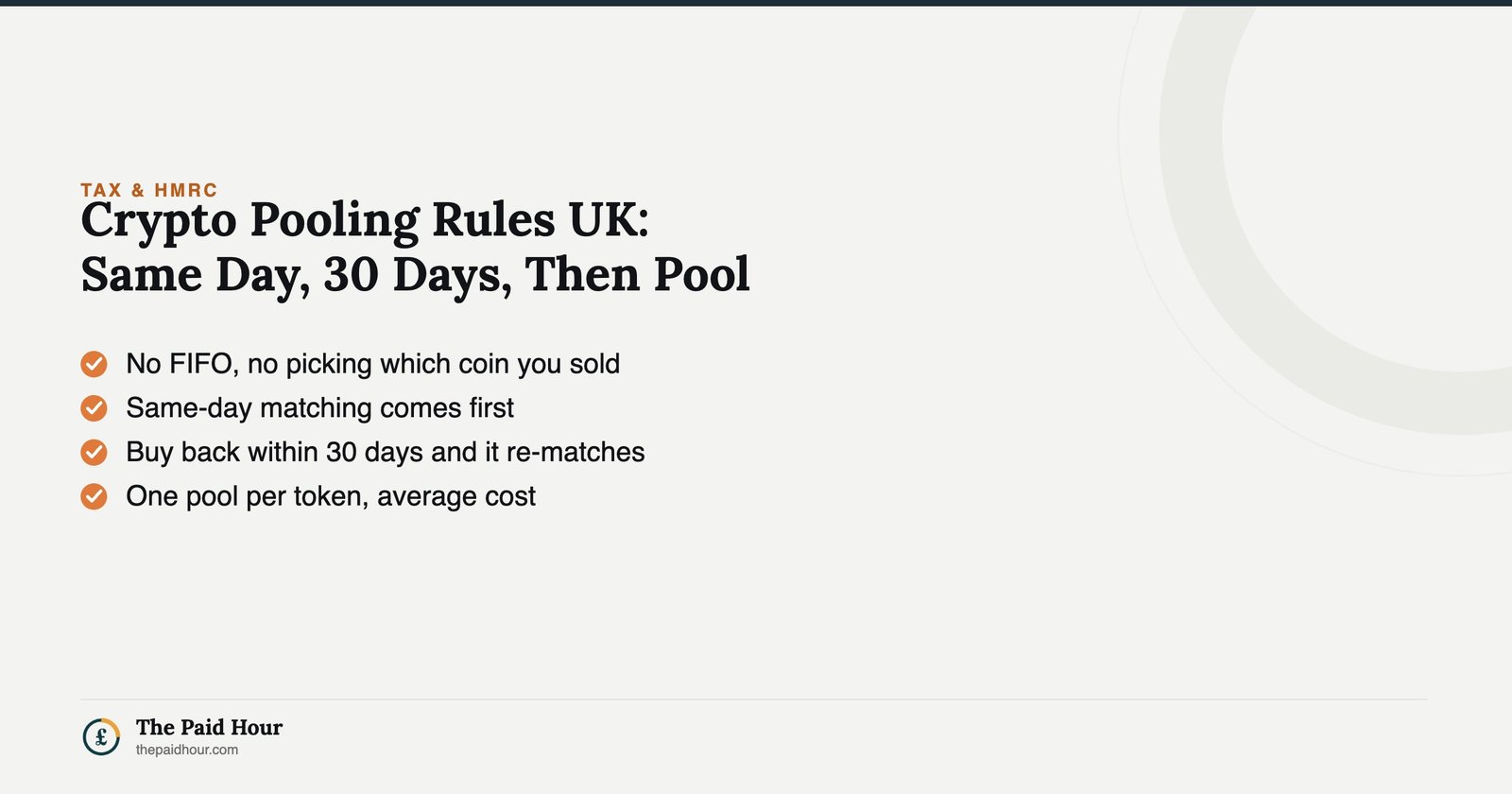
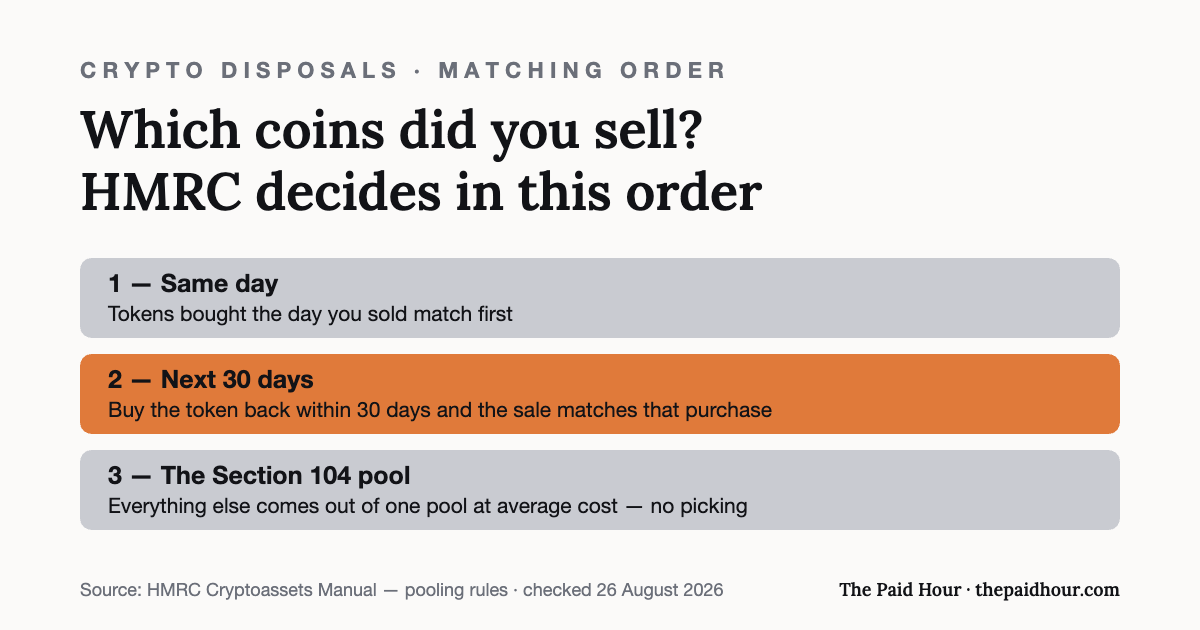
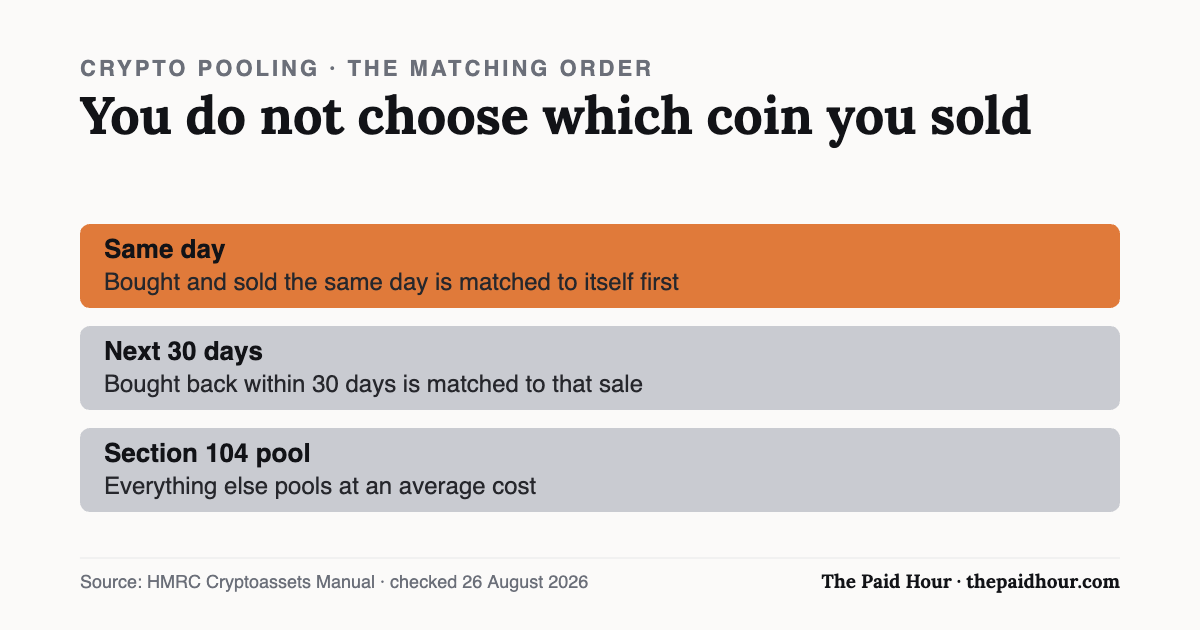
Straight answer: UK rules do not let you choose which coin you sold. Every token of the same type goes into one Section 104 pool at an average cost, but two rules jump the queue first: anything bought and sold on the same day is matched to itself, and anything you buy back within 30 days of selling is matched to that sale instead of the pool. Apply them in that order or the number is wrong.
The crypto pooling rules in the UK answer one question: what did the coins you just sold actually cost you? Section 104 pooling is the method HMRC uses. Every token of the same type is lumped into a single pool, and a sale takes an average-cost slice out of it. No tracing a particular coin back to what you paid for it.
An exchange will hand you a transaction history. It will not hand you a pool. That part is on you.
What crypto pooling replaces
Ignoring crypto pooling rules UK matching order is the single most common software error. Crypto tax software built for the US market causes more trouble here than anything else, because it defaults to FIFO or lets you pick specific lots. Neither exists under UK rules.
HMRC’s reasoning is that tokens of the same type are “indistinguishable from one another”, so there is no coin to identify. Every acquisition feeds a running average; every disposal takes an average-cost slice.
Each token gets its own pool. Hold Bitcoin, Ethereum and Solana and you are running three pools side by side, each with its own average rather than one blended figure for “crypto”. Set up a sheet per coin from the start; retrofitting one two years later is where evenings go to die.
Crypto pooling rule one: the same-day rule
Before anything reaches the pool, tokens bought and sold on the same calendar day are matched against each other. Not against the pool, not against another day. HMRC’s manual works an example where several disposals of one token on a single day are treated as one combined disposal, matched against what was bought that day, with only the remainder going to the pool.
If your entire history is “bought once in 2021, sold once last month”, this rule will never touch you. Trade in and out of a token in the same week and it applies constantly.
Rule two: the 30-day rule
Sell a token and buy the same token back within 30 days, and the repurchase is matched against that earlier sale instead of dropping into the pool, earliest repurchase first.
It exists for the same reason the old bed-and-breakfasting rule exists for shares. Without it you could sell at a loss, buy the identical position straight back, and claim a loss while holding exactly what you started with.
This is the rule that surprises people, and it cuts both ways. It can shrink a paper loss or erase it. It can just as easily change a gain. For whatever portion the rule reaches, the actual repurchase price becomes the cost that counts, the pool average does not get a look in until every acquisition inside the window is used up.
A worked crypto pooling example
Invented figures, chosen to show the mechanics. Not real prices, and not a position anyone should copy.
| Date | What happens | Running pool |
|---|---|---|
| 1 March | Buy 0.5 BTC for £15,000 | 0.5 BTC, cost £15,000 |
| 1 June | Buy 0.5 BTC for £20,000 | 1.0 BTC, cost £35,000 |
| 10 August | Sell 0.3 BTC for £13,500 | Provisionally against the pool |
| 25 August | Buy 0.2 BTC for £9,000 | Inside 30 days of the sale |
Against the pool alone, the August sale would cost £10,500 (0.3 at the £35,000 average) against £13,500 of proceeds, a £3,000 gain. The 25 August purchase changes that.
0.2 BTC of the disposal matches the 25 August purchase at its actual cost of £9,000, against £9,000 of the proceeds. Gain on that slice: nil. The remaining 0.1 BTC comes from the pool at £3,500, against £4,500 of proceeds. Gain: £1,000.
Total gain £1,000 instead of £3,000, and the pool drops only to 0.9 BTC at £31,500, because only 0.1 left it. A £2,000 swing in taxable gain from one rule most people have never heard of. That swing is the entire point of getting crypto pooling rules UK matching right before you file.
Swapping one token for another is a disposal
Tax does not wait for sterling to appear in a bank account. HMRC’s guidance is explicit that exchanging one token for another is a disposal in its own right: you are treated as selling the first at market value and buying the second with the proceeds.
That disposal runs through the same-day rule, the 30-day rule and the pool exactly as a cash sale would. The token you receive starts its own pool at that same market value. It does not feel like realising a gain, which is precisely why it catches people.
What crypto pooling does not cover
NFTs. HMRC treats non-fungible tokens as separately identifiable assets, which is the entire point of them. No pool, no same-day rule, no 30-day rule. Each one is its own asset with its own cost and its own calculation, like a painting.
Crypto received as payment. If a client settles an invoice in Bitcoin, or you are mining or staking for rewards, that is an Income Tax question first. The sterling value on the day you receive it is income, and only then does that same value become the cost that enters the pool. Both sides are covered in the guides to crypto mining tax and side hustle tax in the UK.
What crypto pooling means for the bill
Pooling only produces the gain or loss. The tax on it is ordinary Capital Gains Tax, crypto gets no separate rates. For 2026/27 the annual exempt amount is £3,000, and above it gains are taxed at 18% within your basic rate band and 24% above it.
That £3,000 covers all your capital gains for the year, not just crypto. Sell shares or a second property in the same year and they are competing for the same allowance. The wider reporting picture is in the guide to crypto tax for UK sole traders, and losses have their own four-year deadline, covered in claiming crypto losses.
One thing has changed the stakes. Under the Cryptoasset Reporting Framework, platforms have been collecting reportable user data since 1 January 2026, with the first reports covering the 2026 calendar year due to HMRC between 1 January and 31 May 2027. Whatever your pool says, HMRC will increasingly have the raw data to check it against.
The records crypto pooling needs
Most exchange tax reports list transactions without attempting the pooling calculation at all, so they are a starting point rather than an answer. HMRC expects you to keep your own records: the pooled cost before and after each transaction, the date and value of every disposal, and bank statements behind them.
A spreadsheet per coin, updated on every buy, sell or swap. Reconstructing two years of trades the week before a deadline, with both matching rules to apply retrospectively, is the version of this that goes wrong.
Exchanges now report to HMRC. Is your pool right?
UK Crypto Tax for the Self-Employed 2026/27. Seven modules and a four-sheet toolkit that computes a Section 104 pool properly and separates what is capital gains from what is income.
- A pool calculator that carries the running average cost and computes the gain on every disposal, same-day and 30-day rules applied first
- The disposals people miss: crypto-to-crypto, spending it, gifting it
- Losses, negligible value claims for dead tokens, and the record pack HMRC expects you to hold for five years and ten months
Under the Cryptoasset Reporting Framework, exchanges have been collecting and reporting UK users’ data since 1 January 2026. The rules did not change. HMRC just stopped having to guess.
Buying more than one? All ten 2026/27 courses for £107, against £328 at full price.
Sources
- HMRC Cryptoassets Manual CRYPTO22200: pooling
- HMRC Cryptoassets Manual CRYPTO22252 — same-day rule
- HMRC Cryptoassets Manual CRYPTO22253: the 30-day rule
- gov.uk, Check if you need to pay tax when you sell cryptoassets
- gov.uk. Capital Gains Tax rates
- gov.uk, Implementation of the Cryptoasset Reporting Framework
The matching order was re-checked against HMRC’s Cryptoassets Manual on 26 August 2026.
Every rule and figure above was checked against gov.uk on 25 August 2026. The worked example uses invented figures to show the mechanics. This is general information about how HMRC calculates gains on cryptoassets, not tax advice, and nothing here is investment advice or a recommendation to buy, sell or hold any cryptoasset. For your own circumstances, speak to an accountant or contact HMRC directly.
Once you’ve applied the same-day and 30-day rules, whatever crypto pooling rules UK tax leaves you with lands in the Section 104 pool, track its running cost carefully.