
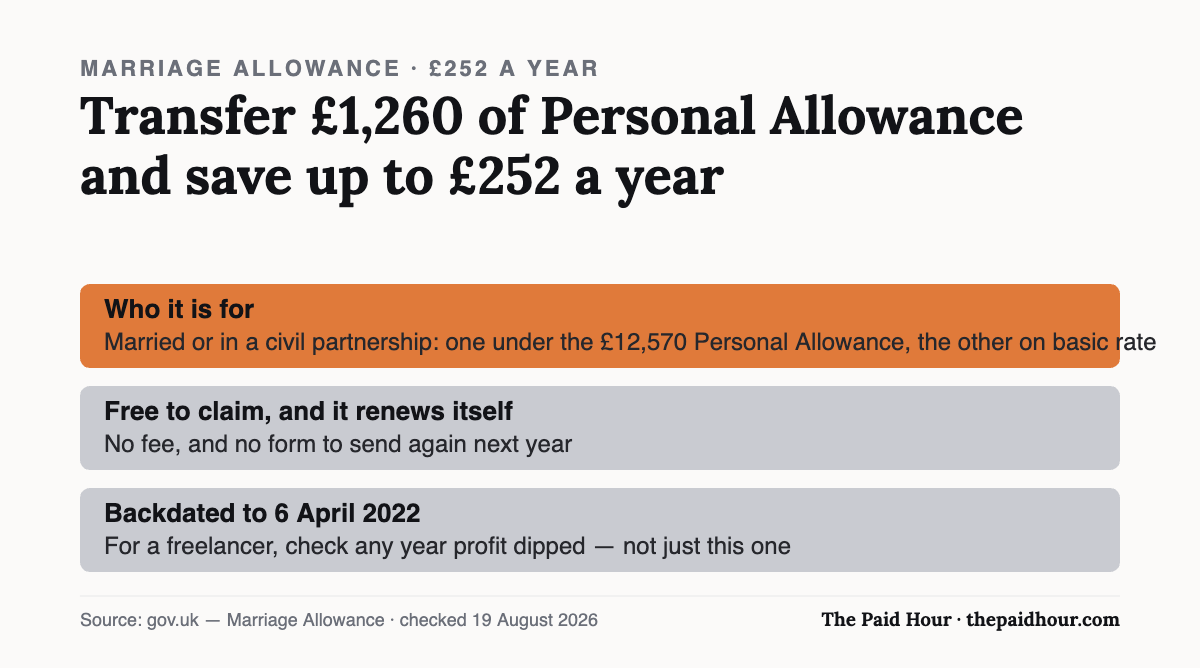
The one-paragraph answer: Married or in a civil partnership, one of you under the £12,570 Personal Allowance, the other on basic rate? Transfer £1,260 of allowance and save up to £252 a year, free to claim, renews itself, and backdates to 6 April 2022. For a freelancer, check any year profit dipped, not just this one.
Marriage Allowance is the relief freelancers miss most often, worth up to £252 a year, and four tax years of it are still open to backdate. Married or in a civil partnership, and one of you earns under the £12,570 Personal Allowance while the other pays basic-rate tax? You can transfer £1,260 of allowance across and cut the household tax bill by up to £252 a year.
It’s free to claim, it renews on its own every year, and you can backdate it all the way to 6 April 2022, four tax years still up for grabs. For a freelancer, the year worth checking is any year your profit dipped below the Personal Allowance, not just the current one. Freelancers with a low-income year should check every past year for Marriage Allowance, not only the current one.
Why freelancers lose out on Marriage Allowance more than most
Marriage Allowance usually gets written up as something for couples where one partner simply doesn’t work. That framing is exactly why self-employed people skip past it.
But the actual test isn’t employment status. It’s taxable income below the Personal Allowance, and for a sole trader that means profit rather than turnover. A designer who invoiced £19,000 and spent £7,000 on kit, software, travel and insurance has profit of £12,000. That’s under £12,570. If their partner is employed on an ordinary salary, the couple qualifies, full stop.
Freelance income moves around. A quiet year, a year with a big equipment purchase, a year with a new baby or a house move, any of those can push profit below the line without it ever feeling like a “low income year” in the moment. Those are precisely the years worth going back and checking.
How the Marriage Allowance transfer works
The lower earner gives up £1,260 of their Personal Allowance. The higher earner gets £1,260 knocked off their taxable income. At the 20% basic rate, that’s £252 of tax saved.
Note the direction here. The lower earner may end up paying a little tax themselves, because their own allowance has shrunk. HMRC’s own example makes this plain:
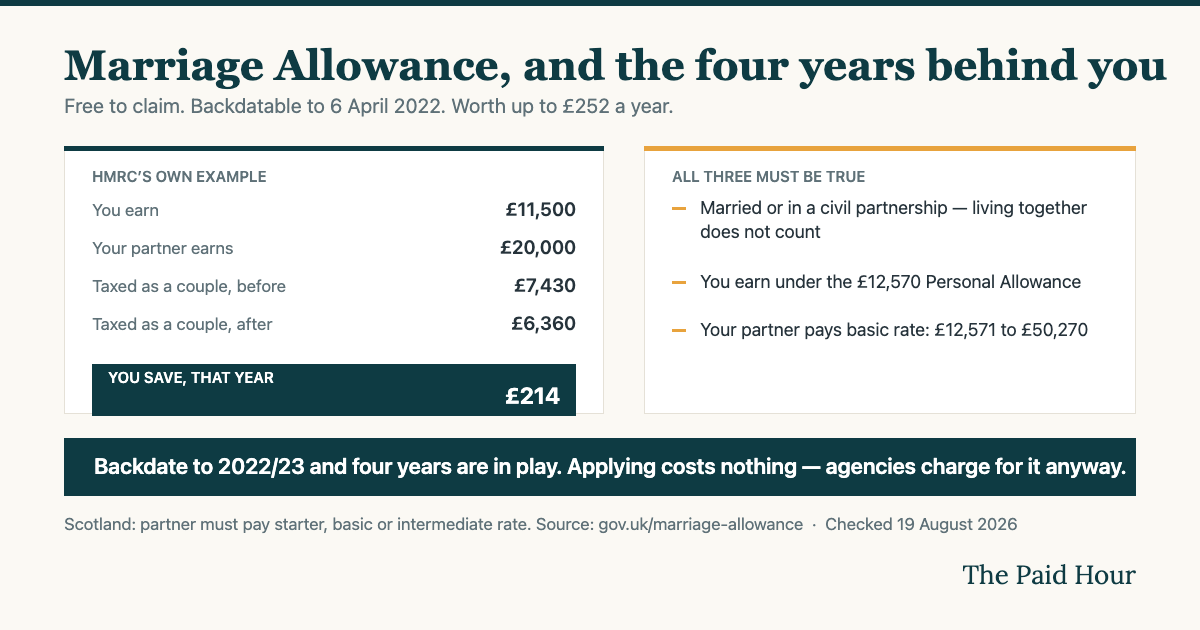
- You earn £11,500. Your allowance was £12,570, so you paid nothing.
- After transferring, your allowance is £11,310, so you now pay tax on £190.
- Your partner’s taxable income drops from £7,430 to £6,170.
- As a couple you’re taxed on £6,360 instead of £7,430, a saving of £214.
So it’s a household decision rather than an individual one. It works because the allowance is worth more sitting with whoever’s paying tax on it.
The full £252 applies when the lower earner has no taxable income at all. Between the two figures, the actual saving lands somewhere in the middle, which is why HMRC hands you a calculator instead of a single flat number.
The three Marriage Allowance conditions
- You’re married or in a civil partnership. Living together, however long, doesn’t count: this is the one condition that rules out most people who try.
- The lower earner’s income sits below the Personal Allowance, usually £12,570.
- The higher earner pays basic rate, usually income between £12,571 and £50,270 before Marriage Allowance is applied.
In Scotland, the second partner needs to pay the starter, basic or intermediate rate, which usually means income between £12,571 and £43,662.
Two things that don’t disqualify you: receiving a pension, or living abroad, as long as you still get a UK Personal Allowance.
One exclusion to be aware of: if you or your partner were born before 6 April 1935, Married Couple’s Allowance is usually worth more instead. You can’t claim both at once.
Backdating: the part people leave on the table
You can backdate a claim to 6 April 2022 for any year you were eligible — that’s four tax years on top of the current one. That’s the backdating window freelancers should never leave unclaimed.
The amount for each earlier year depends on whatever Personal Allowance rate applied at the time, so the total isn’t simply four times £252. But for a couple who qualified the whole way through, it adds up to a meaningful sum arriving as one payment, for filling in a single form.
If your partner has died since 5 April 2022, the claim can still be made by phone. If they were the lower earner, whoever manages their tax affairs makes that call.
Claim it yourself — it’s free
There’s an online application on GOV.UK and it takes a few minutes. It costs nothing. Freelancers can claim Marriage Allowance themselves in about ten minutes on GOV.UK: no accountant needed.
Worth saying plainly, because there’s an entire industry built on the opposite impression: firms that advertise “marriage tax refunds,” submit the exact same free form on your behalf, and keep a percentage of the backdated payout, sometimes a large one. You’re not buying any expertise there. The form just asks for your National Insurance numbers and a way to confirm your identity.
Once claimed, the transfer repeats automatically every year until you cancel it. Convenient while circumstances stay the same, and a genuine problem when they don’t, if your freelance income recovers back above £12,570, or the relationship ends, you need to cancel it yourself. Put a reminder wherever you keep your tax deadlines.
What to do about Marriage Allowance
If the allowance does not fit your situation, the other household route is paying a spouse for work they actually do. That is a different set of rules with a real trap in it, covered in splitting income with a spouse.
- Work out your profit for each of the last four years, not your turnover. Your allowable expenses decide that figure.
- Check any year it fell below £12,570 while your partner was on basic rate.
- Run HMRC’s calculator if you also have dividends, savings income or benefits from a job, those change the answer.
- Apply directly on GOV.UK and backdate to 2022/23 in the same application.
- Set a reminder to review it each year when you do your return, since it renews on its own.
Related: the Income Tax bands explain where the £12,570 and £50,270 figures come from.
Filing it yourself this year?
HMRC Tax & Expense Mastery 2026/27. Nine modules and eleven working templates that take a UK freelancer from “do I even need to register” to a correct return, with MTD quarters built in.
- Fifteen expense categories, with the trap inside each one (training, clothing, meals, the seven-year pre-trading rule)
- Home and vehicle: flat rate against actual cost, with the £312 break-even worked out and the mileage lock-in rule
- The year-one payments-on-account cash shock, and the routine that stops it landing twice
HMRC does not send a list of what you forgot to claim. Most freelancers leave several hundred pounds of legitimate expenses on the table every single year, and the return still gets filed.
Buying more than one? The Complete Freelancer System, all five for £87, against £215 at full price.
Sources
- GOV.UK, Marriage Allowance: how it works
- GOV.UK. Apply for Marriage Allowance online
- GOV.UK, Married Couple’s Allowance
- GOV.UK: Income Tax rates and Personal Allowances
Figures checked 19 August 2026. This is general information, not financial or tax advice. If you have dividend or savings income, use HMRC’s calculator or call the Income Tax helpline before claiming.