

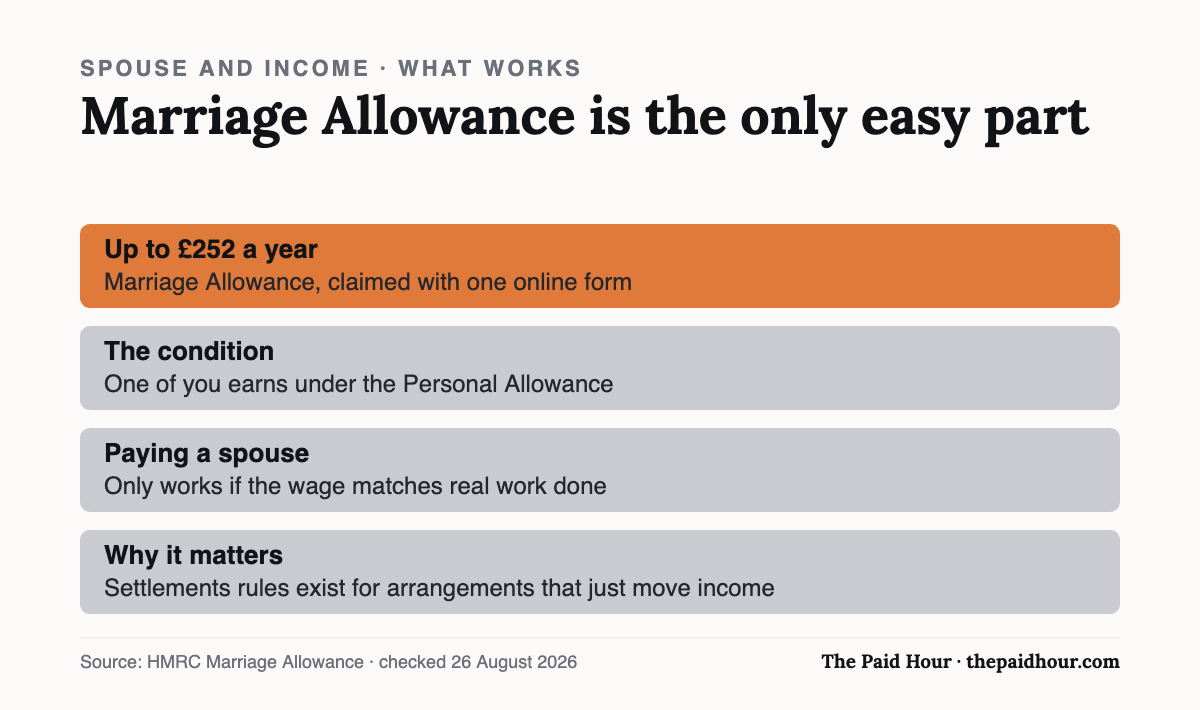
What matters here: Marriage Allowance is the easy win, up to £252 a year for one online form, if one of you earns under the Personal Allowance. Beyond that, paying a spouse only works when the wage matches real work done; the settlements legislation exists precisely for arrangements that are really just moving income.
Table of Contents
£252 a year, for doing precisely nothing except filling in one online form. That’s the upper limit of Marriage Allowance, and it’s usually the first thing worth checking before anyone starts splitting income with a spouse in more complicated ways that can get a sole trader into trouble with HMRC.
Splitting income with a spouse or civil partner sounds like an obvious move once one of you is a basic rate taxpayer and the other has spare capacity in their personal allowance. And some ways of doing it are completely fine. But HMRC has specific rules aimed directly at income-splitting arrangements that exist mainly to move money into a lower tax band, and getting this wrong doesn’t just mean a wasted attempt, it can mean the income gets taxed on you anyway, on top of penalties.
Why splitting income with a spouse is tempting
Splitting income with a spouse comes up constantly among self-employed couples for a simple reason: UK Income Tax is progressive, you pay 20% on profits in the basic rate band, 40% above £50,270, and so on. If one partner is a higher rate taxpayer and the other has little or no income of their own, moving some of the business income across can reduce the household’s total tax bill, sometimes by a meaningful amount. The instinct isn’t wrong. The trouble is in how people try to achieve it.
The settlements legislation: the trap in splitting income
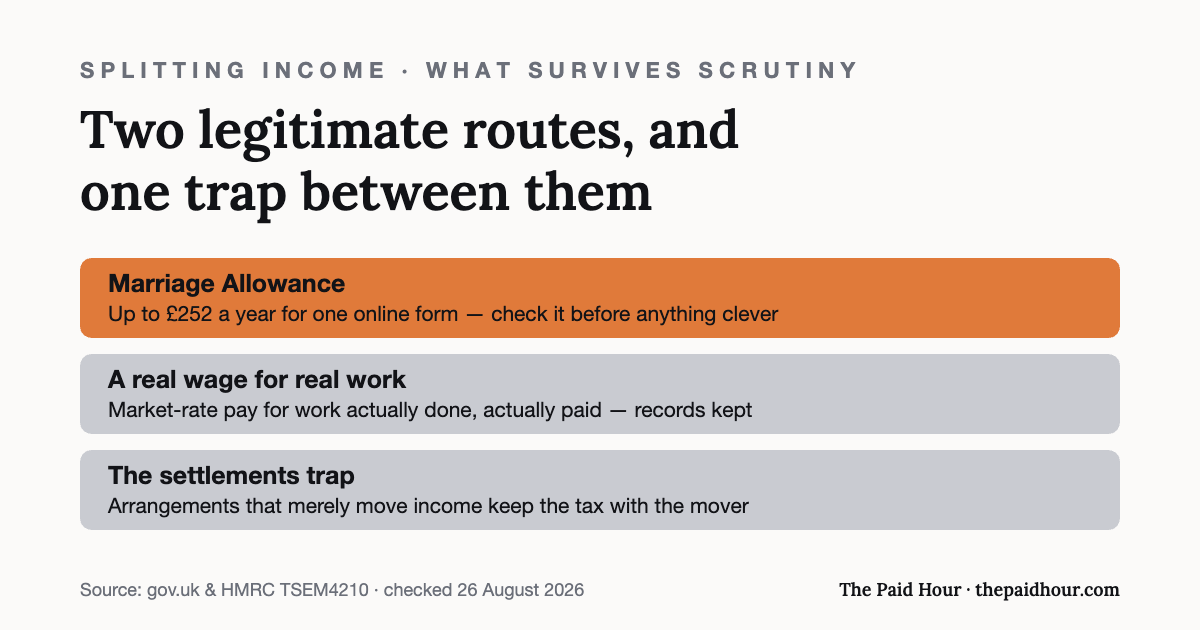
HMRC has a specific set of rules, generally referred to as the settlements legislation, aimed squarely at arrangements where one spouse effectively hands income-generating rights to the other without them doing anything to earn it. If HMRC decides an arrangement counts as a “settlement,” the income is taxed as though it still belongs to the person who arranged it: the tax saving simply doesn’t happen, no matter what paperwork says otherwise.
There is an exception for outright gifts between spouses and civil partners. But, and this is the part that catches people who’ve read half the guidance — that exception doesn’t apply if what’s been given is “wholly or substantially a right to income” rather than a genuine share of the underlying business. HMRC’s own manual gives an example of a husband handing his wife shares that entitled her to a slice of his company’s income, with no work or capital contribution from her at all, that was treated as a settlement, and the income was taxed on him regardless.
The practical takeaway when splitting income with a spouse: an arrangement that looks like real participation in the business. Genuine work, genuine capital, a genuine partnership, tends to be fine. An arrangement that’s really just “give my spouse a right to some of my income so it’s taxed at their rate” is exactly what this legislation exists to catch.
What actually works: two legitimate ways of splitting income
There are two established ways of splitting income with a spouse that HMRC generally accepts, provided they reflect what’s happening in the business rather than existing purely on paper. Get either one right and splitting income with a spouse becomes a straightforward, defensible part of how the business is run instead of something to worry about.
The first is forming a genuine business partnership. If your spouse works in the business, client work, admin, marketing, whatever it is, and you agree a profit-sharing arrangement that reasonably reflects each partner’s contribution, that’s a real partnership rather than a settlement. Each partner registers separately for Self Assessment, the partnership itself files a partnership return, and profits are split and taxed according to the partnership agreement. The key word throughout is genuine: real involvement, a defensible split rather than a 90/10 split that happens to land your spouse in the tax band you want purely because it’s convenient.
The second is employing your spouse to do real work in the business, paid at a reasonable commercial rate for that work. This is the more common route for sole traders who don’t want the formality of a partnership. It’s also the one where the details matter most.
Employing your spouse: what "reasonable" actually means
Employing your spouse is the version of splitting income with a spouse that most sole traders end up using, precisely because it doesn’t require the formality of a partnership. If you employ your spouse, HMRC’s general test for allowing the wage as a business expense is the same one that applies to any employee’s pay: it must be wholly and exclusively for the purposes of the trade, and that in practice means paying roughly what you’d pay a stranger to do the same job. Overpay significantly relative to the work being done, and HMRC can disallow the excess as a deduction: the wage doesn’t have to be wrong to fail, just clearly more than the job is worth.
National Minimum Wage is where a lot of guides get this wrong. Ordinarily any employee has to be paid at least the minimum wage for their age. But gov.uk specifically excludes “family members of the employer living in the employer’s home” from minimum wage entitlement, so a spouse working in your business while living with you doesn’t legally have to be paid minimum wage the way an unrelated employee would. That doesn’t mean pay whatever you like, though: for the wage to hold up as a genuine business expense instead of a disguised way of splitting income with a spouse, it still needs to reflect a fair commercial rate for the actual work and hours involved.
Once the wage crosses the relevant thresholds, you’ll need to run PAYE as an employer, registering with HMRC, reporting pay through Real Time Information, and handling any tax or National Insurance due. It’s genuine admin, not a token gesture, and treating it as a formality rather than running payroll properly is one of the more common ways this goes wrong.
Two examples that show where the line sits
Deepa runs a design studio and her husband Alex handles invoicing, client scheduling and the studio’s social media for around ten hours a week. She pays him £14 an hour through proper PAYE, matching roughly what a part-time admin assistant would cost locally, and keeps a simple log of his hours and tasks. That’s splitting income with a spouse the way HMRC expects to see it, real work, a defensible rate, proper records.
Ravi is a higher rate taxpayer running a consultancy, and pays his wife £25,000 a year as “marketing support” despite her doing no identifiable work in the business and having no marketing background. There’s no timesheet, no output, no commercial rationale beyond moving £25,000 into her lower tax band. If HMRC ever queried it, that wage is exactly the kind of arrangement the wholly-and-exclusively test and, potentially, the settlements legislation are designed to unpick, and the tax saving could unwind entirely, with the income taxed back on Ravi.
Marriage Allowance: the simple option most people check last
Before setting up a partnership or payroll purely to reduce a household’s tax bill, it’s worth checking whether Marriage Allowance already does most of the job with none of the admin. In short: if one spouse earns below the Personal Allowance and the other is a basic rate taxpayer, the lower earner can transfer part of their unused allowance across, worth up to £252 a year, with no change to how the business operates at all. We’ve covered the full eligibility rules and how to backdate a claim in our dedicated Marriage Allowance guide, it’s worth ruling in or out before setting up anything more involved.
It won’t get you anywhere near the saving a genuine partnership or employment arrangement could produce if your spouse is actually doing substantial work in the business. But for a lot of households, splitting income with a spouse doesn’t need to go further than that one form.
Mistakes that turn splitting income into a problem
When splitting income with a spouse goes wrong, it’s usually one of a handful of avoidable mistakes. The single biggest is paying a spouse for work that isn’t happening, or barely happening, purely to shift income into their tax band. It’s the most obvious version of exactly what the settlements legislation and the wholly-and-exclusively rule both exist to catch, and it tends to be easy for HMRC to spot if it’s ever looked into.
Another common way splitting income with a spouse is easy to get wrong is treating “employing” a spouse as informal, no records of hours, no payslips, no PAYE registration, just an arrangement between two people who trust each other. That might feel unnecessary within a marriage, but from HMRC’s perspective it looks identical to an arrangement with nothing genuine behind it, because there’s no paper trail proving otherwise.
The third is setting a profit split in a partnership that has no relationship to either partner’s actual contribution: capital, hours, skills, risk, and can’t be explained in a sentence that doesn’t start with “for tax reasons.” A split doesn’t need to be 50/50 to be genuine, but it does need a rationale beyond the tax outcome.
How to set either route up
Setting up either route for splitting income with a spouse takes an afternoon of admin rather than weeks. For a partnership, both of you register with HMRC — one as the “nominated partner” who registers the partnership itself and both individually for Self Assessment, and the partnership submits its own return each year showing how profits were allocated. A written partnership agreement isn’t a strict legal requirement but is worth having anyway, since it’s the clearest evidence of a genuine arrangement if HMRC ever asks questions.
For employing a spouse, you’ll register as an employer with HMRC, set them up on payroll software, and process their pay the same way you would for any other employee, including payslips and the relevant Real Time Information submissions each pay period. There’s a genuine side benefit here too: a spouse earning enough through PAYE builds up qualifying years toward their own State Pension, which unpaid work in the background never does.
Quick answers to the questions people actually ask
Can I just transfer some of my self-employment profit to my spouse’s bank account without any of this? Moving money between joint or personal accounts doesn’t change who the income belongs to for tax purposes. The profit is taxed on whoever earned it as a sole trader, regardless of whose account it later sits in.
Does any of this apply if we’re not married or in a civil partnership? The settlements legislation and its spousal exemption specifically concern spouses and civil partners. Unmarried partners are treated differently under some of these rules, so it’s worth getting specific advice instead of assuming the same approach applies.
Is a limited company an easier way of splitting income with a spouse? Not automatically, the settlements legislation applies to company arrangements too, as HMRC’s own example involving company shares shows. Company structures bring their own considerations entirely separate from sole trader status, and aren’t a shortcut around these rules.
What if my spouse’s work in the business varies week to week? Keep records that reflect that reality, a rough log of hours and tasks each week or month is far better evidence than a flat assumption, and it’s exactly what would support the arrangement if it were ever queried.
What to do about splitting income
Check Marriage Allowance first: it takes minutes and needs no changes to how the business runs. If your spouse already does or could do genuine work in the business, decide honestly whether a formal partnership or proper employment fits, then set it up with real records, a defensible rate or profit split, and (for employment), actual PAYE rather than an informal arrangement in name only.
This isn’t personalised tax advice, it’s a description of how these mechanisms work and what HMRC’s own guidance says about each. Splitting income with a spouse in a way that holds up isn’t complicated once you know the difference between genuine participation and a paper arrangement, but if your situation is anything but straightforward, it’s worth a proper conversation with an accountant before you set anything up.
Whichever route you choose, revisit it once a year rather than setting it up and forgetting about it. A partnership profit split or a spouse’s job description that made sense when the business was smaller doesn’t automatically stay defensible as things change. Hours worked, responsibilities taken on, or the business’s overall profit can all shift enough that the original split with your spouse no longer reflects reality. Keeping it current is far less effort than untangling it later if HMRC ever asks.
Want the whole tax system, not one rule?
HMRC Tax & Expense Mastery 2026/27. Nine modules and eleven working templates that take a UK freelancer from “do I even need to register” to a correct return, with MTD quarters built in.
- Fifteen expense categories, with the trap inside each one (training, clothing, meals, the seven-year pre-trading rule)
- Home and vehicle: flat rate against actual cost, with the £312 break-even worked out and the mileage lock-in rule
- The year-one payments-on-account cash shock, and the routine that stops it landing twice
HMRC does not send a list of what you forgot to claim. Most freelancers leave several hundred pounds of legitimate expenses on the table every single year, and the return still gets filed.
Buying more than one? The Complete Freelancer System, all five for £87, against £215 at full price.
Sources
- HMRC manual, TSEM4210 (settlements legislation)
- gov.uk: Who gets the minimum wage
- gov.uk — Marriage Allowance
The Marriage Allowance figure and settlements principle were re-checked against gov.uk on 26 August 2026.
This is general information about how the rules work, not tax advice. The links above go to the primary sources; for your own circumstances, speak to an accountant or contact HMRC directly.