
The short version: There is no single self-employed tax rate, because you pay two taxes on the same profit. Income Tax is 0% to £12,570 (an allowance that a lower-earning spouse can partly transfer across), then 20% to £50,270, 40% to £125,140 and 45% above. Class 4 National Insurance adds 6% between £12,570 and £50,270 and 2% above. So the rate on your next pound is 26p, then 42p, and between £100,000 and £125,140 it is 62p.
Table of Contents
People ask what the tax rate is for the self-employed and get shown an Income Tax table, which is half an answer. The other half is National Insurance, and it lands on the same profit, in the same January payment, without appearing on any of the rate tables.
Both together is what you actually pay. Here is that number.
Self-employed tax rates: what you pay on a given profit
Profit, not turnover, income after allowable expenses. 2026/27 figures, England, Wales and Northern Ireland.
| Profit | Income Tax | Class 4 NI | Total | Effective rate |
|---|---|---|---|---|
| £20,000 | £1,486 | £446 | £1,932 | 9.7% |
| £30,000 | £3,486 | £1,046 | £4,532 | 15.1% |
| £50,000 | £7,486 | £2,246 | £9,732 | 19.5% |
| £60,000 | £11,432 | £2,457 | £13,889 | 23.1% |
| £100,000 | £27,432 | £3,257 | £30,689 | 30.7% |
Rounded to the pound, and arithmetic from the published rates instead of figures HMRC prints. Note how far the effective rate sits below the band you are “in”, someone on £50,000 of profit is a basic rate taxpayer paying an all-in 19.5% rather than 20%, because the first £12,570 is free.
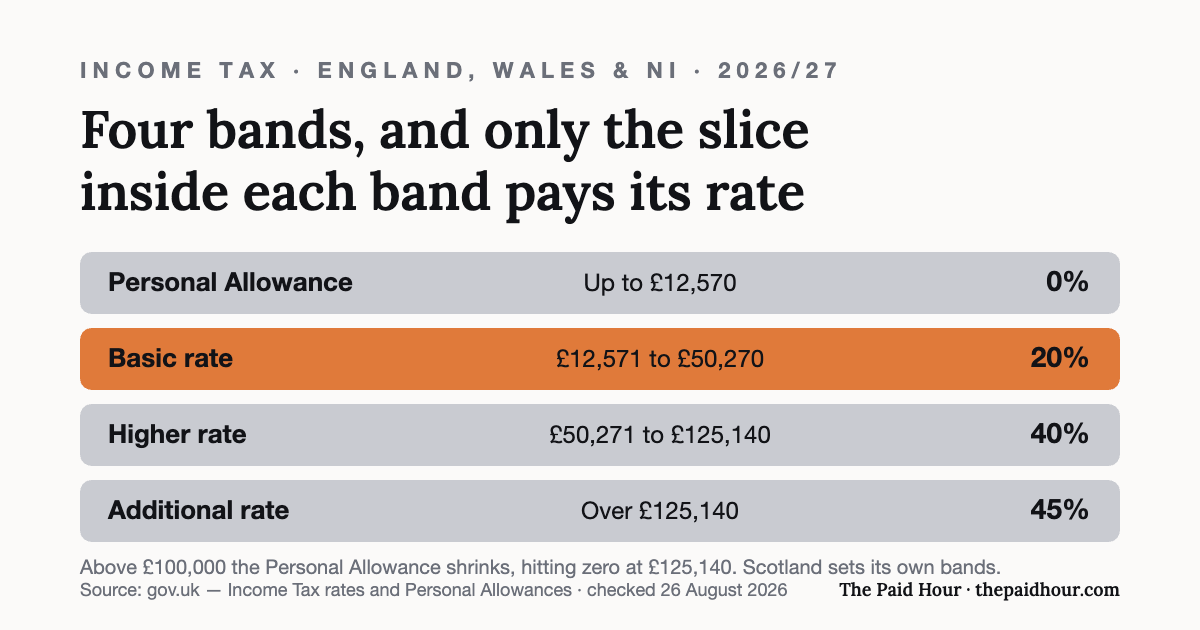
The Income Tax rates and bands
| Band | Taxable income | Rate |
|---|---|---|
| Personal Allowance | Up to £12,570 | 0% |
| Basic rate | £12,571 to £50,270 | 20% |
| Higher rate | £50,271 to £125,140 | 40% |
| Additional rate | Over £125,140 | 45% |
Worth killing off the most common misunderstanding early. Crossing into a band does not re-rate everything underneath it. On £51,000 of profit you pay nothing on the first £12,570, 20% on the next £37,700, and 40% on the £730 at the top: £7,832 in total, of which just £292 is higher rate. The bands stack. A better year never leaves you worse off.
National Insurance, which sits on top
Class 4 is the one that costs money: 6% on profits between £12,570 and £50,270, then 2% above £50,270. It is collected through the same Self Assessment return on the same date.
Class 2 is the one that confuses people. The rate is £3.65 a week and the Small Profits Threshold is £7,105, but above that threshold, Class 2 contributions are treated as having been paid. Your National Insurance record is protected and you hand over nothing. There is more in the guides to self-employed National Insurance and how Class 2 and Class 4 differ.
Budgeting from the Income Tax table alone is the single most common reason a January bill comes as a shock.
The tax rates on your next pound
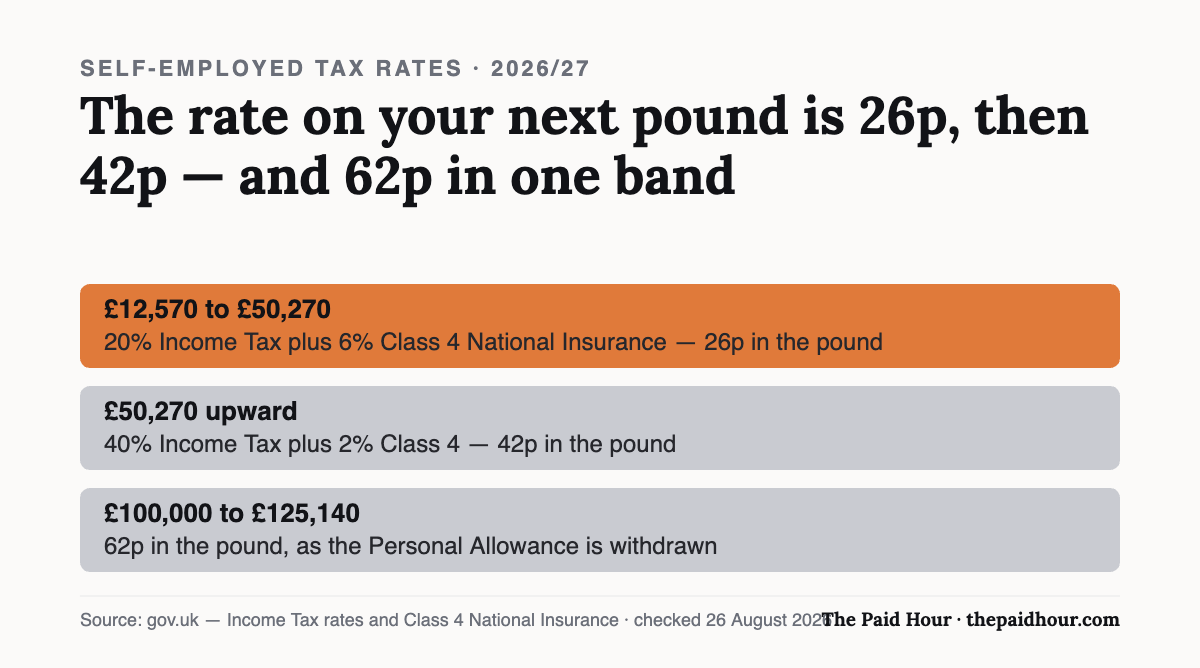
This is the table people need and almost nobody publishes, because it only exists once you add the two taxes together.
| Profit | Income Tax | Class 4 | Your next pound |
|---|---|---|---|
| Up to £12,570 | 0% | 0% | 0p |
| £12,571 to £50,270 | 20% | 6% | 26p |
| £50,271 to £100,000 | 40% | 2% | 42p |
| £100,001 to £125,140 | 40% plus the taper | 2% | 62p |
| Over £125,140 | 45% | 2% | 47p |
Look at the last two rows. The marginal rate goes down at £125,140. That is not a mistake.
The £100, 000 trap: where tax rates spike
Above £100,000 of adjusted net income, the Personal Allowance is cut by £1 for every £2 you earn. gov.uk: “your allowance is zero if your income is £125,140 or above.”
Follow one extra pound of profit at £110,000:
- 40p of higher rate tax on the pound itself.
- 50p of Personal Allowance disappears. That 50p was untaxed and is now taxed at 40%, another 20p.
- 2p of Class 4 National Insurance.
62p on one pound. The 60% figure gets quoted everywhere; for a sole trader it is 62%, because Class 4 does not stop at the higher rate threshold the way employee National Insurance largely does.
It appears on no official rate table, because formally there is no 62% band. It is just the arithmetic of the taper. It runs for £25,140 of profit and then stops, above £125,140 the marginal rate falls back to 47p.
If you control when you invoice, this is one of the few places in the tax system where timing changes the number. Pension contributions and Gift Aid both reduce adjusted net income, which is why people in this band talk about them constantly. What to do about it is a question for an accountant and your whole position. Knowing the band is there is the part most people are missing.
Tax rates apply to profit rather than turnover
The single biggest difference between a freelancer’s bill and an employee’s on the same money. Invoice £60,000, spend £12,000 running the business, and taxable profit is £48,000, you never reach the higher rate at all.
Which makes claiming properly worth real money rather than pennies. Every pound of legitimate expense in the basic rate band saves 26p. The list is in the guide to allowable expenses for UK freelancers, and if you are working out what to put aside each month, how much to save for tax runs the same numbers the other way round.
Two allowances also sit outside the bands: the first £1,000 of trading income and, separately, the first £1,000 of property income.
Scottish tax rates, if you live there
Scotland sets its own Income Tax bands and rates for non-savings, non-dividend income, and they are not the ones in the table above. The Personal Allowance is the same UK-wide; the bands built on top of it are not. National Insurance is not devolved, so Class 4 works the same wherever you live.
If you are Scottish resident for tax purposes, use the Scottish rates instead of this page.
Things that move your tax rates
- Marriage Allowance. If your income is below the Personal Allowance you may be able to transfer part of it to a spouse or civil partner.
- Blind Person’s Allowance is added on top of the Personal Allowance.
- Married Couple’s Allowance may apply where one of you was born before 6 April 1935.
- Payments on account. The January bill often carries an advance payment toward next year attached to it, which is not a higher rate, just a different schedule.
Claiming Child Benefit in a higher-earning household? The High Income Child Benefit Charge claws some of it back through the same return.
Most of these figures were set in November. what Autumn Budget 2025 changed for the self-employed is covered separately.
Want to see what these rates mean in cash terms for a specific invoice? Get an HMRC-ready invoice template so your own paperwork matches what you actually owe.
Want the whole tax system, not one rule?
HMRC Tax & Expense Mastery 2026/27. Nine modules and eleven working templates that take a UK freelancer from “do I even need to register” to a correct return, with MTD quarters built in.
- Fifteen expense categories, with the trap inside each one (training, clothing, meals, the seven-year pre-trading rule)
- Home and vehicle: flat rate against actual cost, with the £312 break-even worked out and the mileage lock-in rule
- The year-one payments-on-account cash shock, and the routine that stops it landing twice
HMRC does not send a list of what you forgot to claim. Most freelancers leave several hundred pounds of legitimate expenses on the table every single year, and the return still gets filed.
Buying more than one? The Complete Freelancer System, all five for £87, against £215 at full price.
Need this ready-made? → Self Assessment Prep Checklist Pack, every deadline, record and allowance in 9 pages (£7.99, instant download)
Sources
- gov.uk: Income Tax rates and Personal Allowances
- gov.uk — Self-employed National Insurance rates
- gov.uk, Adjusted net income
- gov.uk. Scottish Income Tax
- gov.uk, Marriage Allowance
Bands and rates re-checked against gov.uk on 26 August 2026.
Rates and thresholds checked against gov.uk on 25 August 2026 and apply to the 2026/27 tax year for England, Wales and Northern Ireland. The totals and marginal rates in the tables are arithmetic from those published rates, not figures HMRC publishes. This is general information, not tax advice: for your own circumstances, speak to an accountant or contact HMRC directly.