
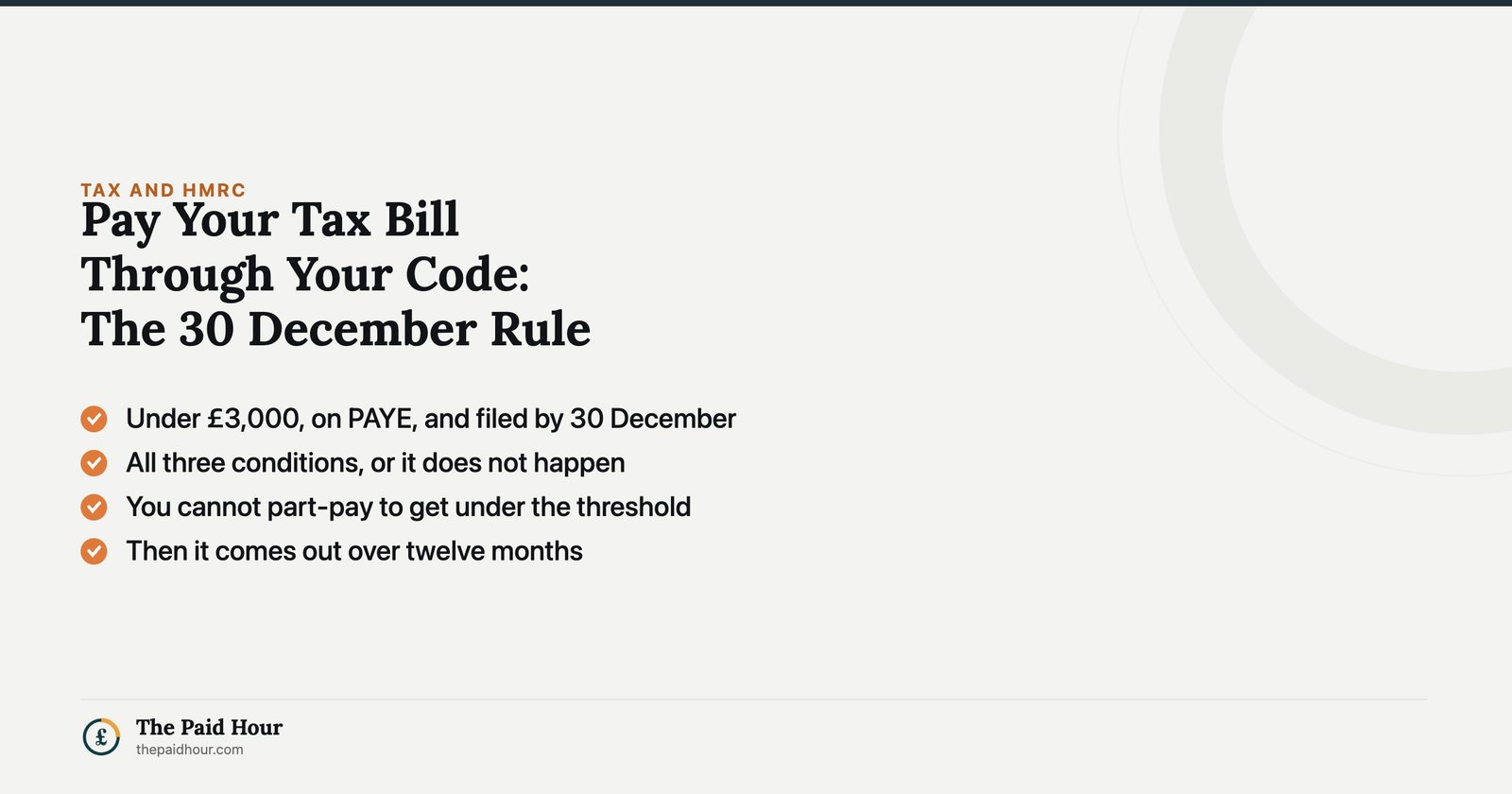
If you owe less than £3,000, already pay tax through PAYE, and get the return in by 31 October on paper or 30 December online, HMRC can collect the balance through your PAYE code over the following twelve months instead of demanding it on 31 January. All three conditions, not any of them. And HMRC says explicitly that you cannot make a part payment to bring the bill under £3,000, the figure is the figure. Even then, three income tests can still block it.
The 30 December deadline appears in every list of Self Assessment dates and almost nothing explains what it is for. This is what it is for.
It is also the only Self Assessment deadline with an upside attached. Miss the others and something bad happens. Miss this one and you simply pay the way you were always going to.
What collecting tax through your PAYE code is
Instead of a single payment on 31 January, HMRC adjusts your PAYE code so the balance comes out of your salary or pension in equal instalments across the following twelve months, alongside your usual deductions.
Same money. Twelve pieces instead of one, and starting in April rather than in the same month as Christmas. For anyone with a wage on one side and freelance income on the other, that is a materially better shape.
You cannot part-pay your way under £3,000
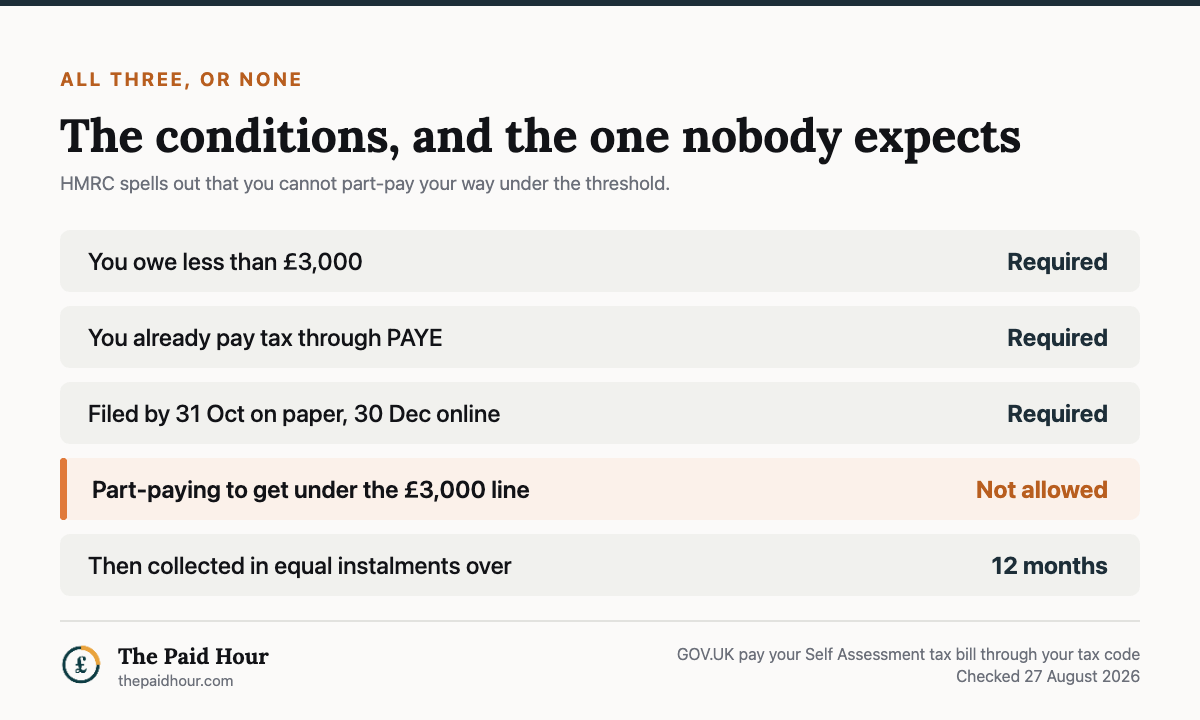
This is the detail worth carrying away, and GOV.UK puts it in brackets as though it were a footnote: you owe less than £3,000 (you cannot make a part payment to meet this threshold).
So a £3,400 bill cannot be turned into an eligible one by paying £500 in December. The test looks at what you owe, not at what is left after you have chipped at it.
Which is a shame, because paying £500 to spread the other £2,900 over a year is exactly the arrangement a sensible person would try to construct.
You need PAYE income for the PAYE code route to work
The second condition rules out a large part of this site’s readership at a stroke. A PAYE code adjustment needs something to adjust, a job, or a company pension.
A sole trader with no employment income has no code for HMRC to change, and there is nothing to be done about that. This is a route for people who are employed and self-employed at the same time, or who have a pension running alongside the freelance work.
If that is not you, skip to the alternatives at the end of this page.
Filing early is the whole trick
Third condition: the return has to be in by 11.59pm on 30 December for an online return, or 31 October on paper.
Thirty-two days before the deadline everybody else works to. In practice that means filing before Christmas rather than in the last week of January, which is when most returns arrive, and it is the only Self Assessment date that rewards being early rather than merely not punishing being late. The rest are in the Self Assessment deadlines.
Note that filing on paper technically qualifies you, by 31 October, but by then you will not know what you owe unless you have done the sums yourself, which rather defeats the purpose.
Three ways the PAYE code route gets refused
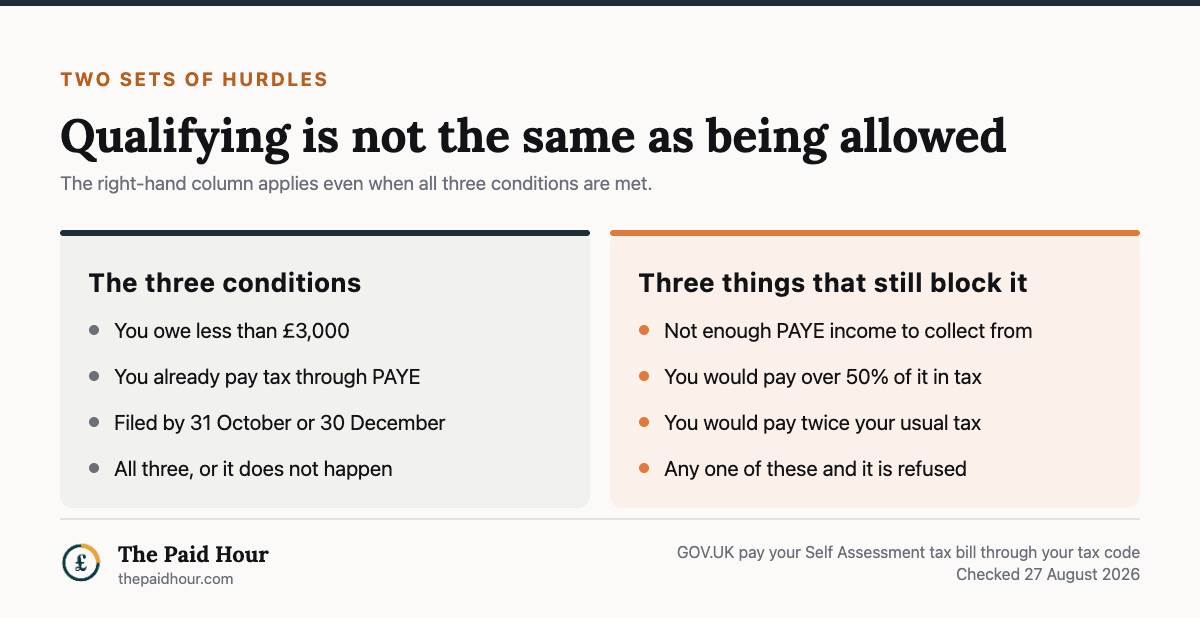
Meeting all three conditions gets you considered, not approved. HMRC will not collect through your PAYE code where you do not have enough PAYE income for it to come out of, where you would end up paying more than 50% of that income in tax, or where you would pay more than twice as much tax as you normally do.
Those are protections rather than obstacles, they stop a code adjustment swallowing a small wage. But the practical effect is that the option is most reliable for someone with a substantial salary and a modest freelance bill, and least reliable for someone with a small part-time job and a large one.
Which is, unavoidably, the wrong way round from who needs it most.
What it does to next year PAYE code
Worth thinking about before you rely on it, because it is not free of consequences.
Your take-home pay falls for twelve months. If you had not planned for that, the relief of avoiding a January bill turns into a smaller pay packet every month from April, which people notice more than they expect to.
And it does not touch your payments on account, which carry on being due on their own dates. Spreading one balance does not spread the instalments towards the next year.
If none of this applies
Two other ways to avoid meeting a whole year’s tax on one January morning.
Pay in advance, in instalments you choose, towards a bill that has not been raised yet. Or, if the bill already exists and you cannot meet it, Time to Pay, which is a different thing with different rules, and where interest keeps running.
The first of those is the one almost nobody uses, and for a freelancer with an uneven income it is closer to how budgeting with irregular income actually works.
Proof to keep if you pay through your tax code
The submission receipt with its date on it, if you filed to hit 30 December. That date is the whole basis of the request.
Then check your PAYE code when it changes in the spring, and check it against the amount you expected to be collected. A code carrying an old adjustment into a year it should not is one of the most common quiet errors in PAYE, and the only person who will notice is you.
Want the whole tax system, not one rule?
HMRC Tax & Expense Mastery 2026/27. Nine modules and eleven working templates that take a UK freelancer from “do I even need to register” to a correct return, with MTD quarters built in.
- Fifteen expense categories, with the trap inside each one (training, clothing, meals, the seven-year pre-trading rule)
- Home and vehicle: flat rate against actual cost, with the £312 break-even worked out and the mileage lock-in rule
- The year-one payments-on-account cash shock, and the routine that stops it landing twice
HMRC does not send a list of what you forgot to claim. Most freelancers leave several hundred pounds of legitimate expenses on the table every single year, and the return still gets filed.
Buying more than one? The Complete Freelancer System, all five for £87, against £193 bought separately.
Sources
- Pay your Self Assessment tax bill through your tax code, GOV.UK
- Self Assessment tax returns: deadlines, GOV.UK
- Pay your Self Assessment tax bill weekly or monthly, GOV.UK
- If you cannot pay your tax bill on time, GOV.UK
The three conditions, the bracketed wording that you cannot make a part payment to meet the threshold, the three circumstances in which HMRC will not collect through your code, and the twelve equal instalments are all quoted from GOV.UK’s guidance on paying a Self Assessment tax bill through your tax code. The 30 December and 31 October dates are from GOV.UK’s Self Assessment deadlines page and move with the tax year. All pages read on 27 August 2026. This is general information about how the rules work, not tax advice.