
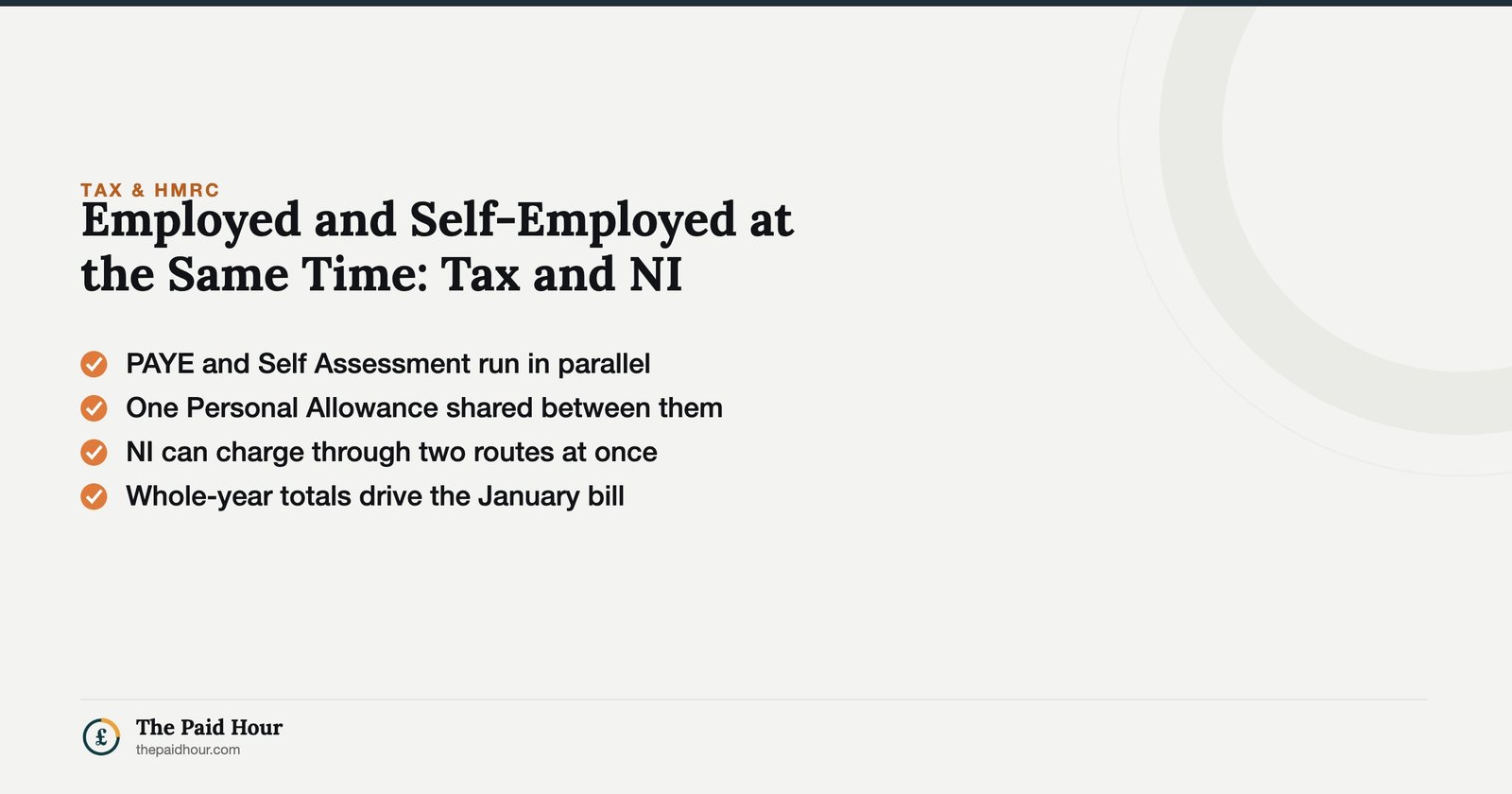
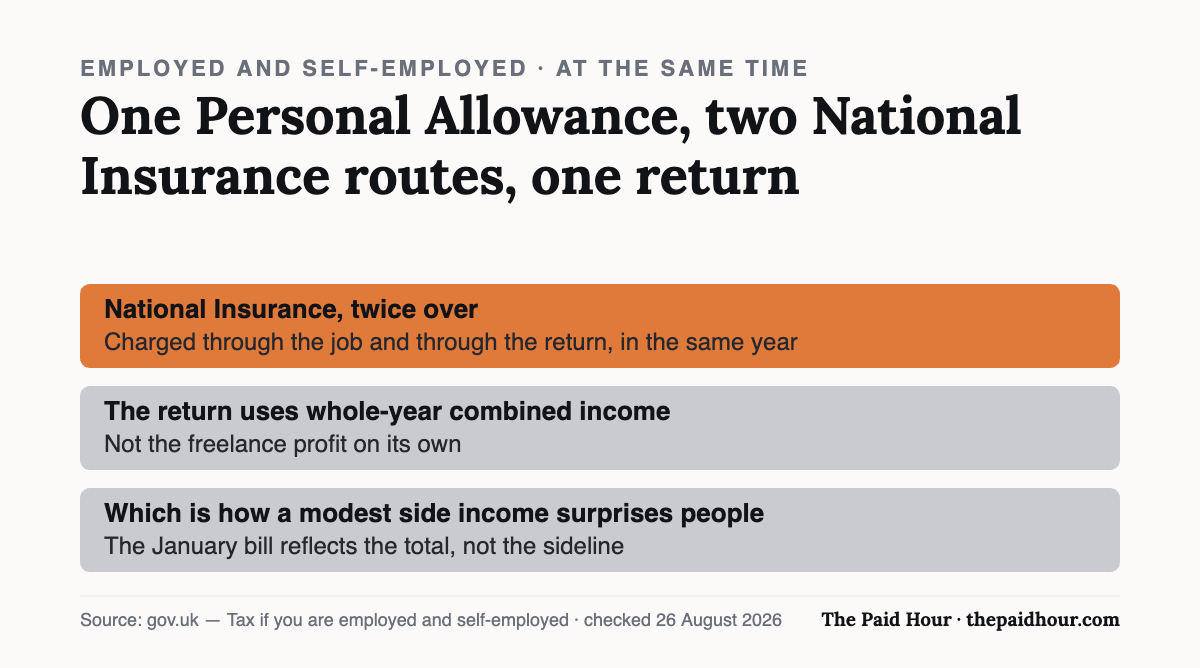
Quick answer: Day job plus freelance work means PAYE and Self Assessment run at the same time, one Personal Allowance shared between them, and National Insurance charged through two separate routes at once. The return uses whole-year combined income, which is how a modest side income produces a surprising January bill.
Employed and self-employed at the same time? Your tax and National Insurance don’t just add up the obvious way. A payslip from an employer and a Self Assessment tax return for freelance or self-employed profit on the side isn’t double taxation for no reason, but the two systems don’t just sit next to each other quietly. Your Personal Allowance is shared between them (and if the self-employed side leaves it partly unused, Marriage Allowance may be worth a look), and your National Insurance can be charged through two different routes at once. Here’s exactly how it fits together.
Employed and Self-Employed at the Same Time: Do I Still File?
Yes. Being on PAYE doesn’t exempt your self-employment income from Self Assessment, the two obligations are entirely separate. gov.uk is explicit that you must send a tax return if you were self-employed as a sole trader and earned more than £1,000 in the tax year, before deducting any expenses or reliefs, regardless of whether you also have a job (gov.uk).
If this is the first year your side income has crossed that line, you need to register with HMRC by 5 October following the end of that tax year (gov.uk). For the full walkthrough of what that first return involves, see your first Self Assessment as a freelancer. Being employed and self-employed at the same time doesn’t reduce that obligation. HMRC treats the two income sources as fully separate for reporting purposes.
How does the Personal Allowance work when you’re employed and self-employed?
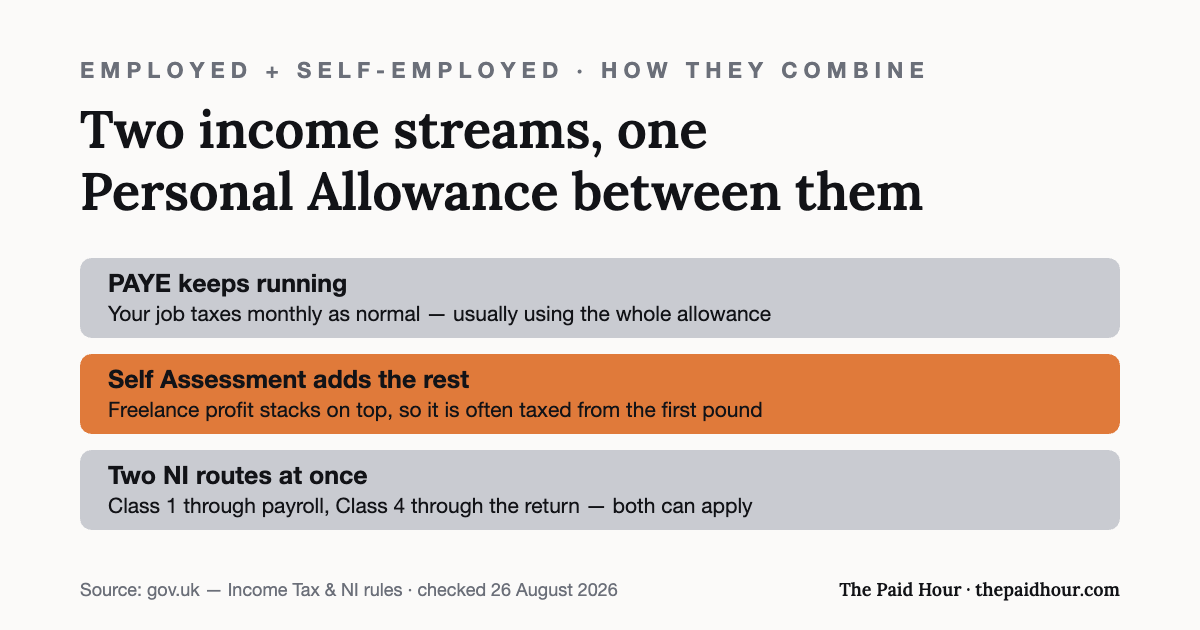
This is the detail most people miss, because it doesn’t work the way a lot of people assume. You do not get one Personal Allowance for your job and a separate one for your self-employment profit, there is only one Personal Allowance (£12,570 for 2026/27), and it applies once, to your total income for the year across every source combined (gov.uk).
In practice, the two systems handle that allowance in two different moments:
- During the year, your PAYE tax code does the estimating. gov.uk’s own guidance on working more than one job confirms your Personal Allowance is “usually allocated” to your main job’s tax code (typically 1257L), so your employer applies it automatically against your salary as you’re paid (gov.uk). Your self-employment income isn’t touched by any tax code at all: it isn’t collected through PAYE, so nothing is deducted from it as it comes in.
- After the year ends, Self Assessment does the reconciling. When you file your return, HMRC works out the tax due on your combined total (employment income plus self-employment profit), against that single Personal Allowance and the same set of tax bands (20% between £12,571 and £50,270, 40% up to £125,140, 45% above, per gov.uk’s current rates), then credits the tax your employer already deducted through PAYE. The Self Assessment bill is effectively the top-up for whatever wasn’t already collected, which, in practice, means your self-employment profit tends to get taxed at whatever rate it lands at on top of your salary, not from a fresh £0. We’ve broken the bands themselves down in detail in our 2026/27 Income Tax rates guide, so this post won’t repeat that table.
Do I pay National Insurance twice, through my job and my self-employment?
Yes, and this is the bit most guides skip. You can owe both:
- Class 1 National Insurance, deducted automatically by your employer through PAYE on your salary, and
- Class 2 and Class 4 National Insurance, charged on your self-employment profit and collected through Self Assessment (gov.uk).
These aren’t alternatives — they’re both due, on their own separate income streams, at the same time. We’ve covered the current Class 2 and Class 4 rates and thresholds in full in our self-employed National Insurance guide for 2026/27, so we won’t repeat the figures here. Anyone employed and self-employed at the same time should expect both bills to land in the same Self Assessment calculation rather than one instead of the other.
Is there a way to avoid overpaying NI when employed and self-employed?
This is the underexplored bit. If you’re paying Class 1 through a job and also owe Class 2/4 on self-employment profit, HMRC caps what you owe overall so you don’t pay National Insurance twice on the same money: an annual maximum. You used to apply for this in advance using form CA72B, but that route no longer exists: deferring Class 2 or Class 4 contributions was discontinued from the 2015/16 tax year onwards, and the CA72B form was formally withdrawn on 26 July 2019 (gov.uk). If you’re employed and self-employed at the same time, that cap now applies automatically through Self Assessment, there’s no form to file.
It’s handled automatically instead. File your Self Assessment return on time, online, or by the 31 October paper deadline, and HMRC applies the cap for you: if you’re already paying the maximum through your job, you may only owe the 2% rate on self-employment profits above the threshold rather than the full blended rate, with no separate application needed (LITRG). Don’t confuse this with the still-current deferment for people with multiple employed jobs (form CA72A), that one only covers Class 1 and has nothing to do with self-employment (gov.uk).
Where this leaves you on being employed and self-employed
Employed and self-employed at once means: one Personal Allowance, applied via your PAYE code during the year and reconciled against your full income through Self Assessment afterwards; and two NI bills (Class 1 via your employer, Class 2/4 via your return), that can both be due at the same time, capped by an annual maximum that HMRC applies automatically through Self Assessment instead of through any application you file. Get your Self Assessment side registered and filed on time regardless, that obligation doesn’t go away just because you’ve also got a payslip.
A job plus a side income: where does it land?
Side Hustle Tax Starter 2026/27. A six-module starter course and six working templates that tell you, in an evening, whether you owe anything at all, and set up the twenty-minute monthly routine that keeps it that way.
- The nine badges of trade as questions you can answer about your own income
- What the platforms send HMRC, the small-seller exemption, and three reply letters for when a letter arrives
- A sales log with a running £1,000 alert, an allowance-versus-expenses sheet, and a tax set-aside calculator at 2026/27 rates
Selling platforms now hand your sales data to HMRC once a year. Selling your own old possessions is never taxable. Buying to resell, making things, or freelancing is. Knowing which side you are on is the whole question.
Buying more than one? All ten 2026/27 courses for £107, against £328 at full price.
Need this ready-made? → Self Assessment Prep Checklist Pack: every deadline, record and allowance in 9 pages (£7.99, instant download)
Registration is the same route whether or not you also have a job. If 2025/26 was your first self-employed year, the deadline is 5 October 2026: how to register as a sole trader with HMRC.
Sources
- Self Assessment tax returns: who must send a tax return, gov.uk
- Register for Self Assessment. Gov.uk
- How tax works if you have more than one job, gov.uk
- Income Tax rates and Personal Allowances: gov.uk
- Self-employed National Insurance rates — gov.uk
- Defer your National Insurance, gov.uk
- National Insurance: application for deferment of Class 2 and/or Class 4 contributions (CA72B). Gov.uk
The shared-allowance mechanics were re-checked against gov.uk on 26 August 2026.
This is general information about how the rules work, not tax advice. The links above go to the primary sources; for your own circumstances, speak to an accountant or contact HMRC directly.