
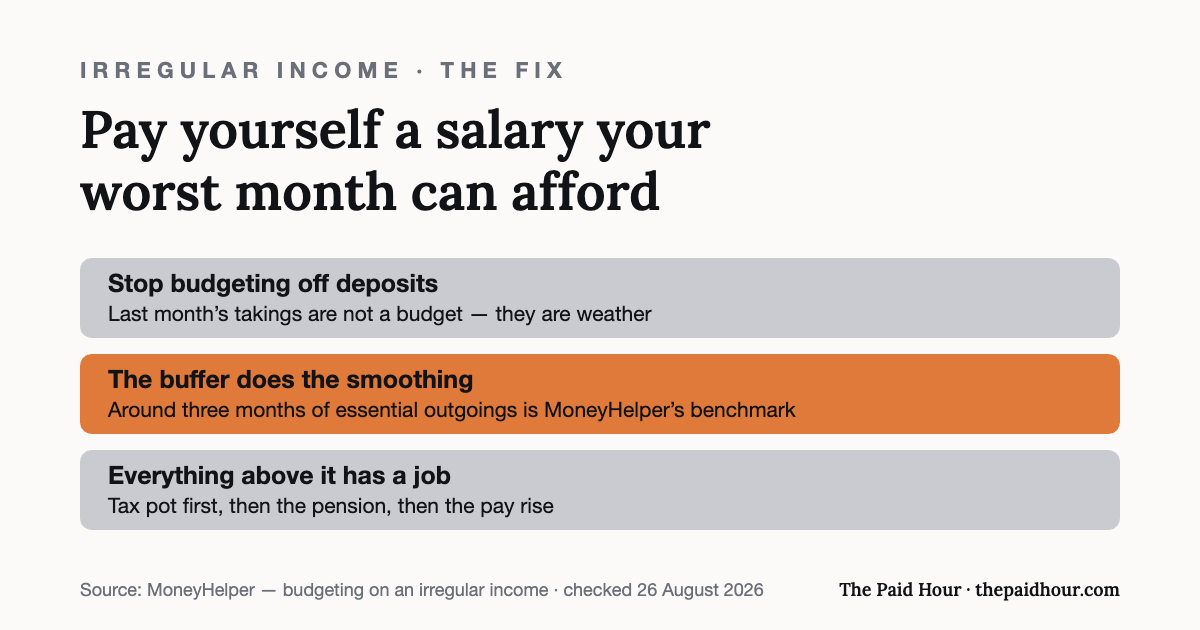
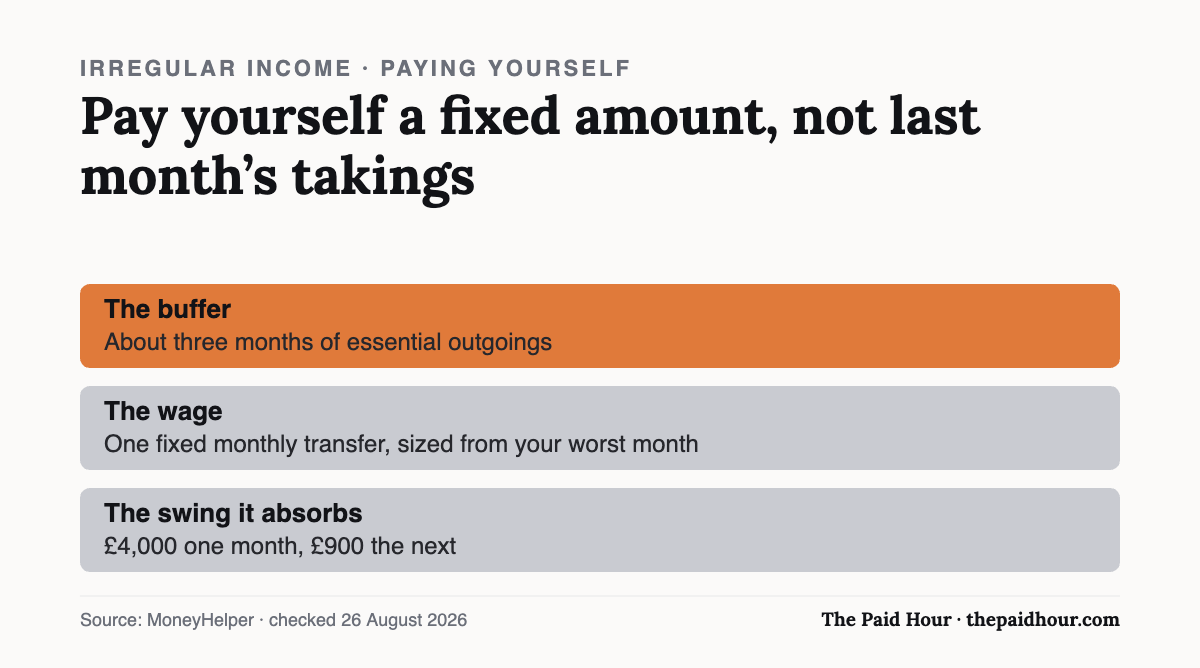
The one-paragraph answer: Stop budgeting off last month’s deposits. Pay yourself a fixed monthly amount from a buffer, sized from your lowest realistic month, MoneyHelper’s benchmark is around three months of essential outgoings. The framework below turns £4,000-one-month, £900-the-next into something that behaves like a salary.
You budget with irregular income differently than with a salary, or you end up guessing every month. One month you invoice £4,000. The next, £900. If you’re budgeting off whatever hit your account last, you’re not budgeting, you’re guessing. The fix isn’t a cleverer spreadsheet, it’s changing what number you budget against in the first place. Here’s a practical framework, built on MoneyHelper’s official guidance, for making irregular freelance income behave like a predictable salary.
Why budgeting on irregular income is different
Standard budgeting advice assumes a fixed monthly wage. Freelance income doesn’t work that way. Client payment terms, seasonal demand, and gaps between projects mean your best month can be four or five times your worst. Budget against last month’s number and you’ll overspend after a good invoice and panic after a quiet one. The problem isn’t the swings themselves; it’s budgeting off the wrong figure.
Should you budget on your average income or your lowest month?
MoneyHelper’s guidance on budgeting for an irregular income sets out two ways to fix a baseline instead of guessing month to month. One option: “budget for your lowest monthly income (at least you’ll always have the major costs covered.” The alternative is to average it out), “total up all your outgoings over the last year and divide it by 12” (or do the same with income) to get a smoothed monthly figure to plan against, rather than reacting to whatever landed this month (MoneyHelper).
In practice, most freelancers do best combining the two: cover essential bills using the lowest-month figure, then use the annual average when deciding what you can realistically spend or invest in the business.
MoneyHelper also offers a free Budget Planner tool if you want to build this out properly rather than working from a rough mental total.
How big an irregular income buffer do you need?
A buffer does more than cover quiet months. It is also the thing a lender looks at when self-employed income is uneven, which is a large part of how a self-employed mortgage application is judged. This is where it’s worth being precise, because the figure people quote isn’t always the one that applies. MoneyHelper’s page on budgeting for irregular income specifically says: “It’s good to have three months’ essential outgoings available. But even having a month’s income saved will protect you against some income shocks” (MoneyHelper).
Separately, MoneyHelper’s general savings guidance gives a wider range: “a good rule of thumb… is to have three to six months’ essential outgoings available in an instant access savings account” (MoneyHelper).
Both are genuine MoneyHelper figures, just from different pages with slightly different framing, the irregular-income page names three months (with one month as a protective minimum), the general savings page widens that to three-to-six. Commentary, not MoneyHelper guidance: given that freelance income is inherently less predictable than salaried income, we’d treat three months’ essential outgoings as the realistic minimum to aim for, and six as the more comfortable target once you’re able to save beyond the basics.
A practical irregular income framework
This section is our own practical approach, not MoneyHelper-sourced: treat it as one workable system instead of the only one.
- All income lands in one place first: ideally a dedicated business bank account, kept separate from personal spending so you can see true trading income at a glance.
- Skim off tax immediately. Move a set percentage of every invoice the moment it’s paid into a separate savings pot, rather than deciding at the end of the year. See how much to save for tax for the actual rates involved.
- Pay yourself a fixed “wage.” Transfer the same modest amount to your personal account every month — based on your lowest-month or averaged figure above, regardless of what came in. Anything left in the business account becomes the buffer.
- Top up the buffer before spending surplus. In a strong month, the buffer gets filled before anything else gets upgraded.
How do payments on account fit into this?
If you’re in Self Assessment, HMRC’s payments on account system means you can owe a lump sum in January and another in July, on top of whatever you owe for the current year. That’s a predictable but easily forgotten cash-flow spike layered on top of already-uneven income. Our guide on payments on account walks through the timing and how to plan the buffer around it, so those dates don’t ambush an otherwise-quiet month.
What to do in a good month vs. a bad one
In a strong month: top up the tax pot first, then the buffer, then consider anything discretionary. New equipment, training, overpaying a business expense in advance. In a quiet month: pay yourself the fixed baseline wage from the buffer, don’t touch the tax pot, and resist the urge to “catch up” by underpricing the next job. The buffer’s whole job is to absorb exactly this kind of month.
Where this leaves you on irregular income
Irregular income isn’t a budgeting failure, it’s the nature of freelance work. Budgeting off your lowest month or a smoothed average (not your best month), building toward three to six months of essential outgoings, and separating tax, buffer and spending money are the concrete steps MoneyHelper and this framework both point to. None of it removes the swings, but it stops them from running your finances for you. That’s really all it takes to budget with irregular income without the month-to-month guesswork.
Where the set-aside sits matters too, an easy-access savings pot for the tax money is the container that makes the percentages stick.
Sources
- MoneyHelper: How to budget for an irregular income
- MoneyHelper: Emergency savings: how much is enough
- MoneyHelper: Budget Planner tool
Reviewed 26 August 2026. This is general information rather than financial advice. Pricing and terms are the provider’s own and change, check the linked pages before you rely on them.
Note on verification: The three-month figure and the three-to-six-month range above are both quoted directly from two separate, live MoneyHelper pages (cited inline), not invented or assumed from the commonly-quoted “3-6 months” rule. The four-step account framework, the payments-on-account cash-flow point, and the good-month/bad-month guidance are this site’s own practical commentary, clearly labelled as such, not MoneyHelper guidance.
Want to pay yourself a salary from irregular income?
Freelancer Money System 2026/27. Seven modules and five working sheets that pay you a predictable monthly amount out of unpredictable income: the account structure, the percentages, and where every pot should sit.
- A salary set from your trailing twelve-month low, not the average, with the calculator that finds it
- The day-it-lands allocation split, so tax and costs are moved before you can spend them
- The written drought plan for a bad quarter, the FSCS licence checker, and the surplus waterfall for a good year
Normal budgeting assumes a payday. Freelance income does not have one. The fix is not discipline, it is structure, and structure is a one-afternoon job.
Buying more than one? All ten 2026/27 courses for £107, against £328 at full price.