
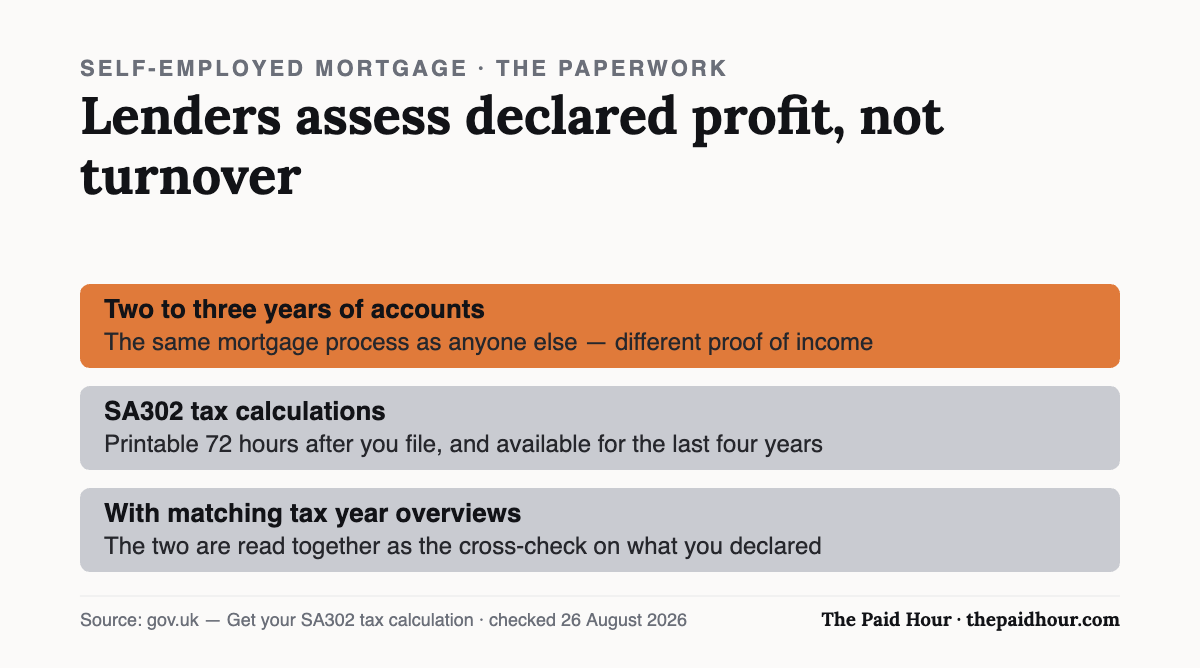
The short version: Lenders run the same mortgage process for the self-employed, they just ask for different proof of income. Expect two to three years of accounts, your SA302 tax calculations (printable 72 hours after you file, up to the last four years) with matching tax year overviews, and assessment on declared profit rather than turnover. This is general information rather than mortgage advice, an FCA-regulated adviser is the person to talk to.
A self-employed mortgage isn’t a different product. Same lenders, same rates, same deposit rules. What changes is the evidence, because there’s no employer payslip to point to. Instead, your Self Assessment paperwork does the talking, which means the application is partly won or lost a year or two before you ever speak to a lender. Here’s what gets asked for, where each document comes from, and how lenders read the numbers on it.
The documents lenders ask for on a self-employed mortgage
Everyone hands over the same base pack: proof of ID, proof of address, proof of deposit, and around three to six months of bank statements. On top of that, MoneyHelper’s application guide lists the self-employed extras: statements of accounts for the past two to three years, and the SA302 tax form, with its affordability guide putting it the same way: “typically, you’re asked to provide two or three-years’ worth of tax returns and business accounts”.
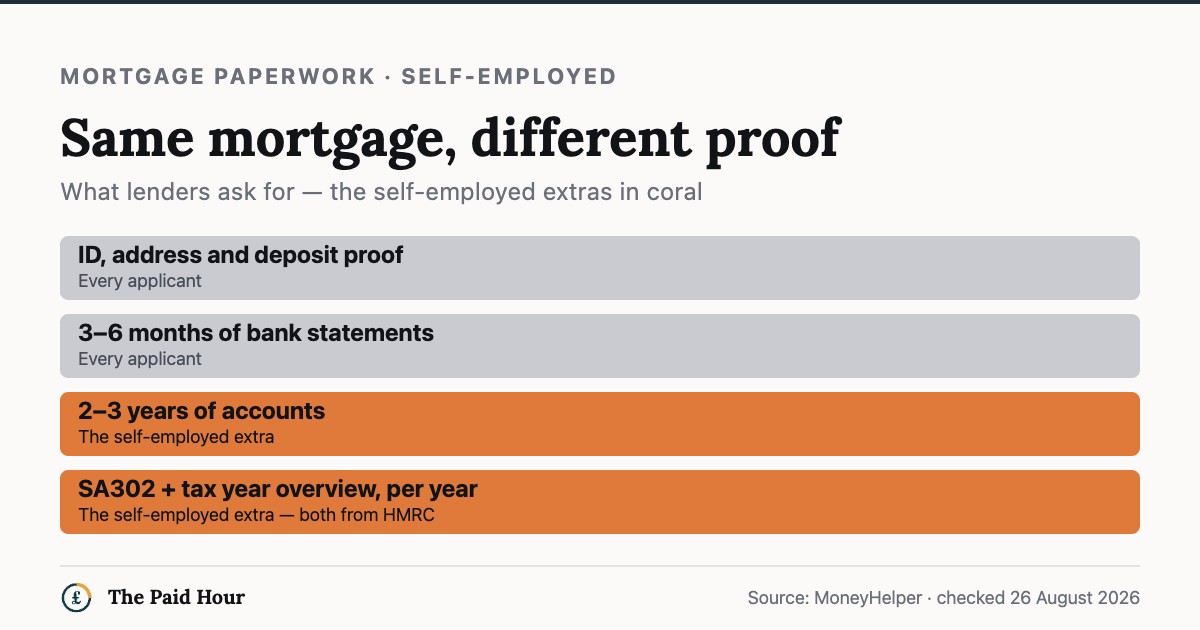
That “two to three years” is common practice, not law. Lenders set their own criteria and treat newer businesses, company directors and sole traders differently: one may take a single year’s figures, another wants three. The pattern is stable enough to plan around; the exact number is a question for the lender or broker in front of you. (Run a limited company and pay yourself in salary and dividends? Different evidence again — company accounts enter the picture, and the SA302 stops being the whole story.)
SA302: the self-employed mortgage document that says what you earned
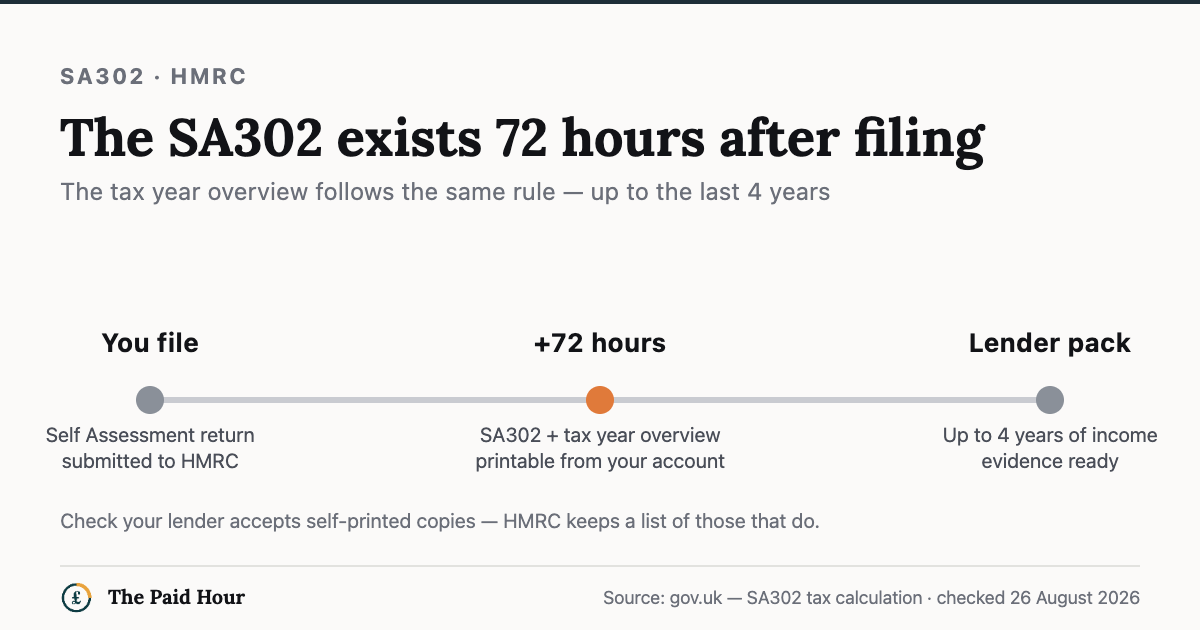
An SA302 is HMRC’s calculation of your tax for one year, and it exists for exactly this moment, gov.uk: “you might be asked for these documents as evidence of your income, for example if you’re applying for a mortgage and you’re self-employed”. You can get one for each of the last four years, from the Self Assessment section of your HMRC online account. If an accountant filed for you through commercial software, the calculation prints from that software instead (sometimes named “tax computation”), and the tax year overview still comes from HMRC.
Two timing details do the damage in practice. You can’t print anything until 72 hours after the return is submitted. And not every lender accepts self-printed copies. HMRC keeps a list of the ones that do, so check before you build your pack around a home-printed set.
The tax year overview — the cross-check
Lenders usually want a second HMRC document beside each SA302: the tax year overview. It confirms the tax you owed and paid for the year, which is how a lender knows the SA302’s numbers are the ones HMRC processed instead of a draft. Same source, same 72-hour rule, printed from your HMRC account. Treat the pair as one unit: an SA302 without its overview is half a document to most underwriters. And the whole pack gets read together, if the accounts, the SA302s and the bank statements tell three different stories about the same year, expect questions before you expect an offer.
The number self-employed mortgage lenders read
All of this paperwork exists to establish one figure: your declared profit, the same number you pay tax on rather than your turnover. MoneyHelper’s guide says lenders typically cap borrowing “at four and a half times your annual income”, with most people offered less. The arithmetic cuts both ways for a sole trader: every allowable expense you claim trims this year’s tax bill and trims the income a lender can multiply.
Neither side of that is advice to claim more or less: it’s just worth knowing that the taxable profit on your return is doing two jobs at once. How each lender averages a variable income across the years is their own criteria, and exactly the kind of question an adviser answers for your actual numbers.
Trading under two years: the self-employed mortgage problem
The two-to-three-year pattern is where newer businesses feel squeezed, and it’s the clearest case for using an adviser rather than guessing: criteria differ, and some lenders will work from a single filed year where others won’t. What’s in your control is making the year you do have count, the return filed promptly instead of at the deadline, records that match it, and a deposit that does some of the persuading. What’s not in your control is each lender’s rulebook, which is the adviser’s half of the job.
Timing: build the self-employed mortgage pack before the house-hunt
MoneyHelper puts approval at two to six weeks once you apply, the slow part is everything before that. If a purchase is on the horizon, file the outstanding return early rather than waiting for the January deadline: the year you’ve just finished only counts once it’s filed, processed and printable. First return still ahead of you? Start with your first Self Assessment as a freelancer, until it’s filed, none of these documents exist.
This is not mortgage advice
This page names no lender, ranks no product, and can’t tell you what you could borrow. Self-employed income assessment varies by lender and by your circumstances, and recommending mortgages is a regulated activity. For decisions, use a whole-of-market broker or an FCA-regulated mortgage adviser, MoneyHelper’s guide to mortgage advice notes an adviser can be particularly helpful if you’re self-employed, and covers checking an adviser on the FCA register.
Expenses claimed, borrowing capacity gone?
Self-Employed Mortgage Playbook 2026/27. Eight modules and four working sheets on how UK lenders really assess the self-employed, and the twelve-month preparation that changes what you can borrow.
- The borrowing estimator covering both the sole-trader reading and the company-director reading
- SA302 and tax year overview: the exact download steps, and why lenders want both
- A twenty-four month readiness timeline and the document pack index lenders ask for
Sole traders are read on a two-year average of net profit, and the lower figure when profit is falling. The expenses you claim this year set the ceiling on what you can borrow next year.
Buying more than one? All ten 2026/27 courses for £107, against £328 at full price.
Read next
- How to File Self Assessment as a Freelancer, Step by Step
- How Much To Save For Tax When Self-Employed
- Self-Employed Mortgage Playbook 2026/27 (course)
Sources
- Get your SA302 tax calculation: GOV.UK
- What is the mortgage loan application process? — MoneyHelper
- What mortgage can I afford?, MoneyHelper
- Mortgage advice: should you use a mortgage adviser?. MoneyHelper
The SA302 rules (last four years, the 72-hour wait, the self-printed acceptance check) and MoneyHelper’s document lists and 4.5× figure were re-checked against the linked pages on 26 August 2026. General information, not mortgage or financial advice, your position depends on your circumstances and each lender’s own criteria.