
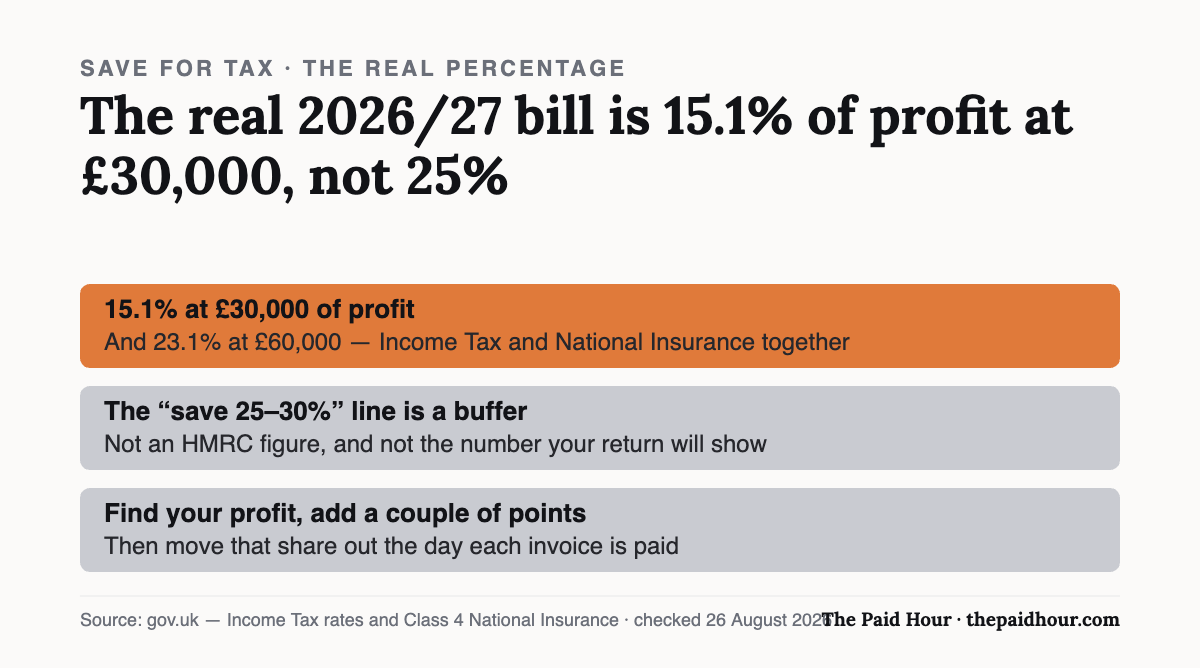
The short version: Most sole traders need to save for tax somewhere between 12% and 25% of profit, the real 2026/27 bill is 15.1% of profit at £30,000 and 23.1% at £60,000. The “save 25–30% for tax” line you see everywhere is a buffer rather than an HMRC figure. Find your profit in the table below, add a couple of points, and save for tax at that percentage, into a separate account, the day each invoice is paid.
How much to save for tax when self-employed comes down to one input: profit. Not turnover, and not the flat “25–30%” that gets repeated across freelancer forums and invoicing apps. HMRC publishes no set-aside percentage anywhere on gov.uk, so this page works one out from the actual 2026/27 Income Tax and National Insurance rates instead.
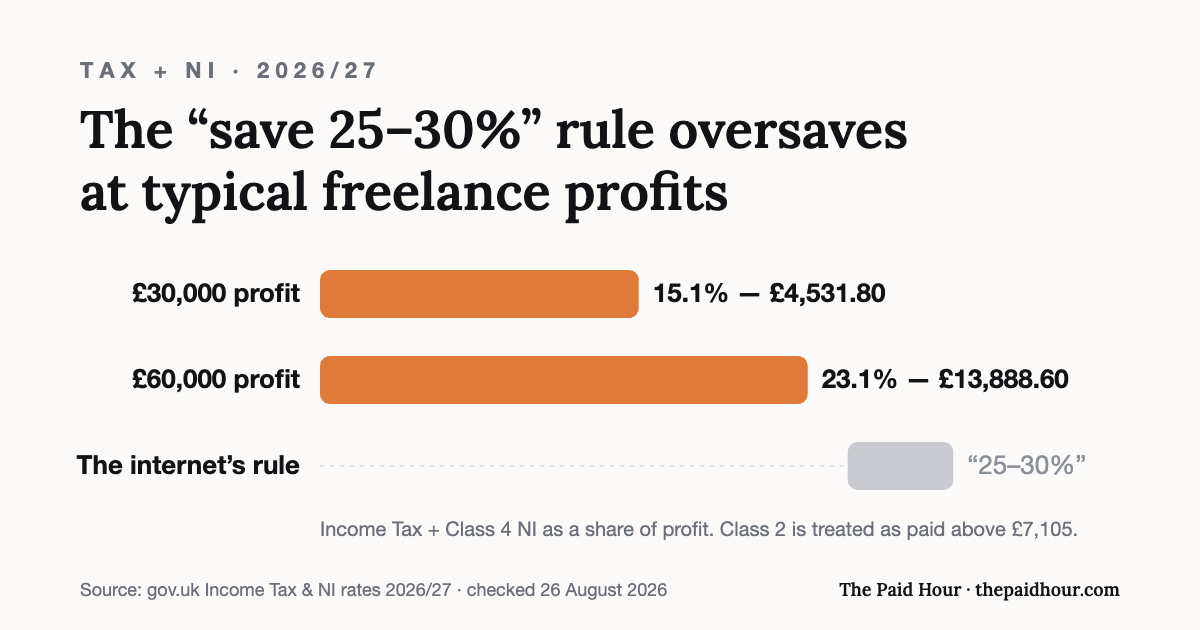
The short version: at £30,000 profit your real bill is 15.1% of profit. At £60,000 it is 23.1%. Saving a flat 30% overshoots for almost everyone under about £70,000. Safe, yes, but that is your cash sitting idle for a year.
How much to save for tax, by profit level
This table is Income Tax plus Class 4 National Insurance on 2026/27 rates, with Class 2 treated as paid automatically, which it is, once profit passes £7,105. The last column rounds up a few points so a good month or a forgotten expense does not leave you short.
| Profit | Tax + NI bill | Effective rate | Worth setting aside |
|---|---|---|---|
| £20,000 | £1,932 | 9.7% | 12% |
| £30,000 | £4,532 | 15.1% | 17% |
| £40,000 | £7,132 | 17.8% | 20% |
| £50,000 | £9,732 | 19.5% | 22% |
| £60,000 | £13,889 | 23.1% | 25% |
| £80,000 | £22,289 | 27.9% | 30% |
| £100,000 | £30,689 | 30.7% | 33% |
Bills rounded to the nearest pound; the exact workings are below. Two things stand out. There is no single self-employed tax percentage, the rate climbs with profit. And 25–30% only becomes literally true somewhere between £70,000 and £100,000. Below that, it is a safety margin wearing the costume of a rule.
The maths behind what you save for tax
Four rates build every figure in the table:
- Personal Allowance: the first £12,570 of profit is tax-free (gov.uk)
- Income Tax: 20% from £12,571 to £50,270, then 40% up to £125,140 (gov.uk)
- Class 4 National Insurance: 6% on profit between £12,570 and £50,270, then 2% above that (gov.uk)
- Class 2 National Insurance: treated as paid once profit passes £7,105, nothing to budget for unless you are below that and paying £3.65 a week voluntarily to protect your State Pension record (gov.uk)
The full detail (including how the Personal Allowance tapers away above £100,000), lives in the guides to Income Tax rates for 2026/27 and self-employed National Insurance. Here, two worked examples show the method.
£30,000 profit
- Taxable profit after the Personal Allowance: £30,000 − £12,570 = £17,430
- Income Tax, all at 20%: £3,486.00
- Class 4 NI at 6% on £17,430: £1,045.80
- Total: £4,531.80: 15.1% of profit
£60,000 profit
- Taxable profit: £60,000 − £12,570 = £47,430
- Income Tax: £37,700 at 20% (£7,540.00), then £9,730 at 40% (£3,892.00) = £11,432.00
- Class 4 NI: 6% on £37,700 (£2,262.00), then 2% on £9,730 (£194.60) = £2,456.60
- Total: £13,888.60: 23.1% of profit
What tax rate does a self-employed person pay?
There is no such thing as a self-employed tax rate. You pay the same Income Tax bands as an employee, plus Class 4 National Insurance on the same profits, and the two stack on top of each other.
For 2026/27, on each slice of profit:
- Nothing at all on the first £12,570, the Personal Allowance.
- £12,571 to £50,270: 20% Income Tax plus 6% Class 4 National Insurance. 26%.
- Above £50,270: 40% plus 2%. 42%.
Class 2 no longer has to be paid. HMRC treats it as paid once profits reach £7,105, and it is £3.65 a week if you choose to pay it voluntarily to fill a gap in your record.
Those are marginal rates: what the next pound of profit costs you rather than what the whole bill comes to. It is why the effective rates above land so much lower: the first £12,570 is free, and most sole traders never reach the 42% slice at all. So when someone asks what percentage the self-employed pay in tax, 26% is the honest answer for the great majority, and it is the number worth holding in your head when you are pricing work.
Save for tax the day you get paid
Knowing your percentage is the easy half. The habit that makes it work: the day a client pays, move your percentage of that payment into a separate account, before the money has time to look spendable. Every invoice, no exceptions, no maths beyond one multiplication.
In practice: a £1,800 invoice lands and you sit at roughly £40,000 profit for the year. Your row says 20%, so £360 goes across before anything else does. Thirty seconds, done monthly at worst, per payment at best. Most banking apps will do the split for you with a savings pot or a second account, and any interest the pot earns is itself taxable income, which feels unfair right up until you remember it used to sit in a current account earning nothing.
The alternative (saving whatever is left at the end of the month), fails in exactly the months it matters, because quiet months have nothing left. That is a cash-flow problem more than a tax one, and the guide to budgeting on an irregular income deals with it properly.
Get the percentage slightly wrong and nothing bad happens. Too high, and January leaves you with a surplus that was always yours. Too low, and you top up from current income, annoying, survivable. The failure mode worth avoiding is having saved nothing at all.
Why January can be 150% of a year’s tax
Your first Self Assessment bill usually is not one year’s tax. Once your bill passes £1,000, HMRC adds payments on account — this year’s balance plus 50% of next year’s estimated tax, paid up front, with another 50% in July. A freelancer who owes £4,500 for 2025/26 pays £6,750 on 31 January (gov.uk).
The table’s set-aside column absorbs most of this. If it is your first year of trading, it will not absorb all of it, add a few points, or at least know the bigger bill is coming.
What about VAT?
Nothing in the table covers VAT, deliberately. If you are VAT-registered. Compulsory once taxable turnover passes £90,000 in any 12 months (gov.uk), the VAT on your invoices was never your money. You are collecting it for HMRC. Park it in its own pot the day it arrives, separate from the income-tax pot, and the quarterly return becomes a transfer instead of a scramble.
Below the threshold, you can ignore this section entirely. Just know the £90,000 test is rolling turnover over any 12 months, not your accounting year, it catches people mid-year.
When to save for tax at a higher percentage
- Profits are growing. Save at this year’s likely rate instead of last year’s. A jump from £35,000 to £55,000 moves you two rows down the table mid-year.
- You earn above £100,000. The Personal Allowance taper pushes your marginal rate above 60%, the flat rules stop working entirely there; see the rates guide.
- You repay a student loan. Self Assessment collects the year’s repayments in one lump: the student loan guide covers the thresholds.
- You have other income. A part-time job or pension uses up allowance and basic-rate band before your freelance profit touches them, so your freelance percentage rises.
One number, moved on payday, reviewed once a year against real profit. That is the entire system.
What to do if you did not save for tax in time
It happens, and the worst response is silence.
File the return anyway. Filing and paying carry separate penalties, so being short of the money is no reason to also miss the filing date, that turns one bad month into two penalties instead of one. What the late filing penalties come to sets out the ladder.
Then arrange a payment plan rather than waiting to be chased. HMRC’s Time to Pay spreads a Self Assessment balance over instalments, and the conditions for setting one up online rather than by phone are in how HMRC Time to Pay works. Interest keeps running on what you owe, so it is not free, but a plan you keep to costs a great deal less than letting the balance sit.
And look at next year in the same week. If the coming year is going to be smaller, you can apply to cut the payment on account instead of borrowing to fund a figure calculated on a year you are not going to repeat. reducing your payments on account covers when that is worth doing and when it backfires.
Feast one month, famine the next?
Freelancer Money System 2026/27. Seven modules and five working sheets that pay you a predictable monthly amount out of unpredictable income: the account structure, the percentages, and where every pot should sit.
- A salary set from your trailing twelve-month low, not the average, with the calculator that finds it
- The day-it-lands allocation split, so tax and costs are moved before you can spend them
- The written drought plan for a bad quarter, the FSCS licence checker, and the surplus waterfall for a good year
Normal budgeting assumes a payday. Freelance income does not have one. The fix is not discipline, it is structure, and structure is a one-afternoon job.
Buying more than one? All ten 2026/27 courses for £107, against £328 at full price.
Need this ready-made? → UK Sole Trader Expense Tracker (Excel), HMRC expense categories pre-built (£5.99, instant download)
Read next
- UK Freelancer Tax Calculator 2026/27
- Self-Employed Tax Rates 2026/27: What You Actually Pay
- Payments on Account: Why Your First Tax Bill Is 150%
- How to File Self Assessment as a Freelancer, Step by Step
Sources
- Income Tax rates and Personal Allowances: gov.uk
- Self-employed National Insurance rates — gov.uk
- National Insurance: how much you pay, gov.uk
- Understand your Self Assessment bill: payments on account. Gov.uk
Rates and thresholds checked against gov.uk on 26 August 2026; every figure above is arithmetic from those published rates. General information, not tax advice, your own number shifts with pension contributions, Gift Aid, other income and anything else on your return.