
The one-paragraph answer: The self-employed mileage allowance for 2026/27 is 55p a mile for the first 10,000 business miles, then 25p, the first rise since 2011/12, worth £1,000 extra on 12,000 miles. Claim it instead of fuel receipts and repair bills, never for ordinary commuting, and not on a vehicle you’ve already claimed capital allowances on. Once you pick the flat rate for a vehicle, you keep it for as long as that vehicle is in the business.
The self-employed mileage allowance is the fixed amount HMRC lets you claim per business mile (client visits, site runs, deliveries), instead of totting up fuel, insurance, servicing and depreciation. It’s the vehicle strand of HMRC’s simplified expenses, open to sole traders and to partnerships with no company partners; a limited company can’t use it. The whole scheme, home-working rates included, is covered in the guide to simplified expenses flat rates, this page goes deep on the mileage rate, which just had its first real news in fifteen years.
The 2026/27 mileage allowance rates, and the 10p rise
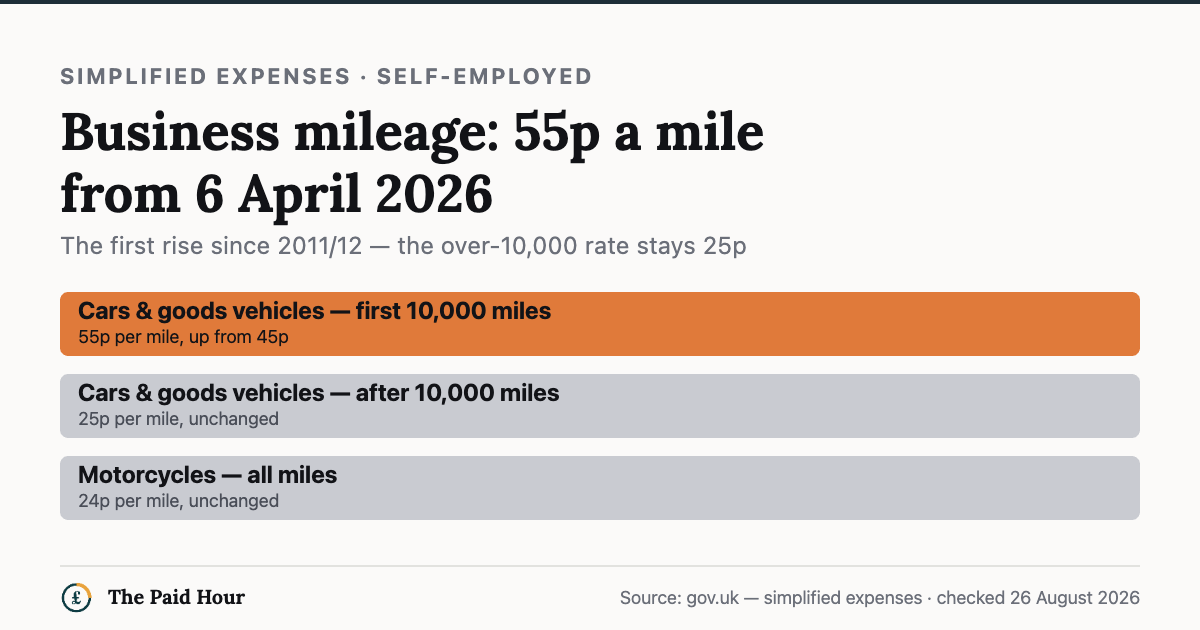
For the 2026/27 tax year, cars and goods vehicles claim 55p per mile for the first 10,000 business miles, then 25p for every mile after that. Motorcycles stay at 24p, however far you ride. The 55p is new, the rate had sat at 45p since 2011/12, and HMRC’s own announcement puts the increase “from 45 pence per mile to 55 pence per mile… taking effect from 6 April 2026”, with the over-10,000 rate unchanged at 25p. Claims for 2025/26 and earlier stay on the old 45p/25p.
What counts as a business mile? The drive to a client, between two jobs, out to a supplier, delivery and courier runs, journeys that exist because the work does. The daily run from home to one regular base is ordinary commuting, and commuting never counts, employed or self-employed. Where home is the business base, client trips from it can qualify, but if a travel pattern looks like commuting with extra steps, don’t claim it, check it first.
One thing the flat rate does not cover: bicycles. HMRC’s simplified expenses vehicle page lists cars, goods vehicles and motorcycles only: the 20p-a-mile bicycle rate you may have seen is the employee scheme rather than this one. If cycling is central to the business, claim the bike’s actual costs instead, and check your position with an accountant first.
What 12,000 miles is worth on the mileage allowance
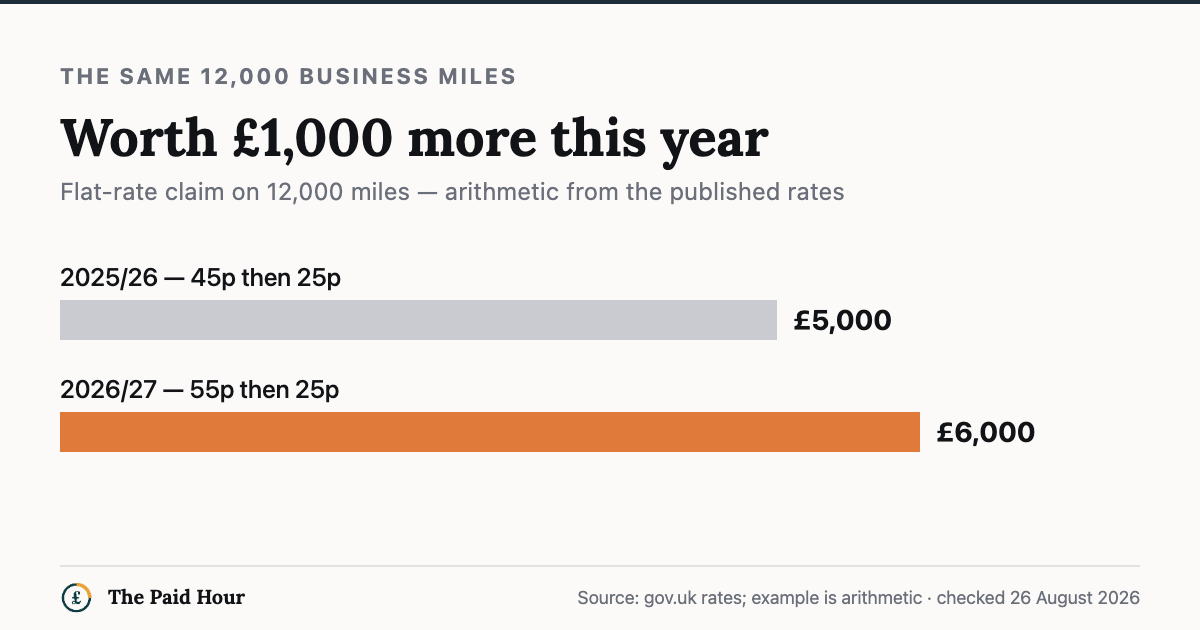
Say you drive 12,000 business miles in 2026/27. The claim splits at the 10,000-mile line: 10,000 × 55p is £5,500, the remaining 2,000 × 25p is £500: £6,000 off your taxable profit, with no separate claims for fuel, MOT, insurance or depreciation, because the flat rate is designed to stand in for all of it. The same 12,000 miles last year came to £5,000. Identical driving, £1,000 more.
At other mileages, same arithmetic:
| Business miles | 2026/27 claim | At 2025/26 rates |
|---|---|---|
| 5,000 | £2,750 | £2,250 |
| 8,000 | £4,400 | £3,600 |
| 10,000 | £5,500 | £4,500 |
| 12,000 | £6,000 | £5,000 |
| 15,000 | £6,750 | £5,750 |
| 20,000 | £8,000 | £7,000 |
On the return itself there’s no special box or claim form — miles × rate goes in with your other allowable expenses.
The figure the whole deduction rests on is the mileage itself, so keep a running log: date, where, why, how many miles. A note on your phone works; the habit is the point, and it slots into the same digital record-keeping you’re building for everything else.
Locked in: the mileage allowance switching rules
The choice is per vehicle, and it sticks. HMRC’s wording: once you use the flat rate for a vehicle, you must keep using it as long as you use that vehicle for your business. No year-to-year chopping between mileage and actual costs to chase the bigger deduction, the fresh choice comes when you change vehicle.
It also doesn’t mix with capital allowances. A vehicle you’ve already claimed capital allowances on (or expensed when working out profits) can’t move onto the flat rate, and a flat-rate vehicle can’t add capital allowances on top, the 55p already includes the wear. If the vehicle is expensive or business-specific enough that writing down its cost matters more than per-mile simplicity, that route is in the guide to capital allowances for sole traders.
Mileage allowance or actual costs?
For a modestly priced car doing real business miles, the flat rate usually wins on both money and effort: £6,000 for 12,000 miles without keeping a single fuel receipt is hard to argue with, and at 55p it just got harder. Actual costs plus capital allowances earn their extra admin when the vehicle is expensive, thirsty, or barely used privately. Run the comparison once, before the first return that includes the vehicle, the lock-in means you’re choosing for its whole life in the business, not for one year.
Employed as well? Different scheme, same headline
If you also have a job and use your own car for your employer’s business, that reimbursement runs on approved mileage allowance payments (AMAP), a separate scheme for employees that rose to the same 55p from April 2026. Keep the two apart: employer miles go through the employer, self-employed miles go on your return, and one mile never claims twice. Juggling a job and freelance work generally is covered in side hustle tax.
Correction, 26 August 2026: this guide conflated HMRC’s Approved Mileage Allowance Payments (the employee scheme), with the simplified-expenses flat rate available to the self-employed. They are separate schemes that happen to share a rate. The text now distinguishes them. See the corrections log.
Filing it yourself this year?
HMRC Tax & Expense Mastery 2026/27. Nine modules and eleven working templates that take a UK freelancer from “do I even need to register” to a correct return, with MTD quarters built in.
- Fifteen expense categories, with the trap inside each one (training, clothing, meals, the seven-year pre-trading rule)
- Home and vehicle: flat rate against actual cost, with the £312 break-even worked out and the mileage lock-in rule
- The year-one payments-on-account cash shock, and the routine that stops it landing twice
HMRC does not send a list of what you forgot to claim. Most freelancers leave several hundred pounds of legitimate expenses on the table every single year, and the return still gets filed.
Buying more than one? The Complete Freelancer System, all five for £87, against £215 at full price.
Sources
- Simplified expenses if you’re self-employed: vehicles, GOV.UK
- Simplified expenses if you’re self-employed: overview: GOV.UK
- Increasing mileage rates: GOV.UK
- Travel (mileage and fuel rates and allowances), GOV.UK
The 55p/25p and 24p rates, the 6 April 2026 start date, eligibility and the per-vehicle lock-in were re-checked against gov.uk on 26 August 2026; the worked example is arithmetic from those published rates. General information, not tax advice, your own position depends on your vehicle, your records and the rest of your return.