
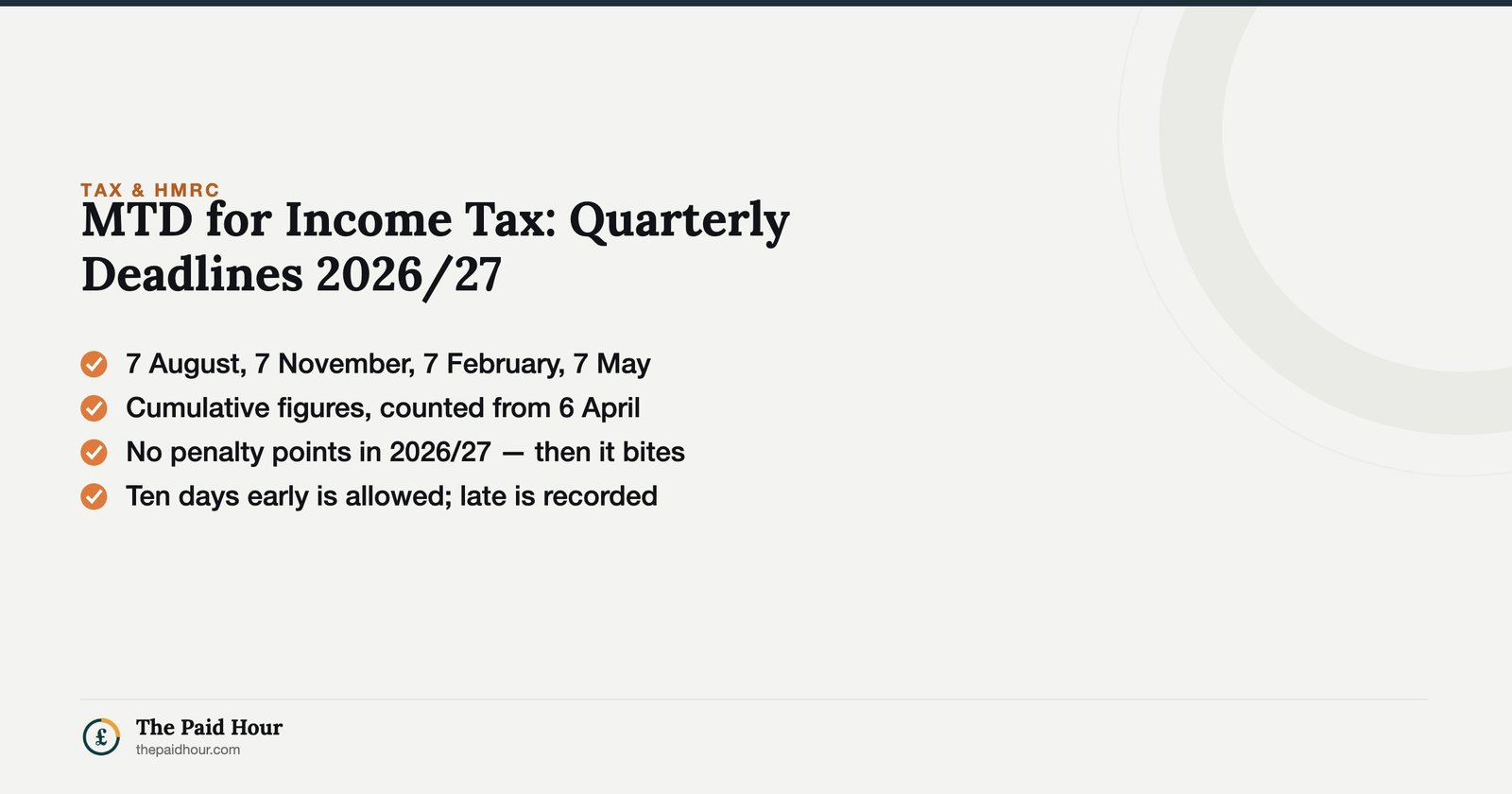
Before you read on: If MTD for Income Tax applies to you, updates are due on 7 August, 7 November, 7 February and 7 May, cumulative figures each time, counted from 6 April. The first one has already passed. There are no penalty points in 2026/27, but that grace ends with the tax year.
Table of Contents
Sole traders and landlords earning more than £50,000 in qualifying income didn’t get a gentle introduction to Making Tax Digital. The first cohort’s opening quarterly update was due on 7 August 2026. That deadline has already been and gone. Some people hit it without issue, some missed it without quite realising what missing it means. This isn’t another “what is MTD” explainer; we’ve already published two of those. This one is the calendar: the MTD for Income Tax quarterly deadlines, spelled out exactly, plus what goes into each submission and what HMRC does when you’re late.
Who MTD for Income Tax applies to right now
This applies to you only if your qualifying income, gross turnover from self-employment and property combined, before any expenses come off, was over £50,000 in the 2024/25 tax year. HMRC based mandation on that year’s Self Assessment return and wrote to people who cleared the bar. If your turnover sat between £30,000 and £50,000, you get an extra year: you join from 6 April 2027, based on 2025/26 income. Anyone above £20,000 follows from 6 April 2028, based on 2026/27 income. Under £20,000 and you’re not in scope yet, though nobody expects that threshold to stay there forever. These are the same thresholds that decide who has to follow MTD for Income Tax from year one.
If any of this is unfamiliar, our guide to what changes for sole traders under MTD covers the basics: the software requirement, the shift away from one annual return, all of it. This post assumes you already know that and just want the dates. Either way, the MTD for Income Tax deadlines below are what actually matter once you’re mandated.
MTD for Income Tax: the four quarterly deadlines for 2026/27
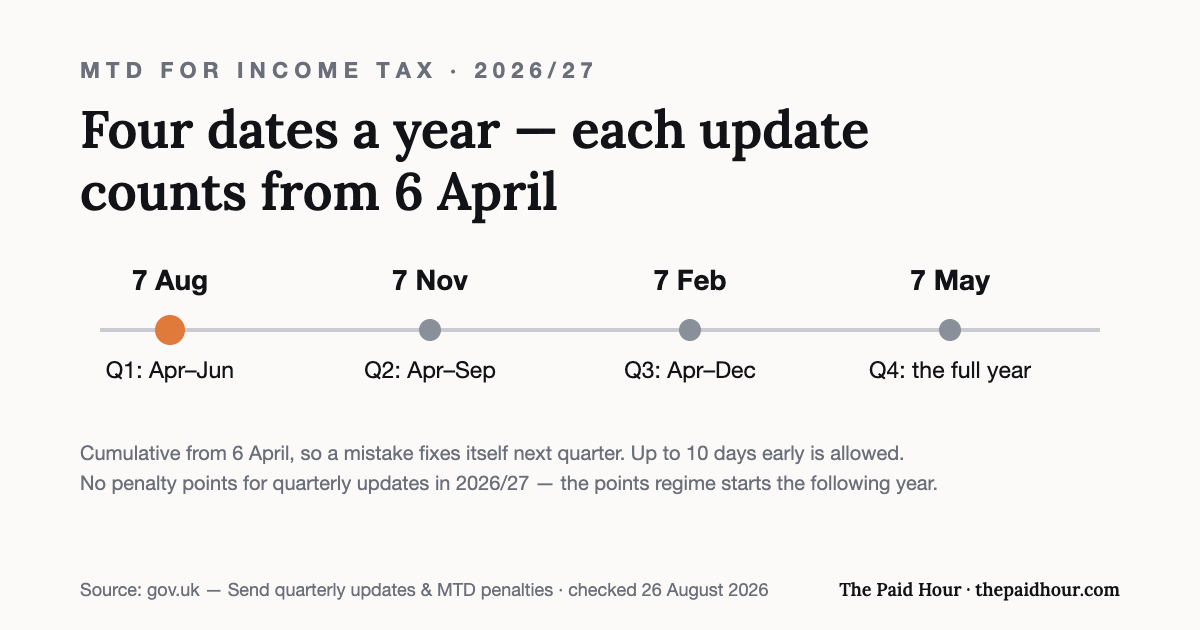
Here is the mistake to avoid: the quarterly updates aren’t four separate three-month reports. They’re cumulative. Each one covers everything from the start of the tax year, 6 April, up to that quarter’s cut-off point, not just the three months since your last submission. So the second update isn’t “July to September.” It’s the whole 6 April to 5 October, with quarter one’s figures already sitting inside it. That’s the part of the MTD for income tax quarterly deadlines system that catches most people out.
| Update | Period covered | Deadline |
|---|---|---|
| 1st quarterly update | 6 April – 5 July 2026 | 7 August 2026 |
| 2nd quarterly update | 6 April – 5 October 2026 | 7 November 2026 |
| 3rd quarterly update | 6 April – 5 January 2027 | 7 February 2027 |
| 4th quarterly update | 6 April – 5 April 2027 | 7 May 2027 |
Deadlines fall on the 7th of the month rather than the 5th, which is where people usually go wrong doing the maths in their head. Quarter one closes on 5 July, but you’ve got until 7 August. Two extra days, every quarter, always. The MTD for income tax quarterly deadlines don’t shift around from year to year, either — the same 7th-of-the-month pattern applies for as long as you’re in the scheme.
The calendar-quarter alternative
There’s a second option, for anyone whose bookkeeping naturally runs on a calendar basis rather than the standard 6 April tax year: calendar update periods, running 1 April, 1 July, 1 October and 1 January instead. The deadlines stay the same: 7 August, 7 November, 7 February, 7 May, only the quarter boundaries shift slightly. You choose one system or the other before your first submission of the year, and gov.uk is explicit that you can’t switch partway through once that first update has gone in. That choice only affects which dates count as the MTD for income tax quarterly deadlines within the year, nothing else about how MTD works changes.
What goes into each MTD for Income Tax submission
The relatively good news: a quarterly update is not a mini tax return. You’re not calculating tax owed or claiming reliefs each quarter. It’s a running total of income and allowable expenses, by category, pulled from your digital records. If you’re using proper MTD-compatible software, see our accounting software roundup for what handles this well, most of the pulling-together happens automatically once your bank feed and receipts are up to date. The bit that’s still on you is deciding what counts as a genuine business expense in the first place, and keeping anything with a personal element out of it.
Because the totals are cumulative, an error in quarter one doesn’t need a formal correction. It just carries through and self-corrects in the next update, since each submission recalculates from 6 April instead of standing alone. That’s one part of the redesign HMRC arguably got right, the original plan had four standalone submissions that each had to be correct in isolation, and that’s not how the system that launched works.
End of year: the MTD for Income Tax final declaration
Quarterly updates don’t settle your tax bill. That happens once, at year end, through what HMRC calls the final declaration, this now folds together what used to be a separate end-of-period statement and full Self Assessment return into one step. You review the cumulative totals from your four updates, add anything they didn’t capture (PAYE income, dividends, gift aid, other reliefs), confirm the calculation, and submit.
Deadline: 31 January following the end of the tax year. For 2026/27, that’s 31 January 2028: same date freelancers have always worked to, MTD or not. Payment falls due the same day. For the wider calendar and what happens if payment is late, we’ve covered that separately in our Self Assessment deadlines guide.
The penalty points system, the real numbers
Miss a deadline during 2026/27 itself and, on the submission side, nothing happens. HMRC has confirmed no penalty points get issued for late quarterly updates in this first year of MTD for Income Tax. That’s a genuine grace period, stated plainly in HMRC’s own penalties guidance rather than a rumour going round accountancy circles. Late payment penalties are a separate matter and still apply regardless of any grace year.
From the second year onward, it’s the points system already running for VAT, extended to income tax: miss a deadline, get one point. Reach four points and you’re charged a fixed £200 penalty, then another £200 every single time you’re late again after that, for as long as you’re sitting at the threshold. One point per missed deadline applies even if you run more than one business and several updates land late in the same period; HMRC issues a single point, not one per business, which is more forgiving than it could have been.
Points don’t sit there forever if you stay under the threshold, each one drops off automatically 24 months after the deadline it was issued against. But once you’ve hit four and triggered a penalty, getting back to zero is stricter: you need twelve straight months of on-time submissions, and you have to clear anything still outstanding from the previous 24 months. Slip once during that clean run and the clock starts over.
Why this surprises people more than the £200 suggests
The annoying part isn’t the £200 itself, plenty of freelancers could absorb that without much thought. It’s that the points system rewards consistency and punishes drift. Someone who’s late twice a year, every year, forever, never quite crosses the threshold and never quite gets clean either. It’s built to catch chronic lateness rather than the odd slip, which means the real risk is treating quarterly updates as optional admin you’ll get round to eventually, instead of a fixed date with a real consequence attached to it.
Put the four MTD for income tax quarterly deadlines in whatever calendar you actually check rather than the one you set up once and forgot about. 7 August, 7 November, 7 February, 7 May, every year you’re mandated. Miss one in year one and the only real risk is on the payment side if tax is owed. Miss them repeatedly from year two, and it adds up in a way that’s easy to ignore right up until it isn’t.
Why most people never think about these dates day-to-day
In practice, the MTD for income tax quarterly deadlines mostly take care of themselves once your bookkeeping software is connected to your bank feed. You categorise transactions as they come in, or your software suggests categories and you approve them. The quarterly figures are already sitting there waiting when the submission window opens.
The people who find this stressful are almost always the ones still doing their bookkeeping in one big batch a few days before each deadline, trying to reconstruct three months of receipts from memory. That’s not really an MTD problem. It’s the same problem sole traders have always had with record-keeping, just with four checkpoints a year instead of one.
If your current software doesn’t make this close to automatic, it’s worth checking whether it’s on HMRC’s recognised list. Or whether it’s time to move to one that is. We’ve compared the main options for UK sole traders in our accounting software roundup.
The actual steps, if you’ve never sent an MTD for Income Tax update
Log into your MTD-compatible software rather than HMRC’s website directly, you can’t file a quarterly update through your Personal Tax Account or the old Self Assessment portal. The software pulls your categorised transactions for the period, shows you the running totals by income and expense category, and gives you a chance to review before you submit.
Check the figures against your own records rather than trusting the software blindly, especially the first time. Bank feed categorisation gets things wrong occasionally: a personal transfer tagged as income, a business expense sitting in the wrong category. None of this needs fixing before you submit; it just needs to be right by the time the final declaration goes in.
Once you’re happy, you submit directly from within the software. There’s no separate HMRC login step, no uploading a file anywhere else. You’ll usually get an on-screen confirmation and a copy in your software’s submission history, which is worth keeping even though HMRC also has its own record of it.
The MTD for income tax quarterly deadlines aren’t something you build a whole afternoon around, in other words. Once the software side is set up properly, each submission is closer to a five-minute check than a task.
Related: crypto tax for UK sole traders — crypto that counts as a trade feeds into these same quarterly updates.
The quarterly update dates sit alongside every other deadline of the year in the 2026/27 tax year calendar.
Miss one of these dates and what it costs depends on the year: there are no penalties for a late quarterly update in 2026/27, and points only start applying from 2027/28.
Picking software, or fixing the one you have?
Digital Bookkeeping System (MTD-ready) 2026/27. Seven modules and a seven-sheet toolkit, built around a category-to-tax-box mapping table that makes your quarterly updates fill themselves.
- A software decision sheet costed over three years, split by turnover, VAT status and phone-or-desktop
- The chart of categories mapped to the Self Assessment and MTD boxes, and the three categories never to auto-categorise
- Weekly and month-end cards, an MTD quarter-close checklist, and an export-and-archive index so their cloud is never your only copy
- Free download: MTD Readiness Checker
Software is priced monthly, excluding VAT, and you will hold the subscription for years. Pick on the wrong number and the difference over three years is more than every course on this site combined.
Buying more than one? All ten 2026/27 courses for £107, against £328 at full price.
Sources
Deadlines, the cumulative rule and the 2026/27 penalty position were re-checked against gov.uk on 26 August 2026.
This is general information about how the rules work, not tax advice. The links above go to the primary sources; for your own circumstances, speak to an accountant or contact HMRC directly.