
Straight answer: Rent on a storage unit you use only for your business is an allowable expense. It sits on HMRC’s own list as “rent for business premises”, and the compulsory insurance is on the same list. The catch is mixed use: the day a personal box goes in, you can only claim the business share. And self storage carries 20% VAT, which you only get back if you’re VAT-registered.
Table of Contents
For a lot of sole traders, the first premises they ever rent is a storage unit. Stock stops fitting in the spare room, tools stop being safe in the van, and a lock-up ten minutes away starts to look sensible. This guide covers what a unit really costs, how to size it, how the tax works, and what to check before you sign anything.
Who actually needs business storage
Three groups keep turning up at the same storage counters.
- Online sellers. eBay, Etsy, Vinted and Amazon stock, plus the packaging that comes with it. If you sell on those platforms, HMRC already receives your sales figures from the platform itself; the storage bill is one of the costs you set against them.
- Tradespeople. Tools and materials that shouldn’t live in a van overnight. A unit near the jobs means the van stops being a target.
- Anyone whose home is being taken over. The working-from-home flat rate is based on hours, not square feet, so it doesn’t grow because the hallway is full of boxes. A separate unit is claimed on top, at its actual cost.
You’re not an edge case. The Self Storage Association UK’s 2026 industry report says 76% of storage use is domestic, which means roughly a quarter of the space in the country’s 3,143 stores is already being used by businesses.
What it costs: an honest benchmark
No operator publishes a national price list. Every quote is per store, per unit size, on the day you ask. What the industry does publish is an average: the SSA UK 2026 report puts average revenue at £27.40 per square foot per year. Apply that to the sizes small businesses actually rent and you get a useful yardstick.
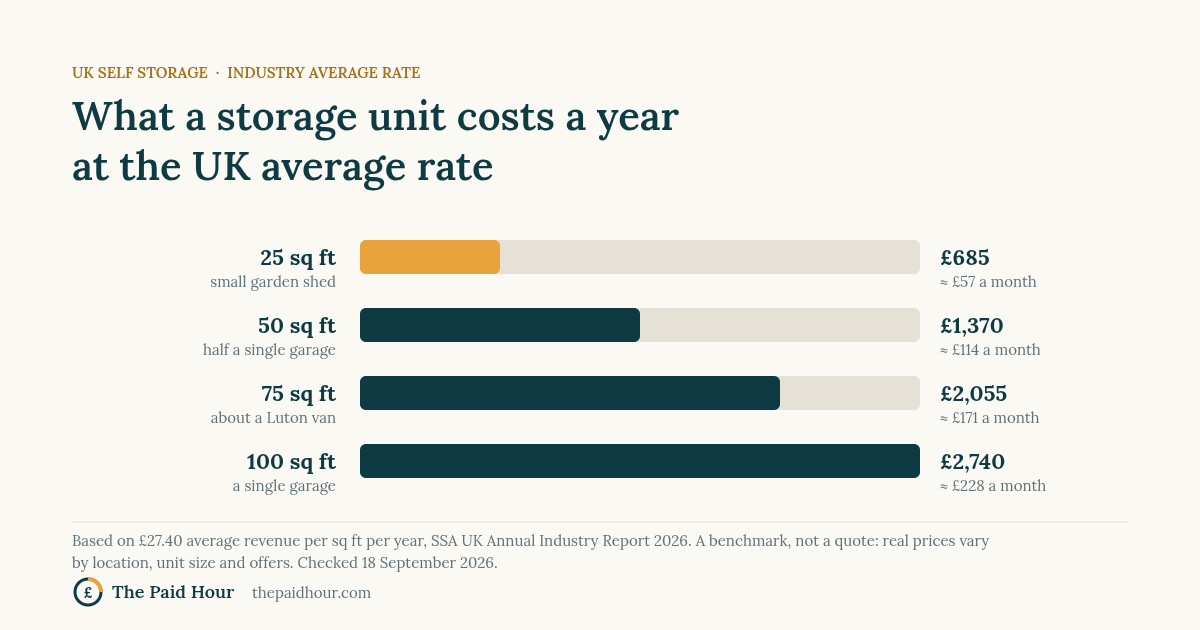
- 25 sq ft (a small garden shed): about £685 a year, or £57 a month
- 50 sq ft (half a single garage): about £1,370 a year, or £114 a month
- 75 sq ft (roughly a Luton van): about £2,055 a year, or £171 a month
- 100 sq ft (a single garage): about £2,740 a year, or £228 a month
Treat these as a benchmark, not a quote. Inside the M25 expect more; in a regional town, often less. Sector occupancy sits at 74.5%, which is why introductory offers are everywhere: Safestore, for example, runs a £1 first month or 50% off for up to eight weeks. Read the conditions before you count on them. New customers only, selected stores and sizes, the two offers can’t be combined, the 50% deal wants the first four weeks paid upfront, and “admin fees may apply”.
Billing at Safestore is typical of the sector and worth knowing before you compare anyone: the price you’re quoted includes VAT, you’re invoiced every four weeks in advance, there’s no deposit, and most customers pay by Direct Debit. On a variable contract the minimum stay is one day.
How big a unit you need
Operators describe sizes in household terms, because that’s what most of their customers are moving. Here’s the same scale translated for a business.
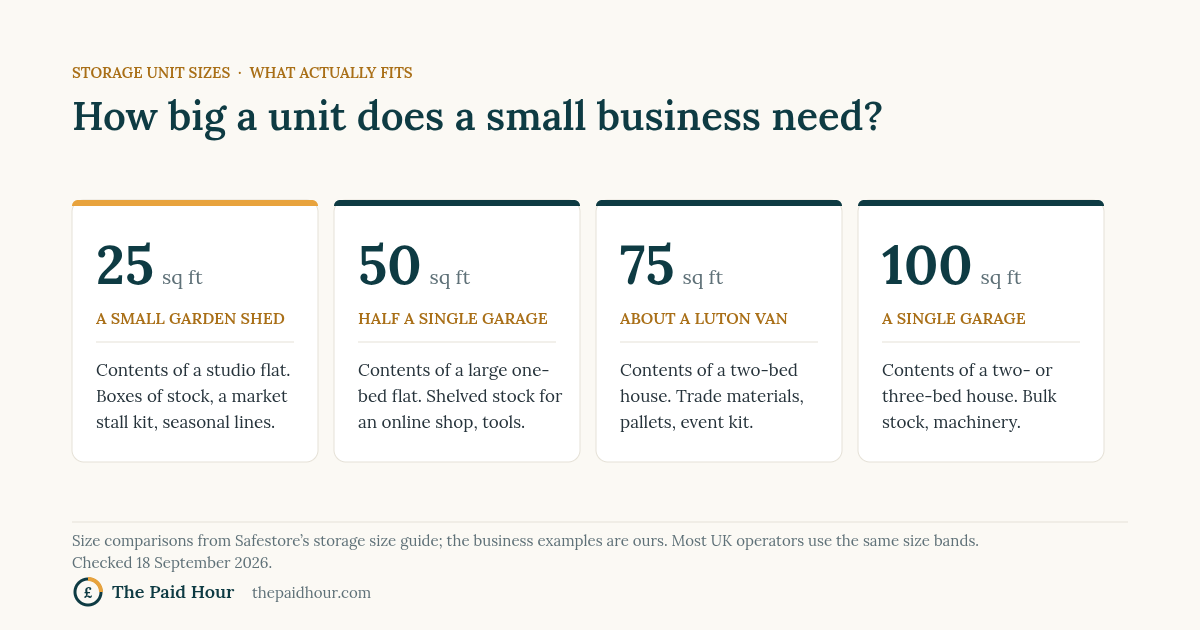
Two rules save real money. Go up, not out. Units are priced by floor area, not volume, so a set of racking turns a 25 sq ft unit into what most people think they need a 50 for. And start one size smaller than instinct says. Ask whether you can move up a size later; operators generally allow it, and every square foot you don’t rent is £27 a year at the average rate.
Can you claim it against tax? Yes, with one catch
HMRC’s list of allowable expenses for office, property and equipment names five business premises costs you can claim: rent for business premises, business and water rates, utility bills, property insurance and security. A storage unit rented for stock or tools is business premises you rent. The contents insurance the operator makes you take out is property insurance. Both belong on your return.
The catch, in HMRC’s own words: “You cannot claim for any non-business use of premises.” If half the unit is stock and half is the family’s Christmas decorations, half the bill is claimable and you’ll need to be able to justify the split. The simplest fix is to keep the unit business-only. Then the whole invoice is the claim and there’s nothing to argue about.
Where it goes on the return. Box 14 on the short self-employment pages (SA103S) or box 21 on the full pages (SA103F), both labelled “Rent, rates, power and insurance costs” on the 2026 forms. Keep every four-weekly invoice; that’s your evidence.
Two things the storage bill isn’t. It isn’t covered by the working-from-home flat rate, which is for the costs of your home, so the unit is claimed separately at its actual cost. And racking or shelving you buy for the unit is equipment, not rent, so it goes through the equipment rules rather than this box. Our allowable expenses guide covers where each of those lands.
The VAT catch
Renting land and buildings is normally exempt from VAT. Self storage isn’t. The law specifically carves “the grant of facilities for the self storage of goods” out of the land exemption, so it’s standard-rated at 20%. That’s why a Safestore quote is expressed with VAT included.
If you’re VAT-registered, ask for a VAT invoice and reclaim the 20% as input tax. Your real cost is the ex-VAT figure, which makes storage roughly a sixth cheaper for you than for the sole trader next door.
If you’re not, the VAT is simply part of what the unit costs you, and you claim the full VAT-inclusive amount as your expense. You don’t lose it; it reduces your taxable profit instead of coming back as a refund.
Seven things to check before you sign
- Contract type and notice. Safestore’s variable contract has a one-day minimum stay. Notice terms live in the licence agreement, not the marketing page, so read them before you pay.
- Insurance is compulsory. Either the operator’s cover (StoreProtect at Safestore, priced on the value you declare) or your own policy. Before relying on your own, check that your business insurance actually covers stock and tools away from your premises. Not every policy does.
- Access hours. Standard opening hours, with extended access “by arrangement”. If you load the van at 6am, confirm that arrangement exists at your store before you sign, not after.
- Deliveries. Many Safestore stores will accept deliveries on your behalf, which is a quiet game-changer for an online shop. Confirm it at the store you’re actually using.
- What the offer reverts to. The £1 first month and the 50% deal both end. Ask for the standard four-weekly rate in writing, because that’s the number you’ll be paying for most of the year.
- Use the price guarantee properly. Safestore will beat a comparable local quote by 10% for the first eight weeks and hold that rate for up to 26 weeks. The conditions: first-time storers only, same-size individual room, quote presented within 28 days of moving in, within 3 miles inside the M25 or 5 miles elsewhere, compared on a four-week stay including VAT. You need a competitor’s quote in hand to trigger it, so getting a second quote is literally how you get the discount.
- Long-stay discounts. Up to 55% off for a 12-month stay, at a limited number of stores. Only worth it if you’re certain of the twelve months.
Where to get a quote
Safestore
Quoted per store with VAT included, no deposit, invoiced every four weeks. Variable contract from one day, deliveries accepted at many stores, and a lowest price guarantee if you bring a rival quote.
Get a Safestore quoteRead next
- Allowable Expenses for UK Freelancers: 2026/27 List
- Working From Home Tax Relief for Sole Traders
- HMRC Platform Reporting: Vinted, eBay and Etsy Rules
- Self-Employed Insurance UK: What Freelancers Actually Need
Sources
- gov.uk, Expenses if you’re self-employed: office, property and equipment
- gov.uk, Self-employment (short) SA103S, 2026 form
- gov.uk, Self-employment (full) SA103F, 2026 form
- legislation.gov.uk, VAT Act 1994, Schedule 9, Group 1, item 1(ka): self storage
- Self Storage Association UK, UK Annual Industry Report 2026
- Safestore, Business storage
- Safestore, FAQs
- Safestore, Storage sizes
- Safestore, Lowest Price Guarantee terms
The HMRC expense list, the SA103 box numbers, the VAT position, the SSA UK figures and Safestore’s offers and billing terms were all checked against the sources above on 18 September 2026. This is general information about how the rules work, not tax advice. For your own circumstances, speak to an accountant or contact HMRC directly.