
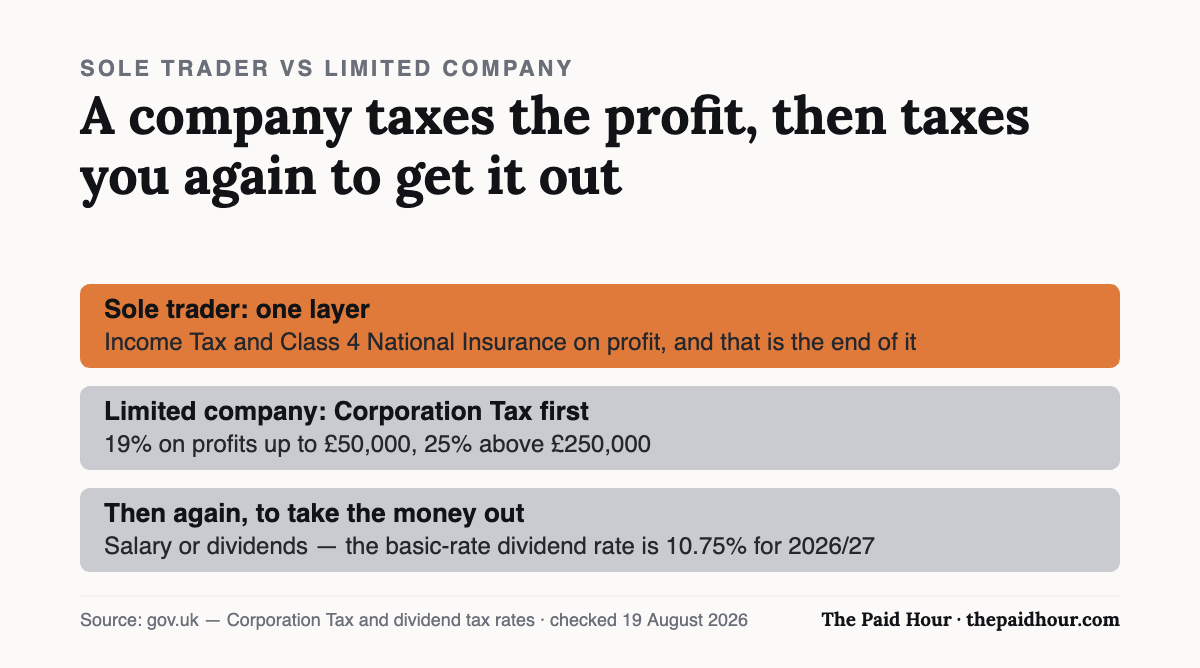
Quick answer: A sole trader pays Income Tax and Class 4 National Insurance on profit. A limited company pays Corporation Tax instead: 19% on profits up to £50,000, 25% above £250,000, and then you pay again to get the money out, through salary or dividends. For 2026/27 the basic-rate dividend rate is 10.75%, up from the 8.75% most comparison articles out there are still quoting. We’re not going to hand you a number for which one’s cheaper: that depends on figures only your accountant can price properly. What we can do is show you exactly what changes.
Why we won’t give you a magic number
Search this question and you’ll find dozens of articles offering a confident threshold: incorporate above £30,000, or £40,000, or £50,000. Treat every single one of them carefully.
The answer moves with your salary level, whether you’ve got other income, whether your partner’s a shareholder, what you pay an accountant, whether you need the money now or can leave it sitting in the company, and whether the rates change, which they just did. A number that was right in 2023 isn’t right anymore.
What doesn’t move is the structure itself. Understand that, and you’ll know exactly which questions to ask when you eventually pay someone to run your actual figures.
Sole trader vs limited company: one layer of tax, or two
This is the whole thing in one idea.
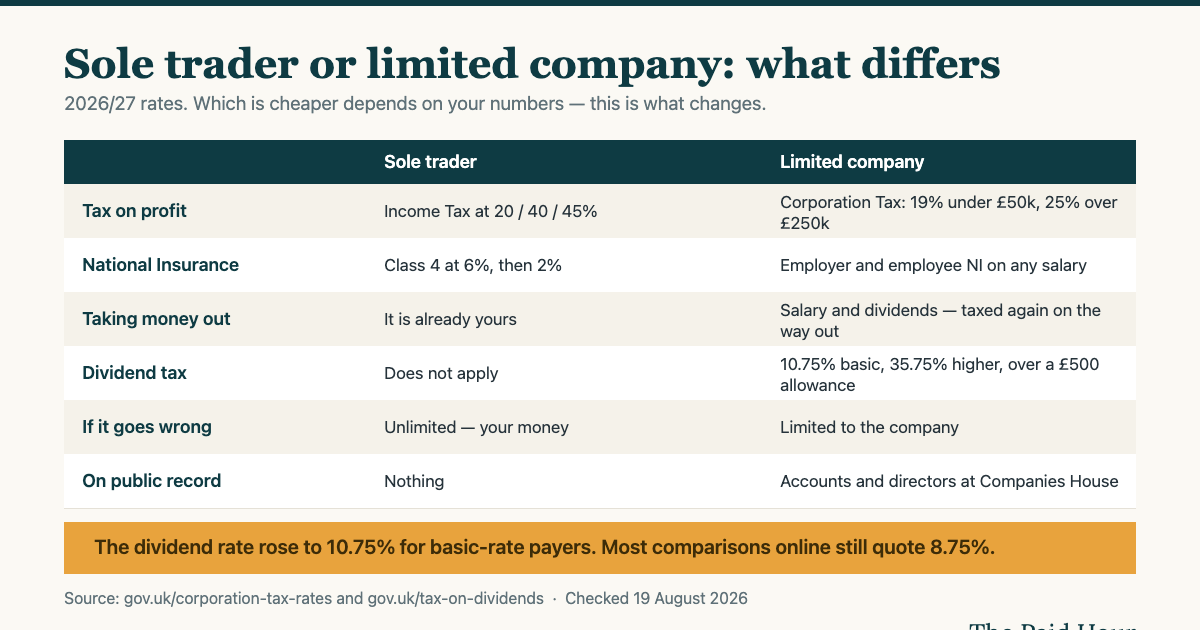
As a sole trader, the profit is you. You pay Income Tax at 20, 40 or 45%, and Class 4 National Insurance at 6%, then 2% above £50,270 (see our Class 4 National Insurance breakdown). Once that’s paid, the money is simply yours. Moving it from the business account into your personal account isn’t a taxable event at all, because there’s no legal distinction between the two accounts to begin with.
As a limited company, the profit belongs to the company rather than you. The company pays Corporation Tax on it. Then, to get that money into your own hands, you pay yourself, and that payment gets taxed again. Salary attracts Income Tax and National Insurance, including employer’s National Insurance. Dividends attract dividend tax instead.
Two layers isn’t automatically worse, though. Corporation Tax at 19% is lower than 20% Income Tax plus 6% Class 4, and dividends don’t carry National Insurance at all. That gap is where the saving has traditionally come from.
The sole trader and company rates, verified
Corporation Tax
- 19%: the small profits rate, on profits of £50,000 or less
- 25%: the main rate, on profits over £250,000
- Between the two, Marginal Relief tapers you gradually from one rate to the other
One detail that catches out people running more than one company: those £50,000 and £250,000 thresholds get divided by the number of associated companies you have, and reduced pro rata for short accounting periods. Run two companies, and each one gets half the threshold.
Dividend tax, 2026/27
| Your Income Tax band | Dividend rate above the allowance |
|---|---|
| Basic rate | 10.75% |
| Higher rate | 35.75% |
| Additional rate | 39.35% |
The dividend allowance is £500. Not £2,000 rather than £1,000: £500. It’s been cut repeatedly over the years and it’s now small enough that it barely features in the calculation anymore.
The basic rate of 10.75% is the figure worth noticing. A great deal of the “go limited and save thousands” writing floating around online was calculated at 8.75%. Two percentage points on the dividends a small company actually pays out matters, and it narrows the gap that made incorporating attractive to begin with.
HMRC’s own example of how the bands interact: £3,000 of dividends alongside £29,570 of wages gives £32,570 total. After the £12,570 Personal Allowance, £20,000 is taxable: 20% on £17,000 of wages, nothing on £500 of dividends, and 10.75% on the remaining £2,500. Dividends sit on top of your other income when working out which band applies to them.
The three things that decide it, and none of them are tax
Liability. A sole trader carries unlimited liability: the business’s debts are your debts, and your personal assets are exposed. A limited company is a separate legal person, so the exposure is generally limited to what’s sitting inside it. If your work carries real financial risk (stock, premises, contracts with serious penalties), this reason alone can settle the question regardless of what the tax says.
Who your clients are. Some larger organisations will only contract with limited companies, full stop. If that describes the work you’re chasing, the decision’s already been made for you.
Admin, and what it costs. A company means annual accounts, a Company Tax Return, a confirmation statement, payroll if you take a salary, and directors’ duties on top. Your accountant’s fee goes up accordingly. That extra cost comes straight off any tax saving, and on modest profits it can eat the whole thing.
There’s also a privacy point people forget entirely: a limited company puts your accounts and your name on the public record at Companies House. A sole trader publishes nothing at all.
Things that change the moment you incorporate
- You can’t use cash basis accounting. Limited companies are excluded from it.
- You can’t use simplified expenses. No mileage flat rate, no home-working flat rate.
- Record-keeping rules differ from the sole trader ones you’re used to.
- You become an employee of your own company if you take a salary, with all the payroll obligations that implies.
Those four are easy to overlook and they change your day-to-day admin more than the tax rates ever will.
Sole trader vs limited company: what to do with this
- Work out your actual annual profit, income minus allowable expenses. Everything below depends on this one number.
- Ask yourself the liability question first. If the answer is “a bad contract could take my house,” the tax is secondary.
- Get a quote for company accounts from an accountant before you decide anything. That number is real, and it’s recurring.
- Then, and only then, ask an accountant to run both scenarios on your actual figures at current rates. An hour of their time is cheaper than getting this wrong for three years running.
- Don’t act on a threshold you read in a blog post. Including this one, we’ve deliberately not given you one.
It shows up in borrowing too. A business credit card taken by a sole trader is personal debt with a business name on it, and there is no company standing between you and the balance, see business credit cards for sole traders.
Incorporating also puts an address on the public register the same day. If you would rather that were not your home, read what a registered office address costs before you file.
Is a limited company actually going to pay you more?
Sole Trader to Ltd Transition 2026/27. The comparison recomputed at real 2026/27 rates after the April dividend rise, the one retention scenario where a company still wins, and the fourteen-step execution plan if it does.
- The computed comparison table from £35,000 to £100,000, with every assumption stated
- The full break-even calculator: change any assumption and it recalculates
- Incorporation in fourteen steps with current Companies House fees, the identity-verification rule in force since November 2025, and the transfer schedule
- Free download: Go-Limited Scorecard
Every free calculator still ranking on Google uses pre-April-2026 dividend rates. Incorporating on the strength of one of them is a decision you pay for every year afterwards.
Buying more than one? The Complete Freelancer System, all five for £87, against £215 at full price.
Sources
- GOV.UK, Corporation Tax rates
- GOV.UK: Tax on dividends
- GOV.UK. Corporation Tax Marginal Relief
- GOV.UK, Become a sole trader
- GOV.UK: Running a limited company: your responsibilities
Rates checked 19 August 2026 for the 2026/27 tax year. This is general information, not financial or tax advice. Choosing a business structure has legal and tax consequences that depend on your circumstances, take professional advice before deciding.