
Straight answer: A sole trader does not need a registered office. The day you form a limited company you do, and whatever address you give Companies House goes on the public register that same day, where anyone can search it for free. A registered office address service costs £39.99 to £49.99 a year plus VAT. Removing your home address from filings afterwards costs £34 per document, and you can only apply once the company has moved.
Table of Contents
Most people who work from home find out about the registered office rule at the worst moment: five minutes into the Companies House incorporation form, when it asks for an address and they type in their flat. This guide explains what the address is for, what Companies House now demands of it, what a service costs instead, and the one situation where you need none of this.
Sole traders do not need one
A registered office is a Companies Act requirement. It applies to limited companies and LLPs, because they exist on a public register. It does not apply to sole traders. When you register as self-employed with HMRC, your address goes to HMRC and nowhere else. There is no public register of sole traders and no page a stranger can search to find where you live. Your “business address” is simply whatever you print on your invoices.
So if you are a sole trader and you have seen “virtual office” adverts, be clear about what you would be buying. A registered office service will not do anything for you. A virtual business address (a London postcode for your letterhead, with real mail forwarded) is a different, dearer product, sold on image rather than compliance. It only becomes a rule the day you switch to a limited company.
What a registered office address actually is
It is the company’s official address for legal post: letters from Companies House, HMRC and the courts. It does not have to be where you work. Companies House sets four conditions, and since the Economic Crime and Corporate Transparency Act changes of 4 March 2024 they are enforced rather than assumed:
- A physical address in the UK, in the same country the company is registered in. A company registered in England and Wales cannot use an Edinburgh address, and a Scottish company cannot use a London one.
- An “appropriate” address. Post delivered there must come to the attention of someone acting for the company, and the sender must be able to get confirmation of delivery. That rules out an empty flat you have moved out of.
- Not a PO Box. Royal Mail PO Boxes have been banned as registered offices since March 2024.
- Public. Companies House publishes it, and says plainly that if you do not want an address to be public, for example because it is someone’s home, do not use it.
Miss those conditions and Companies House can move the company to a default address and, if you do not fix it, strike the company off. Two more things sit alongside the address. Every company must now give Companies House a registered email address, which is not published. And the registered office address, company number and place of registration must appear on your business letters, order forms and website, so whatever you choose will be printed on every invoice you send.
Why your home address is the wrong choice
Using your home costs nothing on the day, which is why so many one-person companies do it. The bill arrives later. The address sits on the incorporation document, on every confirmation statement and on every filing that mentions it, and all of that is downloadable by anyone, for free, for the life of the company and after it is dissolved.
Getting it back off the register is possible but slow and paid. Since 27 January 2025 you can apply to suppress a home address that was used as a registered office, at £34 for each document it appears on (form SR01). If the company is still active, you have to change the registered office to somewhere else before you apply. If the company has been dissolved, you wait six months first. Three years of filings can easily mean four or five documents, which is more than a year of a paid service.
There is a second address to think about. Every director also gives Companies House a service address, which is public, and a usual residential address, which is kept on a private register and shared only with credit reference agencies and specified public authorities such as the police. The service address can be the same as the registered office. If you use a service provider for the company but put your home down as your own service address, you have protected the company and exposed yourself. That is why the providers sell the two together.
What a registered office service costs
Two established providers publish their prices in full, and both were checked on 21 September 2026. Everything below is per year and excludes VAT, so add 20% to get the amount that leaves your account.
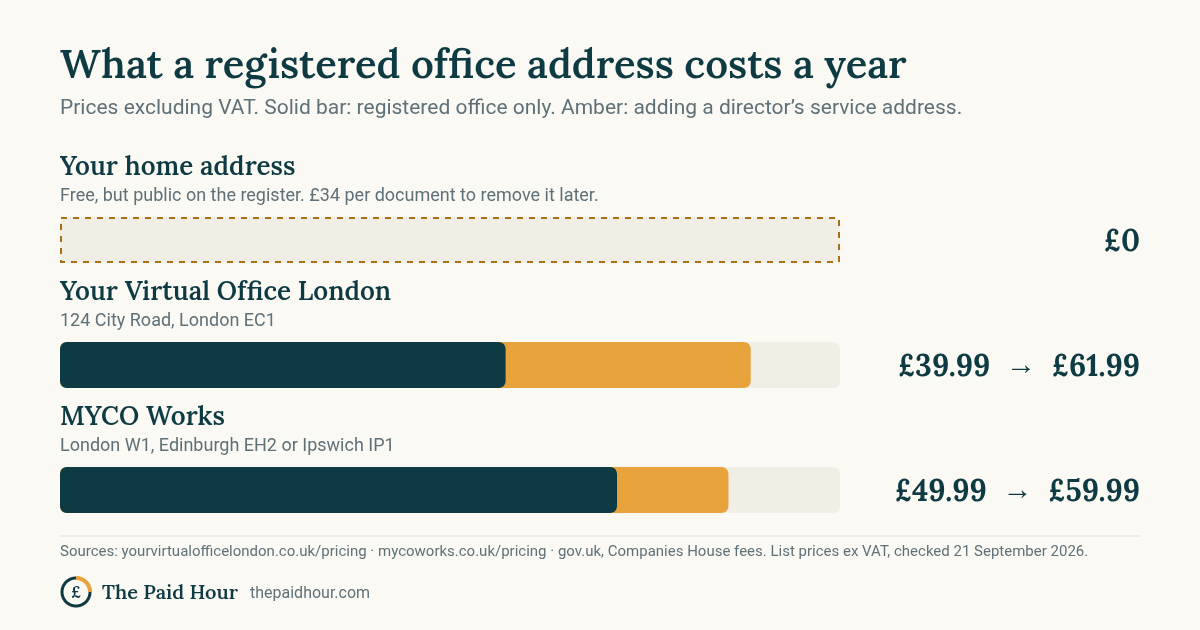
Your Virtual Office London (run by Capital Office) charges £39.99 a year for a registered office at 124 City Road, London EC1V 2NX. Statutory mail is scanned to you free, or held for collection or forwarding. A director’s service address is a separate line at £22 a year, so both together come to £61.99. Billing is for 12 months and there is no auto-renewal trap: if you do not pay again, the service ends. The provider runs anti-money-laundering ID checks before the address goes live. On the day we checked, a 30% flash-sale code was showing on the pricing page; treat that as a bonus, not the price.
MYCO Works (whose affiliate programme runs under the name Registered Office (UK) Ltd) charges £49.99 a year for a registered office at one of three addresses: 167-169 Great Portland Street, London W1; 5 South Charlotte Street, Edinburgh EH2; or 50 Princes Street, Ipswich IP1. Official mail is scanned and uploaded to a client portal free, with originals forwarded at 50p plus postage if you ask within two weeks. Adding the director service address costs £10 at sign-up (£20 later), making the bundle £59.99. ID must be verified within seven days of ordering, with photo ID and a proof of address under three months old. The service does not auto-renew; a reminder goes out about a month before it ends.
The practical difference is £10 a year and geography. For an England and Wales company that wants the cheapest compliant address, Your Virtual Office London wins on price. For a company registered in Scotland, only the Edinburgh address works, so MYCO Works is the one of the two that fits. Both entry-level services handle statutory mail only: letters from Companies House, HMRC and the courts. Post from customers, banks or suppliers needs the “virtual business address” tier, which is £120 a year at Your Virtual Office London and £169.99 plus a £20 postage deposit at MYCO Works.
Companies House fees and the 2026 changes
The address is one line on a form, but the form has a price, and the prices moved on 1 February 2026. Filing online, incorporation is now £100 (£124 on paper), the annual confirmation statement is £50 (£110 on paper), and a voluntary strike-off is £13. Companies House lists no fee for changing the registered office, which is done on form AD01 and must keep the company in the same part of the UK.
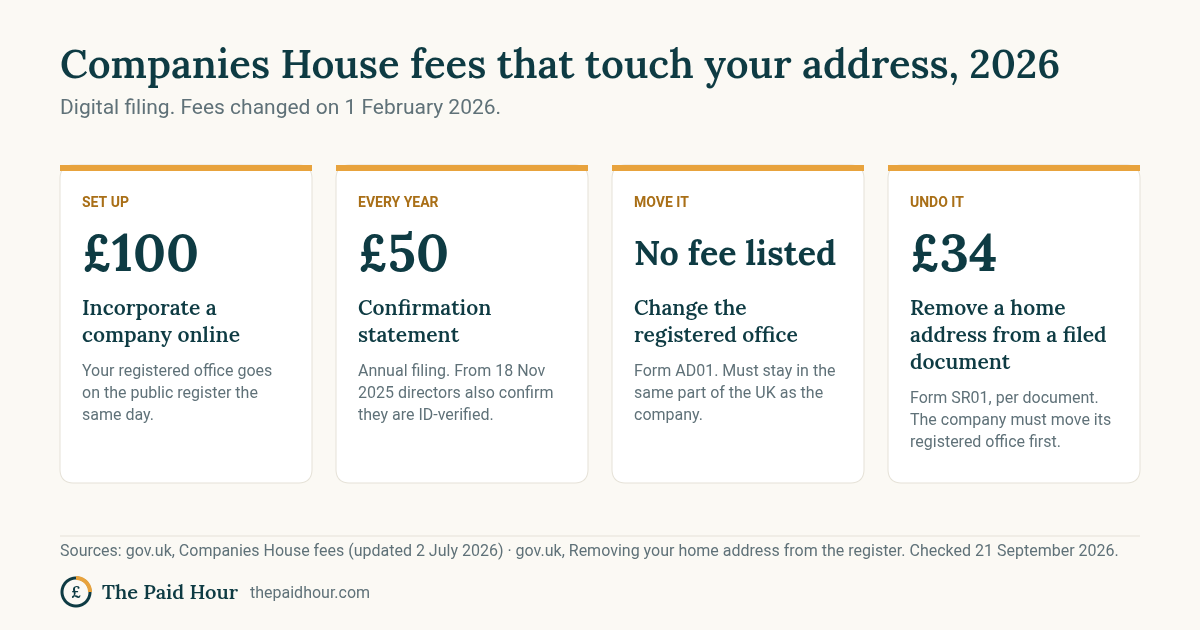
The bigger 2026 change is identity verification. Since 18 November 2025, anyone incorporating a company or being appointed as a director or person with significant control must verify their identity first. Existing directors have a 12-month transition, confirming they are verified when they file their first confirmation statement in that window, which closes in November 2026. Verifying through GOV.UK One Login is free. An authorised agent can do it for you, and the address providers above are the kind of firm that offers this, but they can charge for it.
Can you claim it against tax?
For a limited company, a registered office fee is a cost the company only has because the company exists. It passes the statutory test for deductions, which is that the spending is incurred “wholly and exclusively” for the purposes of the trade (Corporation Tax Act 2009, section 54; HMRC’s Business Income Manual at BIM37007), and it goes through the accounts as an ordinary running cost. There is no personal benefit in receiving HMRC’s post at a third-party address.
For a sole trader paying for a virtual business address, the same wording applies under section 34 of the Income Tax (Trading and Other Income) Act 2005. If the address is used only for the business, it is an allowable expense in the same family as home-office costs and other office expenses. The wholly and exclusively rule has no “mostly business” version: HMRC’s own manual says any non-trade purpose fails the whole amount, so keep it a business-only address.
Five things to check before you pay
- Country. The address must be in the same UK jurisdiction as the company: England and Wales, Scotland or Northern Ireland. Neither provider here covers Northern Ireland.
- Which mail is included. The £39.99 and £49.99 tiers cover statutory mail only. If a customer posts you a cheque, it will not be handled unless you are on the business-mail tier.
- What “free scanning” leaves out. Scans are free; originals cost postage plus a handling fee, and business-mail tiers take a deposit. Ask what happens to parcels.
- The ID deadline. Both providers run identity checks before the address is live, and MYCO Works gives you seven days. Until the check clears you do not have a compliant address, so do it before you file your incorporation.
- Renewal. Neither service renews itself. If it lapses while Companies House still lists the address, your registered office stops being “appropriate” and the strike-off process can begin. Put the renewal date in your calendar, and if you ever leave a provider, file the AD01 before the contract ends, not after.
One last detail catches people out. Because the registered office has to appear on your business letters, order forms and website, the address you buy will be visible to every client. A West End or City postcode reads well. Just do not describe it as your office if a client might turn up.
Where to get one
Your Virtual Office London
£39.99 a year plus VAT for the registered office, £22 more for a director’s service address. Statutory mail scanned free, 12-month billing, no auto-renewal. England and Wales companies only.
See EC1 address pricesMYCO Works
£49.99 a year plus VAT, or £59.99 with the director service address. Three addresses, including the only Scottish one here. Free scanning to a client portal, no auto-renewal. Its affiliate programme offers the code AWIN10 for 10% off; check it applies at checkout.
See MYCO Works pricesRead next
- When To Switch From Sole Trader To Limited Company
- Sole Trader vs Limited Company: 2026/27 Dividend Rate
- Working From Home Tax Relief for Sole Traders
- Business Rates When Working From Home: When They Apply
Sources
- gov.uk, Set up a private limited company: rules for registered office addresses and email addresses
- gov.uk, Companies House begins phased roll out of new powers to tackle fraud (4 March 2024)
- gov.uk, Your personal information on the Companies House register
- gov.uk, Removing your personal details from the Companies House register
- gov.uk, Companies House fees
- gov.uk, Companies House fees are changing from 1 February 2026
- gov.uk, Change a company’s registered office address (AD01)
- gov.uk, Companies House confirms identity verification rollout from 18 November 2025
- gov.uk, Running a limited company: signs, stationery and promotional material
- HMRC, Business Income Manual BIM37007: wholly and exclusively
- Your Virtual Office London, Pricing
- MYCO Works, Pricing and packages
- MYCO Works, Registered office address service
- MYCO Works, Registered office and director service address
The Companies House rules, fees and identity-verification dates, the HMRC deduction test and both providers’ prices and terms were checked against the sources above on 21 September 2026. This is general information about how the rules work, not legal or tax advice. For your own circumstances, speak to an accountant or contact Companies House or HMRC directly.