
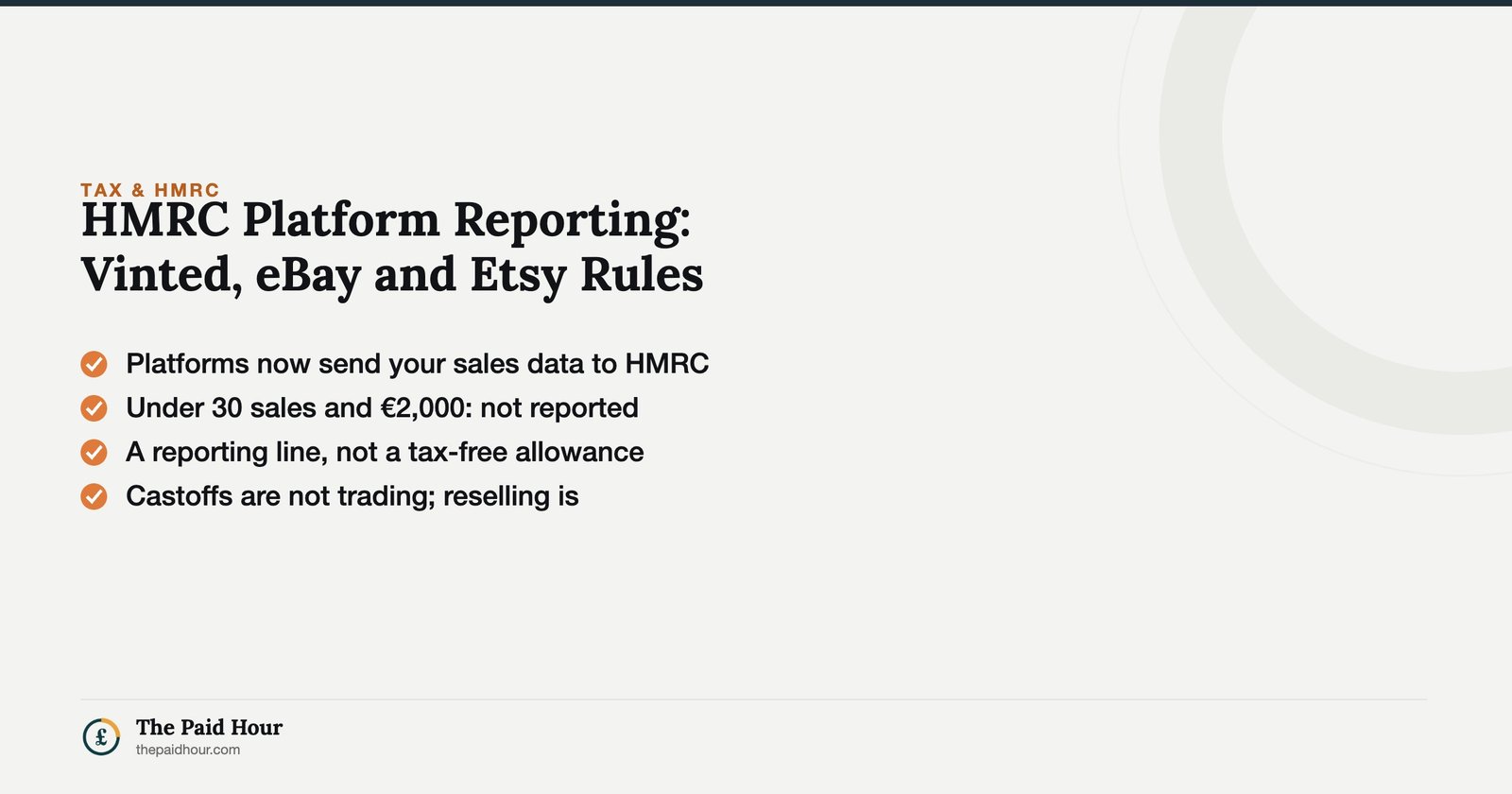
In short: HMRC now receives your Vinted, eBay and Etsy sales data automatically, but no tax rule changed. A platform like Vinted must report you unless you made fewer than 30 sales of goods and took less than €2,000 (about £1,700) in the year; both have to be true. That is a reporting threshold rather than a tax-free allowance. Clearing out possessions you already owned is not trading. Buying stock to resell is trading from the first sale, and you must register once your trading income passes £1,000 in a tax year.
Table of Contents
Every parcel you’ve sent through Vinted, eBay or Etsy since January 2024 has quietly been logged somewhere HMRC can see it. That’s not a threat, it’s just how the HMRC platform reporting rules actually work now. It’s also caused a genuine wave of panic among people who sold a few old jumpers and a broken blender and are now convinced they owe tax on it. Mostly, they don’t.
The headlines make it sound like HMRC has suddenly gained new powers to tax your side hustle. It hasn’t. What’s changed is visibility rather than the tax rules themselves. Those two things get mixed up constantly, and on a site with our name attached to it, that’s not a mix-up we’re willing to make. So let’s separate them properly, starting with what the HMRC platform reporting rules require and where they stop.
What the HMRC platform reporting rules changed on 1 January 2024
Since 1 January 2024, UK digital platforms (marketplaces, gig-economy apps, short-let rental sites, delivery platforms), have had to collect and verify identity details from sellers and earners, then report their activity to HMRC once a year. This isn’t a UK-only idea. It comes from an OECD framework adopted by dozens of countries, brought into UK law via secondary legislation, so HMRC gets the same kind of automatic data feed that banks have been sending it for years.
The first batch of reports was due to HMRC by 31 January 2025, covering seller activity for the 2024 calendar year. The next one landed by 31 January 2026, covering 2025. It’s now an annual cycle, every January, platforms send HMRC (and you) a summary of what you sold or earned the year before.
What gets reported is fairly blunt: your name, address, and tax reference details where the platform holds them, plus the number of transactions and total amount you were paid. Not a full breakdown of every item: just the headline numbers, sitting in a file HMRC can cross-reference against your tax return, or the lack of one.
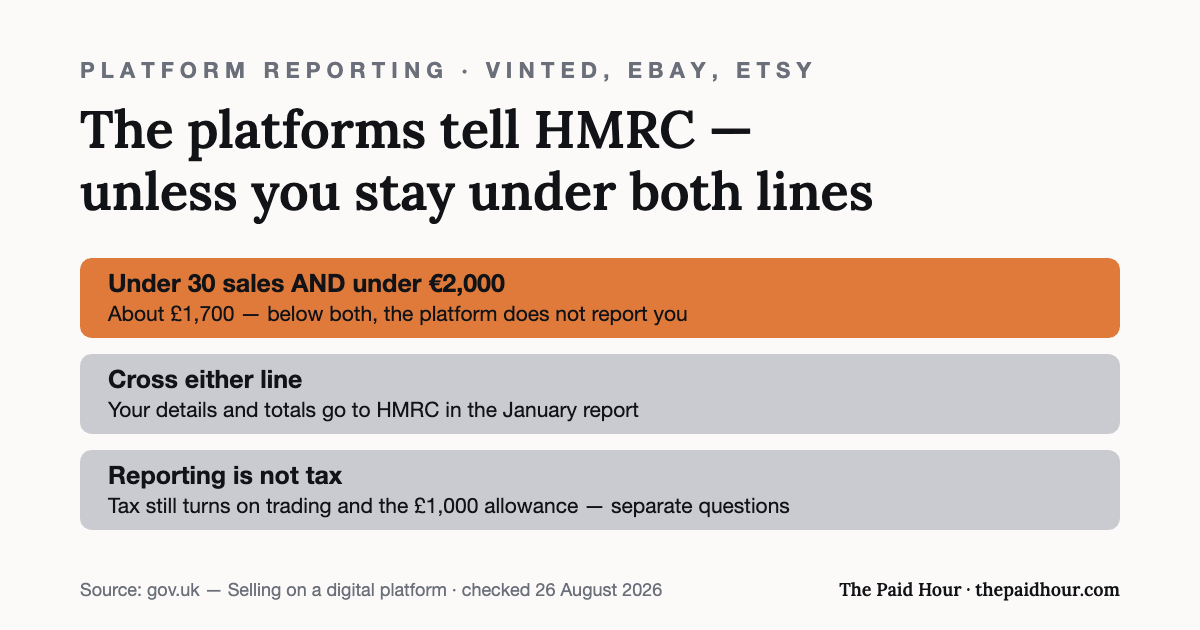
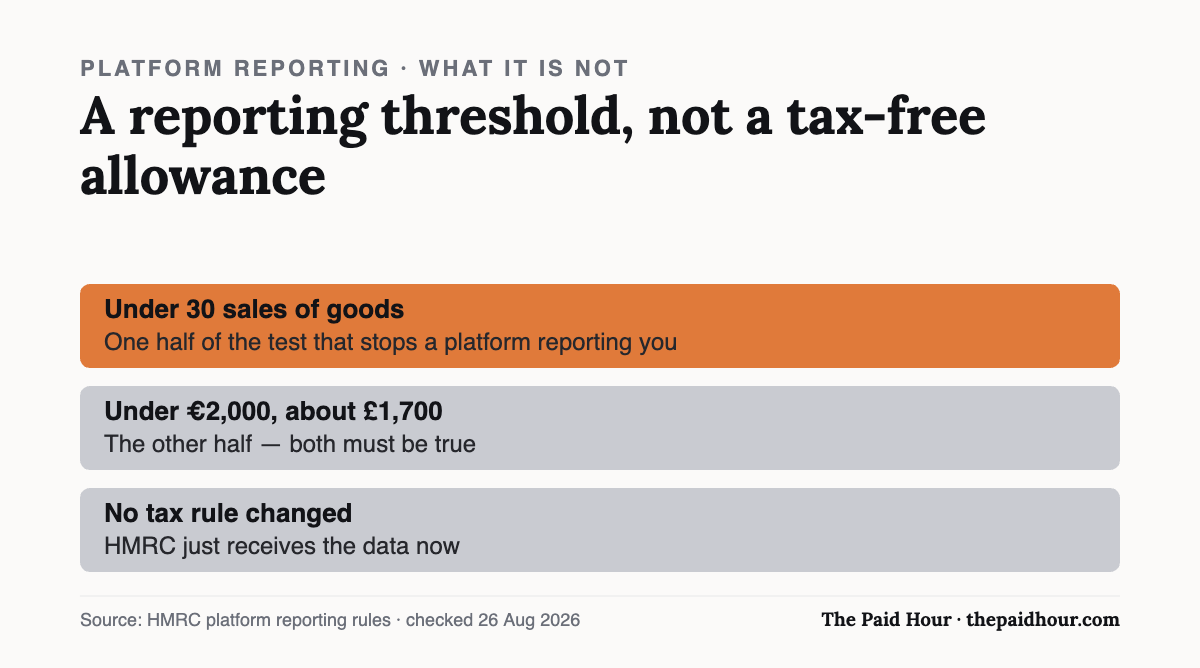
There’s one genuine carve-out worth knowing, and it’s the part people get wrong most often. For sales of goods specifically, a platform doesn’t have to report a seller who had fewer than 30 sales and under €2,000 (roughly £1,700) in the year, both conditions have to be true. That threshold doesn’t apply to services, property rental or vehicle hire; those get reported regardless of amount. And this is a reporting threshold on the platform, not a tax-free allowance for you. Staying under it just means the platform won’t flag you this particular way. It says nothing about whether you owe tax.
Does this mean you suddenly owe tax on Vinted sales you didn’t before?
No. And this is the bit worth reading twice if you clicked on this article slightly panicked.
The trading allowance hasn’t moved. You can still earn up to £1,000 a year from self-employment, casual services or selling things you’ve made or bought to resell, without telling HMRC anything, as long as none of the exceptions apply (claiming Class 2 National Insurance credits, Tax-Free Childcare, Maternity Allowance, or wanting to claim loss relief being the main ones). Our guide to the £1,000 trading allowance covers those exceptions in more detail if you’re close to the line.
What’s different is that HMRC no longer has to rely on tip-offs, spot checks or asking a platform directly. It gets the numbers handed to it automatically, at scale, every year. That’s a compliance-visibility change instead of a new tax. If you weren’t liable for tax on your selling activity in December 2023, you’re still not liable now purely because a platform reported you — the report itself has no legal effect on what you owe.
Selling your own stuff vs reselling for profit, the actual test
This is where most of the confusion actually lives, and it’s not new, the HMRC platform reporting rules just put a spotlight on a distinction that’s existed for years.
Clearing out your wardrobe, selling a phone you’ve upgraded from, listing books you’ve already read, that’s disposing of personal possessions. HMRC doesn’t generally treat this as trading, because you’re not buying or making things with the intention of selling them on. According to HMRC’s own guidance, the only tax that can realistically apply here is Capital Gains Tax, and and then only if a single item sells for £6,000 or more, which rules out almost everything moving through a typical Vinted or eBay account.
Trading is different. If you’re buying stock to flip, sourcing items specifically to resell, or making things to sell for profit, that’s a business activity regardless of what platform you use or how small it feels. Once your combined trading income for the tax year goes over £1,000, you need to register and declare it. We’ve written more on where that line sits in how HMRC decides you’re trading, and our side hustle tax guide walks through the registration steps if you land on the trading side of it.
The honest answer for most Vinted sellers is: you’re decluttering rather than trading, and none of this changes anything for you. The honest answer for people running a small resale operation off the back of car boot sales and charity shop finds is: you were probably always supposed to be declaring this, and now HMRC can see it a lot more easily than it used to.
Two examples that show where the line sits
Deborah has a wardrobe clearout every spring. This year she listed forty-odd items on Vinted. Old work clothes, shoes that never fit right, a coat she wore twice, and made about £640 across the year. Every item was originally bought for her own use, none of it was bought to resell, and nothing sold for anywhere near £6,000. She’s under both the reporting threshold and the trading allowance, and even if she weren’t, none of this is trading. Vinted may still report her account if her numbers happen to sit above the goods threshold in a busy year, but a report changes nothing about what she owes, which is nothing.
Priya does something different. Most weekends she does the rounds of charity shops and car boot sales specifically looking for underpriced items she can clean up and relist, vintage denim, kitchenware, the odd bit of furniture. She’s not using any of it herself first. That’s sourcing stock with the intention of reselling for profit, which is trading in HMRC’s eyes from the first sale, not from some threshold she crosses later. Once her total trading income passes £1,000 in a tax year she needs to register for Self Assessment, whether or not any platform ever reports her.
The numbers behind the Vinted panic
Worth knowing how big this actually got, because it explains why the story kept resurfacing through 2025 and into 2026. Figures obtained by accountancy firm BDO under a Freedom of Information request, and reported by Accountancy Daily, show HMRC received platform reports on almost 3.99 million seller accounts in 2025, up from 1.47 million in 2024, close to two and three-quarter times as many, as more platforms came fully into scope.
Accountancy Daily describes that as a “272% rise”; on the underlying figures it quotes (1,466,171 reports in 2024 and 3,988,892 in 2025), the increase is about 172%, and the larger number is the ratio rather than the rise. Combined sales value went from £25.5 billion in 2024 to nearly £55 billion in 2025.
According to BDO tax partner Dawn Register, HMRC is in the final stages of building an automated system to match this data against Self Assessment records, which is what future compliance activity will run on. HMRC itself has been fairly clear on the point: receiving a report about you is not a tax bill, and it’s not an accusation. It’s a data point that gets compared against what you’ve already told them.
- Someone with a genuine pattern of buying or sourcing stock, high transaction counts, and no matching Self Assessment record
- Someone whose reported platform income looks meaningfully higher than what they’ve declared elsewhere
- Someone who’s crossed the trading allowance threshold on paper but never registered
That is who a nudge letter is aimed at, not someone who sold their old trainers twice this year.
What the HMRC platform reporting rules don’t cover
It’s worth being clear about the edges of this too, because the panic tends to assume the rules are broader than they are. The legislation applies to platforms that meet the legal definition of a reporting platform operator: broadly, a service that facilitates a sale or booking and knows or can find out who was paid. A one-off private sale arranged through a noticeboard, a local WhatsApp group, or cash changing hands at a car boot sale isn’t being fed into this system, because there’s no platform sitting in the middle collecting your details and processing the payment.
That’s not a loophole worth engineering your selling around, for two reasons. First, if you’re trading, the tax was always owed regardless of how the sale happened to be arranged. Second, most of the popular resale platforms people actually use day to day do meet the definition and are reporting, so trying to route around it usually just means giving up the buyer protection and payment handling that made the platform worth using in the first place.
What to do if a Vinted nudge letter lands on your doormat
Don’t ignore it, and don’t panic-pay something you might not owe either, a letter prompted by the HMRC platform reporting rules is a prompt to check, not a verdict. A nudge letter is HMRC’s version of “we think you might need to check this”, it usually gives you a response window measured in weeks instead of days, and it’s designed to prompt a voluntary check rather than open an investigation immediately.
Work out honestly which side of the personal-possessions-vs-trading line you’re on. If it’s decluttering, you can usually write back and say so. If you’ve been trading and haven’t declared it, HMRC’s voluntary disclosure route is almost always a better outcome than waiting for them to open a formal enquiry, penalties are typically lower when you come forward first. If you’re not sure which applies, that’s worth a proper conversation with an accountant before you reply to anything rather than a guess.
Getting ready for the next Vinted report before 31 January
You don’t need to do anything special just because these rules exist, but a bit of housekeeping saves a headache if a letter ever does turn up. Keep a rough note of what you’re selling and why: decluttering versus sourcing to resell, even if it’s just a note on your phone. It’s much easier to explain your situation with a contemporaneous record than to reconstruct your reasoning eighteen months later from memory.
If you’re on the trading side and getting close to the £1,000 allowance, register for Self Assessment before you cross it instead of after — registration itself doesn’t cost anything, and doing it early means you’re not scrambling in January. And if you run more than one platform, remember the £1,000 trading allowance is a single limit across all your self-employment income combined, not £1,000 per app.
Vinted, eBay and Etsy: where this leaves you
The tax rules haven’t changed. Your visibility to HMRC has, because of the HMRC platform reporting rules that quietly took hold from January 2024 onwards. If you’re selling stuff you already owned because you don’t need it any more, this reporting cycle is background noise, HMRC seeing your Vinted account doesn’t create a tax bill out of nowhere. If you’re sourcing stock to resell and you’ve been quietly under the radar, the radar just got a lot better, and it might be worth getting ahead of it rather than waiting for a letter to decide the timing for you.
Stock taking over the spare room? The rent on a storage unit used only for the business is an allowable expense: see business storage: what it costs and what you can claim.
Had a letter about your Vinted or Etsy sales?
Side Hustle Tax Starter 2026/27. A six-module starter course and six working templates that tell you, in an evening, whether you owe anything at all, and set up the twenty-minute monthly routine that keeps it that way.
- The nine badges of trade as questions you can answer about your own income
- What the platforms send HMRC, the small-seller exemption, and three reply letters for when a letter arrives
- A sales log with a running £1,000 alert, an allowance-versus-expenses sheet, and a tax set-aside calculator at 2026/27 rates
Selling platforms now hand your sales data to HMRC once a year. Selling your own old possessions is never taxable. Buying to resell, making things, or freelancing is. Knowing which side you are on is the whole question.
Buying more than one? All ten 2026/27 courses for £107, against £328 at full price.
Need this ready-made? → Self Assessment Prep Checklist Pack. Every deadline, record and allowance in 9 pages (£7.99, instant download)
Sources
- GOV.UK, Selling goods or services on a digital platform (the fewer-than-30-sales and under-€2,000 reporting threshold)
- GOV.UK: Reporting rules for digital platforms
- GOV.UK, Tax-free allowances on property and trading income (£1,000 trading allowance)
- GOV.UK. Capital Gains Tax on personal possessions (£6,000 or more)
- Accountancy Daily, HMRC targets 4m side hustlers as online platforms share data (BDO Freedom of Information figures)
The reporting thresholds were re-checked against gov.uk on 26 August 2026.
Checked against gov.uk on 25 August 2026. The platform-volume figures are BDO’s, obtained under Freedom of Information and reported by Accountancy Daily: they are not HMRC published statistics, and are quoted here as such. General information, not tax advice, if a nudge letter arrives and you are unsure which side of the trading line you are on, speak to an accountant before you reply.