
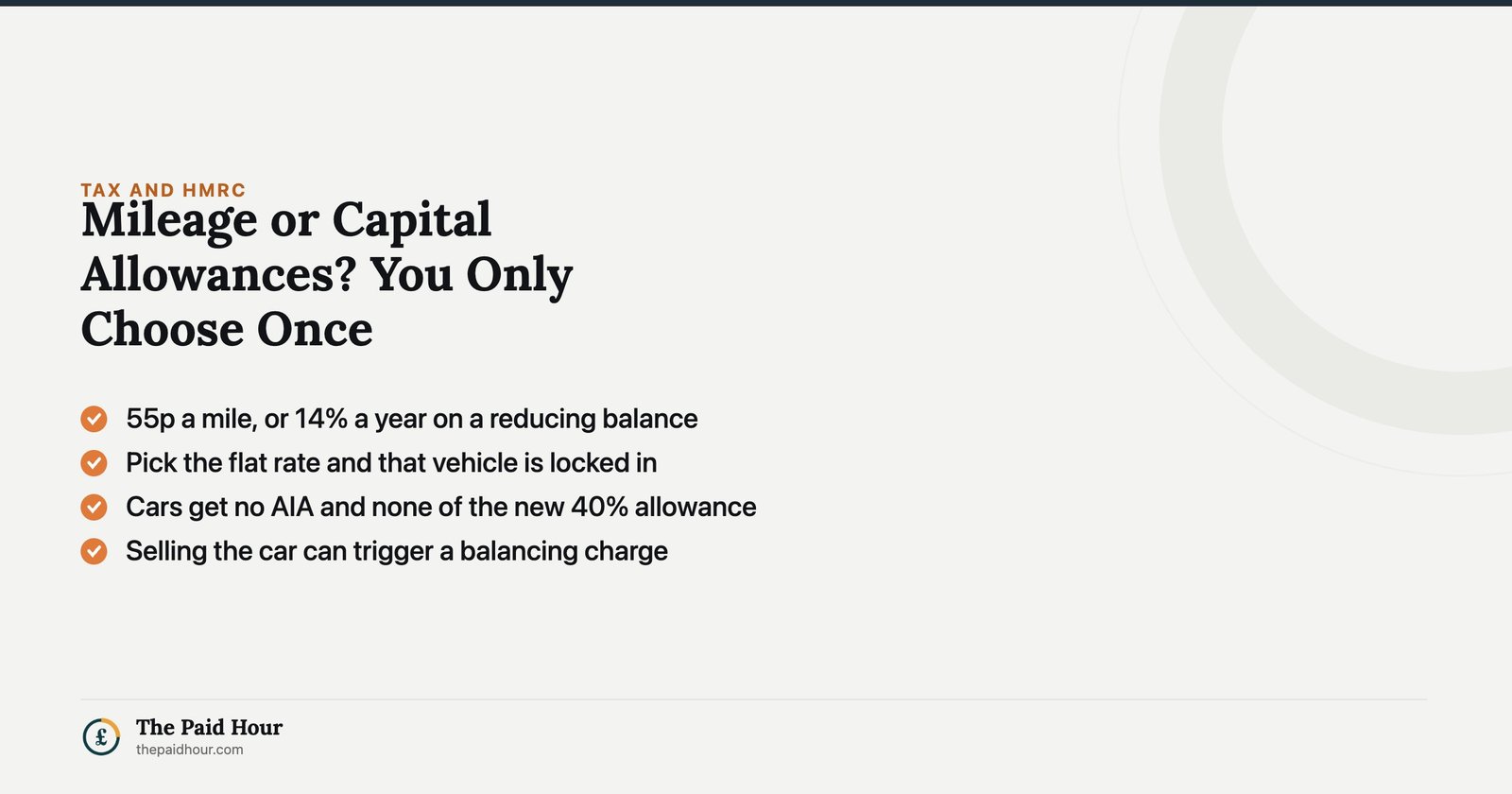
Before you read on: There are two ways to claim a car and you only get one of them per vehicle. Take the flat rate and you must keep taking it for as long as you use that car in the business. Take capital allowances and you can never switch to the flat rate for that car. The arithmetic moved in April 2026: the mileage rate went up to 55p while the main writing-down allowance came down from 18% to 14%, so the flat rate now wins in more cases than it used to.
Can you claim a car when you are self-employed? Yes, by one of two routes, and choosing between them is one of the few tax decisions a sole trader makes that cannot be undone.
Most guides describe both and stop. The interesting part is that the two routes moved in opposite directions this April.
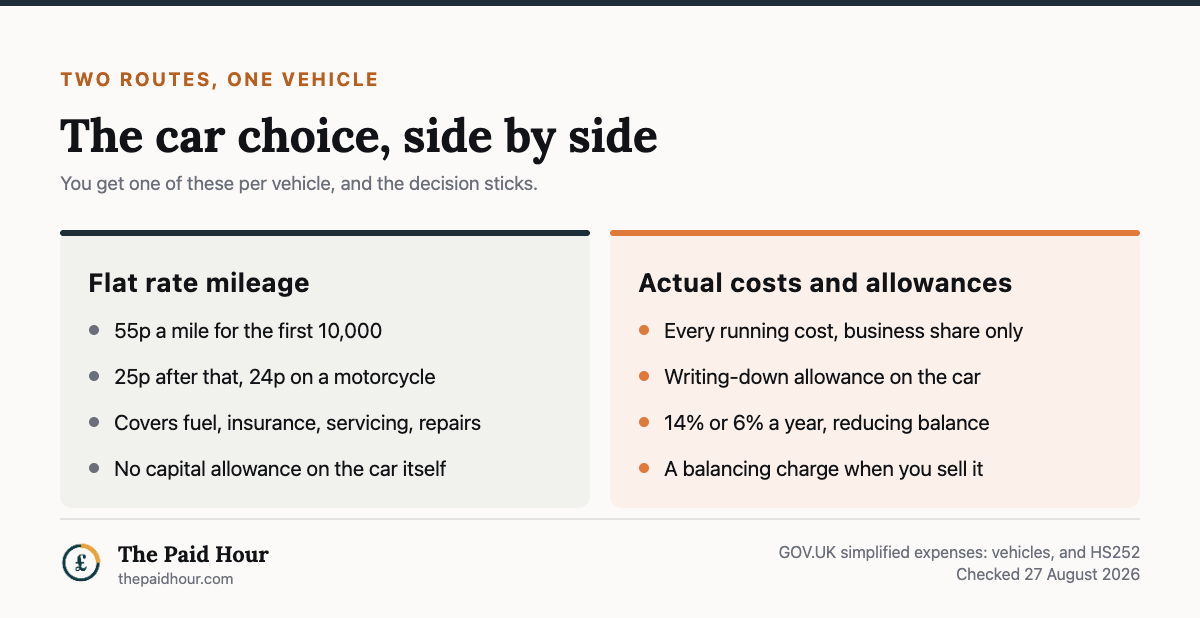
Why the capital allowances choice is a one-way door
GOV.UK closes the door from both sides, in two separate sentences that people tend to read one of.
Going in: once you use the flat rates for a vehicle, you must continue to do so as long as you use that vehicle for your business.
Coming back: you cannot claim simplified expenses for a vehicle you have already claimed capital allowances for, or you have included as an expense when you worked out your business profits.
So the decision is made the first time the vehicle appears in your books, often by an accountant you have not met yet, in a year when you were not thinking about it. Buying a different car resets the question. Changing your mind about this one does not.
What capital allowances rate a car actually gets
Cars are the awkward asset in the capital allowances system. You cannot use the annual investment allowance on one: HMRC’s helpsheet says so in as many words, so instead of deducting the cost, you write it down a slice at a time, and the size of the slice depends on what comes out of the exhaust.
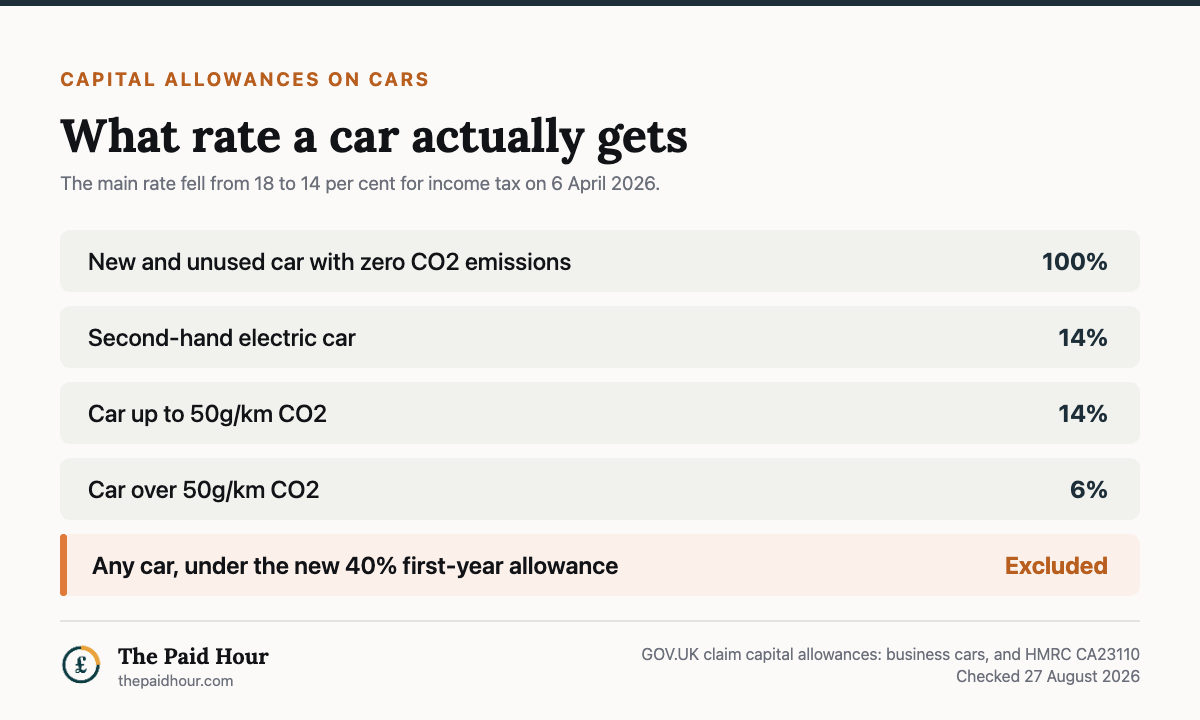
Six per cent on a reducing balance is slower than it sounds. A £20,000 car in the special rate pool gives you £1,200 of allowance in year one and £1,128 in year two, and there is still more than £17,000 sitting in the pool when most people have sold the car.
The main rate fell to 14% this April
From 6 April 2026, for anyone within income tax, the main rate writing-down allowance dropped from 18% to 14%. For corporation tax the date was 1 April 2026. It was announced on 26 November 2025 alongside a new first-year allowance, and it has had almost no coverage aimed at sole traders.
There is a trap attached. HMRC’s helpsheet HS252 Capital allowances and balancing charges 2026 still gives the main pool rate as 18%. Correctly, because that helpsheet is for the tax year that ended on 5 April 2026. Read it while filing that return and it is right. Read it while planning a purchase now and it is a year out of date.
Cars are excluded from the new 40% allowance
The same announcement created a 40% first-year allowance on main rate expenditure from 1 January 2026, and it is good news for unincorporated businesses, who had been shut out of full expensing.
It does not help you buy a car. Second-hand assets are out and, in the measure’s own words, cars will also be excluded from the scope of the new FYA. A van is main rate plant and can take the annual investment allowance anyway. A car remains a car.
One figure to confirm before you rely on it: the 100% first-year allowance for a new and unused zero-emission car is still listed both on GOV.UK’s business cars page and in HMRC’s Capital Allowances Manual, but both of those pages were last updated before the November 2025 announcement. If an electric car is the reason you are reading this, check that one directly with HMRC rather than taking it from any article, including this one.
Private use puts the car in a pool of its own
HMRC is explicit: items you use for both business and private purposes, cars included, do not go into the main or special rate pool. Each one gets its own single asset pool, and the allowance is cut to the business proportion.
Which means a car used 60% for work does not give you 14% of the cost. It gives you 60% of 14% of the cost, on a balance that is still falling by the full 14% each year. The private-use restriction costs more than people expect, and it is the single biggest reason the flat rate wins for ordinary cars.
The balancing charge nobody plans for
Because the write-down is slow, the pool balance stays high. Sell the car for more than what is left in its pool and the difference is added to your profits. A balancing charge, in HMRC’s language.
That is a tax bill arriving in the year you replaced the car, which is the year you least wanted one. The flat rate has no equivalent. You claim the miles, you sell the car, nothing happens.
So: mileage or capital allowances
For most sole traders driving an ordinary car with real private use, the flat rate wins, and the gap widened this April: the mileage rate rose to 55p for the first 10,000 miles while the allowance on the car fell to 14%. It is also the only option that survives losing your receipts.
Capital allowances earn their keep in a narrower set of cases. An expensive vehicle, low business mileage, high running costs, little or no private use, or a new zero-emission car if that 100% allowance is still there when you buy. A high-mileage trade with a cheap car should not be anywhere near them.
Work out both numbers on the actual car before the first return that includes it. The mileage allowance page has the rates and what counts as a business mile, and simplified expenses covers the other flat rates you may be entitled to at the same time.
What to keep
On the flat rate: a mileage log, and nothing else. On capital allowances: the purchase invoice, the CO2 figure from the V5C, every running cost, and a defensible business-use percentage you can explain the same way three years running.
Whichever you pick, write down which one you picked and when. It is the piece of information your future accountant will ask for first, and the one nobody ever has. More on the wider list in allowable expenses for UK freelancers.
Claiming everything you are owed?
HMRC Tax & Expense Mastery 2026/27. Nine modules and eleven working templates that take a UK freelancer from “do I even need to register” to a correct return, with MTD quarters built in.
- Fifteen expense categories, with the trap inside each one (training, clothing, meals, the seven-year pre-trading rule)
- Home and vehicle: flat rate against actual cost, with the £312 break-even worked out and the mileage lock-in rule
- The year-one payments-on-account cash shock, and the routine that stops it landing twice
HMRC does not send a list of what you forgot to claim. Most freelancers leave several hundred pounds of legitimate expenses on the table every single year, and the return still gets filed.
Buying more than one? The Complete Freelancer System, all five for £87, against £215 at full price.
Sources
- Simplified expenses if you are self-employed: vehicles, GOV.UK
- Claim capital allowances: business cars, GOV.UK
- Capital allowances: new first-year allowance and reducing main rate writing-down allowances, GOV.UK
- HS252 Capital allowances and balancing charges 2026, GOV.UK
- CA23110: first year allowance rates, HMRC Capital Allowances Manual
- Increasing mileage rates, GOV.UK
The 55p and 25p mileage rates apply from 6 April 2026 and are taken from GOV.UK’s simplified expenses guidance and the measure published on 17 June 2026. The 14% main rate writing-down allowance, its 6 April 2026 start date for income tax and the exclusion of cars from the new 40% first-year allowance are from the measure published on 26 November 2025 and last updated on 14 August 2026.
The AIA exclusion for cars, the single asset pool for private use and the balancing charge are quoted from helpsheet HS252, which covers the tax year ended 5 April 2026. The CO2 bands are from GOV.UK’s business cars page. All pages read on 27 August 2026. This is general information about how the rules work, not tax advice. Check your own position with HMRC or an accountant before you file.