
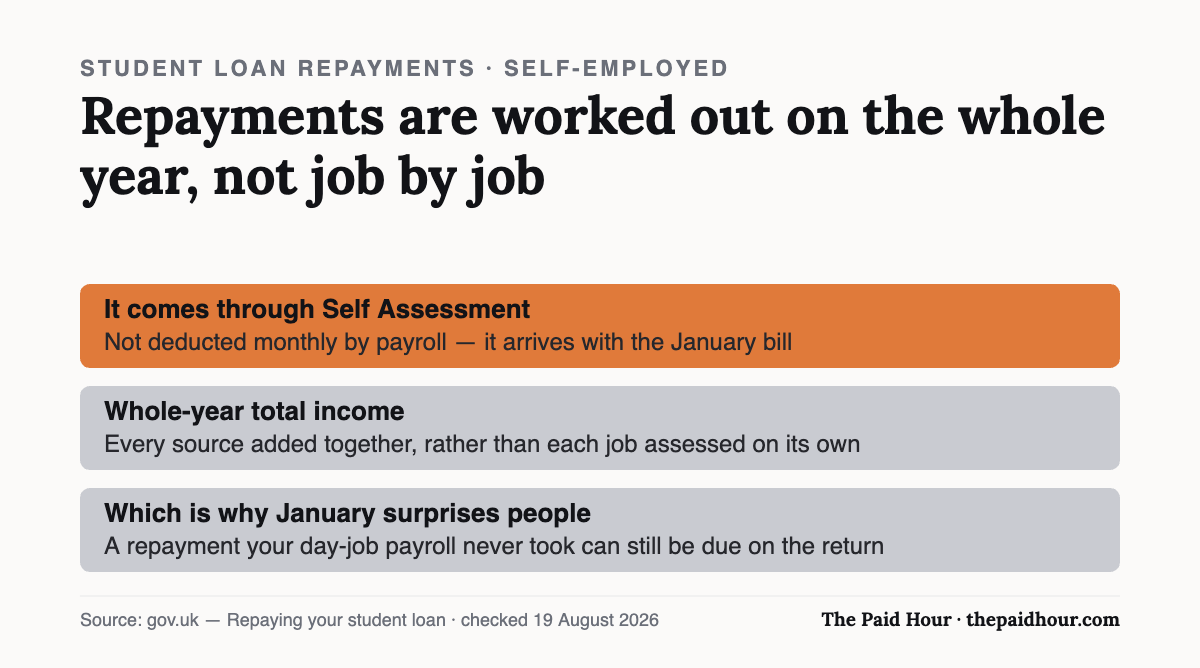
Before you read on: Self-employed student loan repayments come through Self Assessment, calculated on whole-year total income rather than deducted monthly per job. That is why a January bill can carry a repayment your day-job payroll never took, and why the SL line on the return surprises people.
Student loan repayments self employed people owe work completely differently from PAYE. If you’re employed, repayments come out of each job separately, month by month, two jobs that individually sit under the threshold can cost you nothing at all. Self-employed, none of that applies. HMRC works your repayment out from your Self Assessment return using your income for the whole year, and if you’re both employed and self-employed, it’s the combined figure that counts. That’s how a £1,359 bill turns up in January, sitting right next to the tax and National Insurance you were already braced for.
Student loan repayments: the thresholds, and which plan you’re on
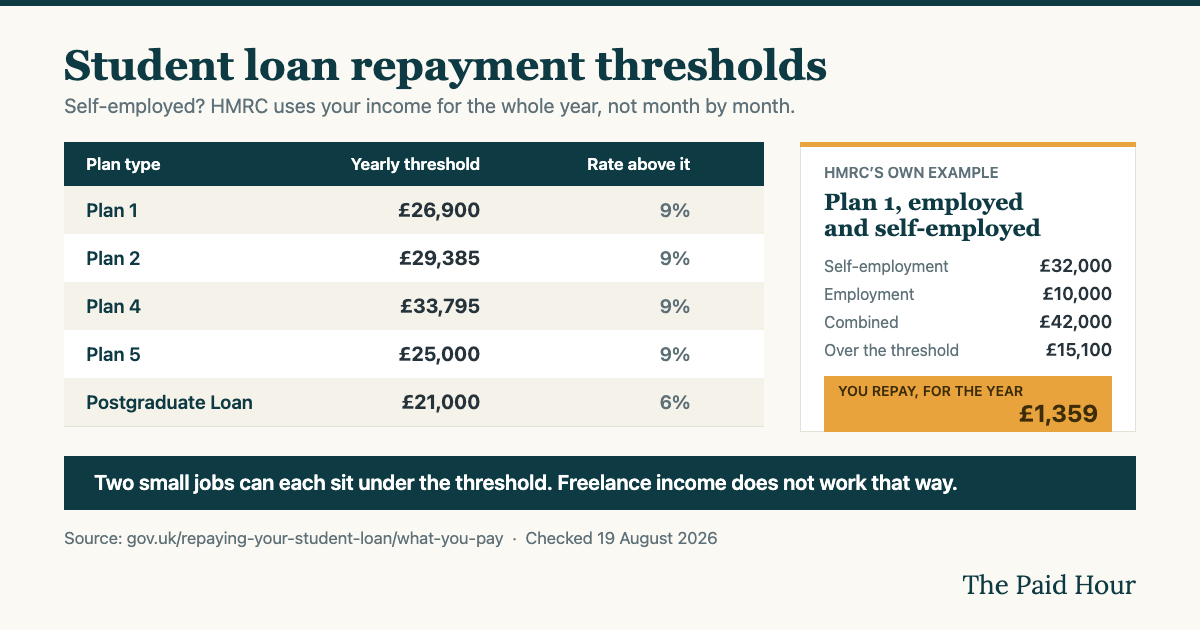
You repay a percentage of income above the threshold for your plan. Nothing below that line counts, and (worth saying clearly), the size of your debt makes zero difference to the annual repayment. Only your income does.
| Plan type | Yearly threshold | Rate above it |
|---|---|---|
| Plan 1 | £26,900 | 9% |
| Plan 2 | £29,385 | 9% |
| Plan 4 | £33,795 | 9% |
| Plan 5 | £25,000 | 9% |
| Postgraduate Loan | £21,000 | 6% |
Don’t know which plan you’re on? Check before you budget. The gap between Plan 4 and Plan 5 is nearly £8,800 of threshold, which at 9% works out to roughly £790 a year of difference on identical income.
Why self-employment changes student loan repayments
For an employee, the test is applied per job, per pay period. HMRC’s own example: two jobs paying £1,000 and £800 a month, both on Plan 1. Neither one is above the £2,241 monthly threshold, so nothing is repaid at all, even though the combined £21,600 a year isn’t far off it. This is exactly why student loan repayments self employed calculations catch people off guard every January.
Bring Self Assessment into the picture and that protection vanishes. HMRC works the repayment out from your return, using your income for the entire year. And if you’ve got a job alongside freelance work, it’s your combined income being tested rather than either one on its own.
HMRC’s example is worth walking through slowly:
- £32,000 from self-employment
- £10,000 from a job
- Combined: £42,000
- Less the Plan 1 threshold of £26,900 = £15,100
- 9% of £15,100 = £1,359 for the year
Anything already taken from the salary gets deducted from that figure. But on a £10,000 job, almost nothing will have been taken, it sits well under the monthly threshold. So most of that £1,359 turns up as a lump sum.
And it lands on 31 January, in the same payment as your Income Tax and National Insurance. Budgeted for tax and forgot this? Your January bill just got over a thousand pounds bigger than planned.
Student loan repayments when you carry more than one loan
Two undergraduate plans, no postgraduate loan: you repay 9% of income over the lowest threshold across the plans you hold, and there’s a single deduction instead of two, it gets split behind the scenes with a cap on how much goes toward the lower-threshold loan.
Add a Postgraduate Loan into the mix, and the two run side by side: 6% over the £21,000 postgraduate threshold, plus 9% over the lowest threshold of whichever other plan you have. HMRC’s example on £30,000, with a Postgraduate Loan and Plan 2, comes to £49 a month: £45 of that postgraduate.
Interest keeps running regardless
Current rates sit at 3.2% on Plans 1, 4 and 5, and 6.2% on a Postgraduate Loan. Plan 2 is variable by income: 3.2% at £29,385 or below, climbing to 6.2% at £52,885 or above.
The line worth reading twice: interest keeps applying even if you’re not working, or your income sits below the repayment threshold. A quiet year for a freelancer means no repayment, and a balance that’s still growing anyway.
The student loan repayments refund almost nobody claims
If your income crossed the weekly or monthly threshold at some point, a good month, a bonus, a big project, a repayment gets taken then. But if your annual income ends up below the yearly threshold once everything’s totalled, you can ask for that money back at the end of the tax year.
Freelance income is lumpy by nature, so this happens to more people than claim it back. It isn’t automatic. You have to ask for it.
What to do about student loan repayments
- Find out which plan you’re actually on, it’s in your online repayment account.
- Add the repayment to your January budget: take your expected combined income, subtract the threshold, take 9%. That’s a real number you’ll owe.
- Set money aside monthly for it, alongside tax and National Insurance. Three separate things come out of the same January payment.
- Had a lean year but one good month? Check whether you’re owed a refund.
- Remember your debt size is irrelevant to the annual repayment. Only income matters, every time.
Related: payments on account is the other thing that makes a first January bill bigger than expected, and Class 4 National Insurance is the third.
Filing it yourself this year?
HMRC Tax & Expense Mastery 2026/27. Nine modules and eleven working templates that take a UK freelancer from “do I even need to register” to a correct return, with MTD quarters built in.
- Fifteen expense categories, with the trap inside each one (training, clothing, meals, the seven-year pre-trading rule)
- Home and vehicle: flat rate against actual cost, with the £312 break-even worked out and the mileage lock-in rule
- The year-one payments-on-account cash shock, and the routine that stops it landing twice
HMRC does not send a list of what you forgot to claim. Most freelancers leave several hundred pounds of legitimate expenses on the table every single year, and the return still gets filed.
Buying more than one? The Complete Freelancer System, all five for £87, against £215 at full price.
Sources
- GOV.UK: Repaying your student loan: how much you repay
- GOV.UK — Which repayment plan you are on
- GOV.UK, Getting a student loan refund
- GOV.UK. Sign in to manage your student loan balance
Thresholds and interest rates checked 19 August 2026. This is general information, not financial advice. Thresholds change most years, check the current figures before budgeting.