
Straight answer: Do self employed need public liability insurance UK law requires? In most cases, no. Public liability insurance is not a legal requirement for the self-employed. There is exactly one policy UK law forces on a small business, and it is employers’ liability, only once you employ someone. Most sole traders buy public liability because a client’s contract demands it, not because the law does. It is also an allowable expense, and HMRC names it by name.
Public liability insurance: common questions
Do self-employed people need public liability insurance?
In most cases, no — not as a matter of UK law. Sole traders overwhelmingly buy it because a client’s contract demands it, or because one accident on someone else’s premises would end the business. Both are good reasons; neither is a legal requirement.
Is public liability insurance a legal requirement for a sole trader?
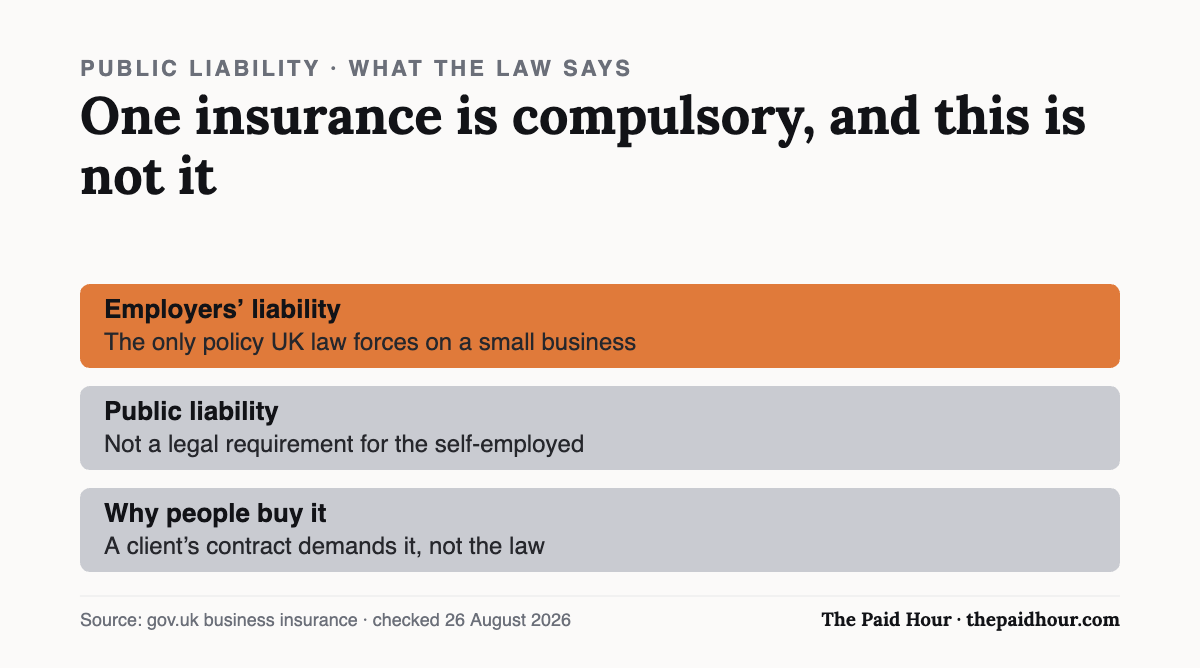
No. There is exactly one insurance policy UK law forces on a small business, and it is employers’ liability — and only once you employ someone.
Do I need employers’ liability insurance as a sole trader?
Only when you take someone on. The Employers’ Liability (Compulsory Insurance) Act 1969 requires at least £5 million of cover, and HSE can fine you up to £2,500 for each day you employ someone without it, plus up to £1,000 for failing to display or produce the certificate. Businesses where every employee is a close relative, and companies whose only employee owns more than half the shares, are exempt. (HSE — Employers’ liability insurance guide, checked 3 September 2026.)
Do I need professional indemnity insurance as a sole trader?
Not under general law. It becomes compulsory through a regulator or professional body in some fields, and through the contract in a great many others — agencies and public-sector clients ask for it routinely. If you give advice, design or specify things for money, assume a client will ask.
Should I take £1 million or £2 million of cover?
Whoever’s contract you are signing decides that rather than you. £1 million is the common floor for small private work; £2 million, £5 million or more turns up in public-sector, construction and large-corporate contracts. Buying above what anyone asks for is money spent on nothing.
So, Do Self Employed Need Public Liability Insurance UK Law Requires?
Search for public liability insurance for the self-employed and you will be told, within about four seconds, that you need it. Every result is selling it. Almost none of them say the one thing worth knowing first, which is that no law requires you to hold it.
That does not make it a waste of money. It changes who you are buying it for. If you decide it is worth having, see Public Liability Insurance Cost UK for what it costs a sole trader.
Is public liability insurance a legal requirement?
No. Companies House puts it about as plainly as a government body ever does: “There’s only one policy you’re legally required to have as a small business, and that’s employers’ liability insurance.”
So if you work alone (no employees, no staff, nobody on the books), there is no statutory insurance requirement sitting over your business at all. Not public liability rather than professional indemnity, not contents cover for the laptop.
What there often is, instead, is a contract. Which is a different kind of obligation, and one that bites just as hard.
What public liability covers
The Association of British Insurers defines it as cover for “the cost of claims made by members of the public for incidents that occur in connection with your business activities”.
Read that as: someone who is not you and not your employee gets hurt, or their property gets damaged, and it happened because of your work. A client trips over the cable you ran across their hallway. You put a screw through a pipe. A customer at a market stall is hit by the gazebo you did not weight down properly. That is the territory.
It pays compensation, and it usually pays the legal costs of defending the claim, though the ABI is careful to note that liability cover picks up “some of the legal fees arising from compensation claims, but not all of your legal expenses will be covered”. Read the policy instead of the sales page on that one.
What it does not cover, which is the bit people get wrong
Public liability is about physical harm and physical damage to third parties. It is not a general “something went wrong at work” policy, and three gaps come up constantly:
- Bad advice or a botched piece of work. If your design is wrong, your code takes the site down, or your report costs a client money, that is professional indemnity territory, a different policy, aimed at “loss or damage resulting from services or advice provided by a business or individual”.
- Anything happening to you. Your injury, your income while you cannot work, your stolen tools. Different policies again.
- Your own staff. An employee hurt at work is employers’ liability, and that is the one the law actually cares about.
A freelance copywriter working from a spare room has close to no public liability exposure and a real professional indemnity exposure. A lot of them buy the wrong one, because public liability is the phrase everybody has heard.
When you do need public liability
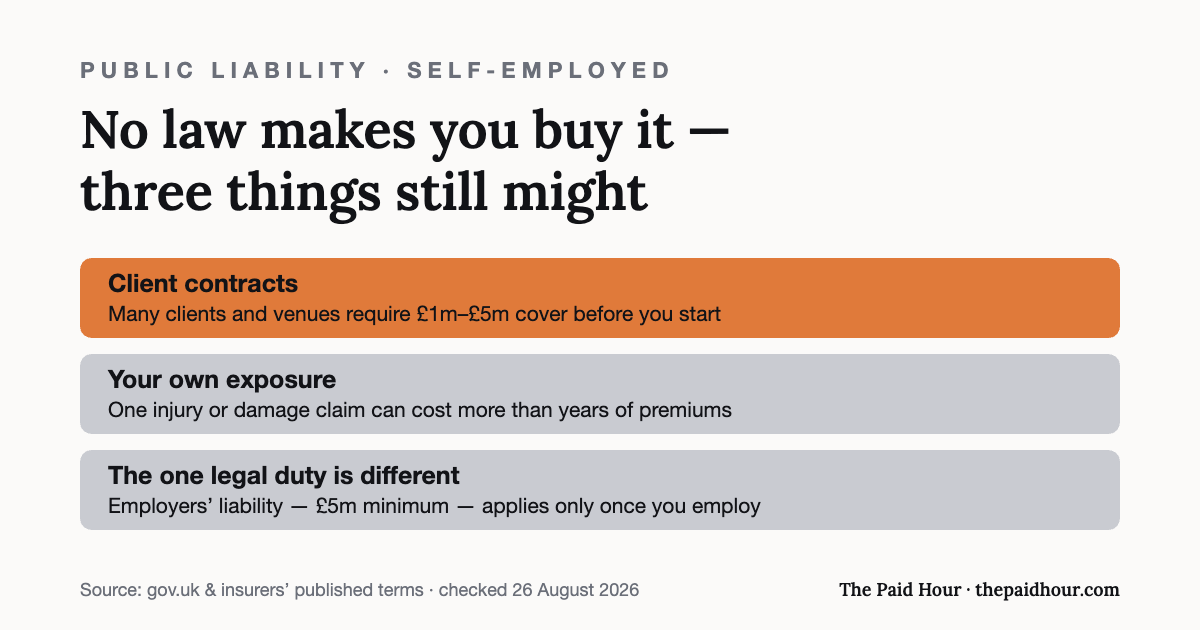
Not because Parliament says so. Because somebody with money will not deal with you otherwise.
- Client contracts. Most corporate and public sector procurement asks for a certificate before you invoice a penny. £1 million is the common floor, £5 million on construction and anything on a managed site.
- Site access. Main contractors and facilities managers will not sign you in without it. No certificate, no gate pass.
- Working in people’s homes. Plumbers, electricians, cleaners, tutors, dog walkers, mobile therapists. The exposure is real and the customer often asks.
- Markets, fairs and events. Organisers and councils routinely make it a condition of the pitch.
- Licensed trades. Some local authority licences carry an insurance condition. Check the licence terms rather than assuming.
If none of that describes your week (you write, design or code, alone, and nobody visits), the honest answer is that you may be buying a policy for a risk you do not run. Spend the money on professional indemnity instead, if you are going to spend it.
The one policy that is the law
Employers’ liability insurance becomes compulsory “as soon as you become an employer”, and it has to cover you “for at least £5 million”.
The penalties are not decorative. You can be fined £2,500 every day you are not properly insured. Failing to display the certificate where employees can see it, or to show it to an inspector, is a separate £1,000.
There are exemptions, and the one that matters to a lot of small operations is family: employees who are a close family member, or who are based outside England, Scotland and Wales, do not trigger the requirement. Take on one person outside that and the clock starts the day they start.
Worth saying out loud, because the two get muddled constantly: employers’ liability is for the people who work for you. Public liability is for everybody else.
How much cover, and who decides
£1 million, £2 million, £5 million, occasionally £10 million. The number is almost never chosen on risk. It is chosen by whoever is asking for the certificate.
So read the contract before you buy the policy rather than after. Buying £1 million and then discovering the framework agreement wants £5 million means paying twice, or worse, arguing about it with a client who has already decided you are disorganised. The jump in premium between levels is usually far smaller than the jump in cover, which is the one part of the sales pitch that happens to be true.
It comes off your tax bill
This gets left out of nearly every article on the subject. Business insurance is an allowable expense, and HMRC’s own guidance uses this exact policy as its example: “You can claim for any insurance policy for your business, for example public liability insurance.”
At the basic rate, a £180 policy costs you nearer £144 after the deduction, and more like £137 once Class 4 National Insurance is in the picture. It does not make an unnecessary policy necessary. It does make a necessary one cheaper than the sticker price, and it belongs on the same list as the rest of your allowable expenses.
For the wider view of which policies a sole trader ends up needing and which are sold hard for no good reason, there is a broader guide to self-employed business insurance in the UK.
What it costs is a separate question, and the advertised price is not the paid price, the published figures are broken down in what public liability insurance costs.
If your risk is the work itself instead of a trip hazard, the policy you want is the other one, professional indemnity, and the six-year tail that comes with it.
The exception, and the only one, is employers liability insurance: compulsory from the first day you have someone working for you, at £5 million minimum.
One route to quotes (Simply Business), is reviewed separately on this site; this page still recommends no insurer.
Insurance sized to a guess?
Protect the Business: Legal, IP & Insurance 2026/27. Eight modules and five working sheets built around a complete annotated freelance contract, with a negotiation note under every clause.
- Registering a trade mark yourself: searching, classes, fees and the opposition period
- UK GDPR without a consultant: the ICO fee tiers, a privacy notice, and the 72-hour breach plan
- An insurance sizing calculator by work type, and the client clauses never to sign as they stand, with the redline for each
You own the copyright in what you make until you assign it in writing. Most clients assume the opposite, and most freelance contracts are silent on it.
Buying more than one? All ten 2026/27 courses for £107, against £328 at full price.
Sources
- gov.uk — Employers’ liability insurance
- Companies House, What insurance does a small business need?
- Association of British Insurers. Liability insurance
- gov.uk, Expenses if you’re self-employed: legal and financial costs
The employers’ liability figures were re-checked against gov.uk on 26 August 2026; insurer requirements are as published in client and venue terms.
Checked 25 August 2026. This is general information about how these policies work and what the law requires, not insurance advice: The Paid Hour is not authorised or regulated by the Financial Conduct Authority, does not arrange or recommend insurance, and earns nothing from any insurer. For cover suited to your own situation, speak to an FCA-authorised broker. The tax points are general information rather than tax advice; for your own circumstances, speak to an accountant or contact HMRC.
Read next
- Public Liability Insurance Cost: What the Ads Leave Out
- Professional Indemnity Insurance: What Sole Traders Miss
- Self-Employed Insurance UK: What Freelancers Actually Need