
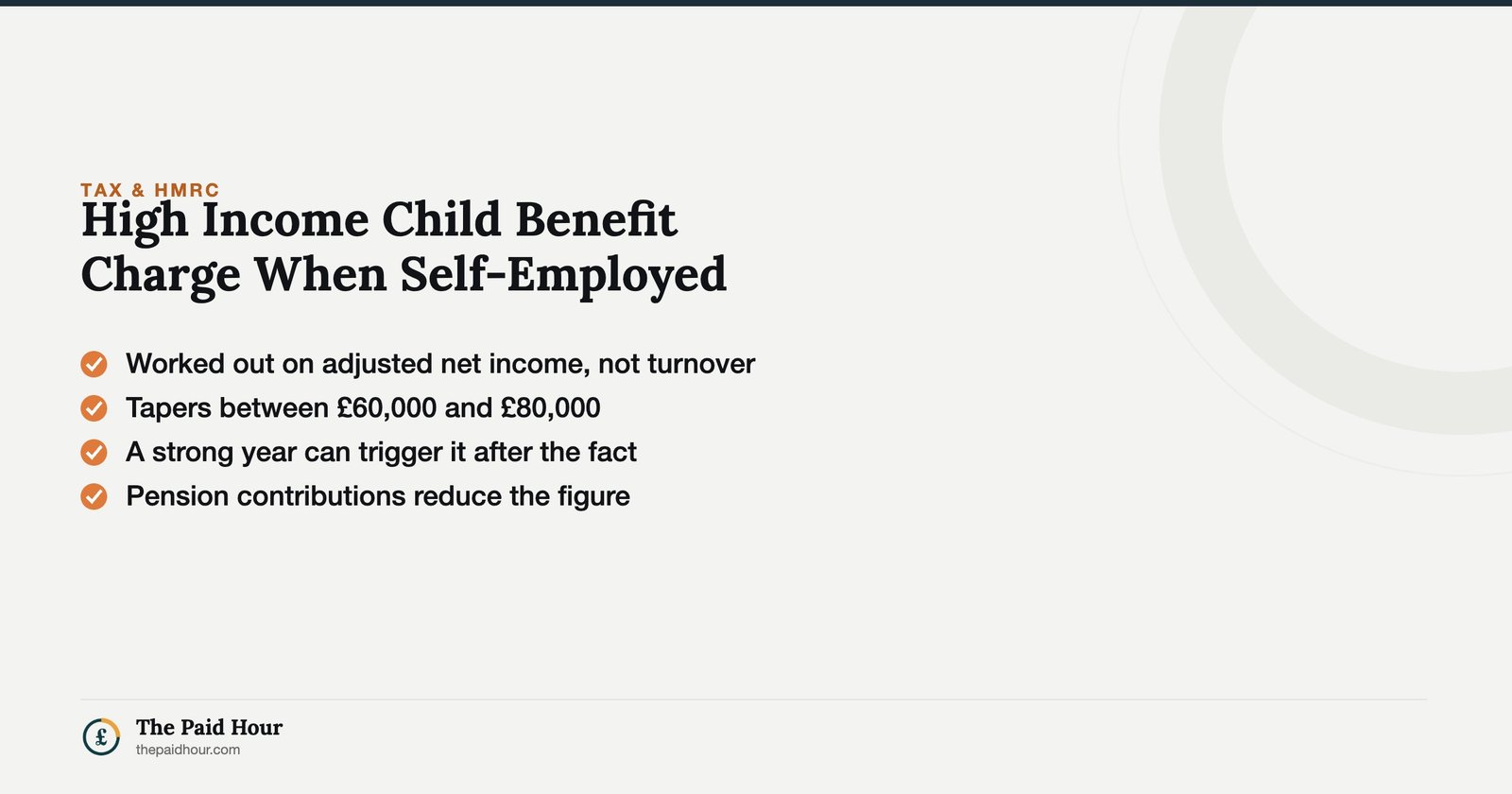
What matters here: The charge is worked out from adjusted net income rather than turnover, so a strong self-employed year can trigger it after the fact. It tapers between £60,000 and £80,000, and a pension contribution reduces the figure the charge is based on. Payslip-style guides do not fit this.
Table of Contents
Most guides to the High Income Child Benefit Charge are written for someone with a payslip. Enter your salary, read off the charge. Self-employed, there’s no single “salary” figure — there’s turnover, expenses, allowances, maybe a pension contribution you made in March to soften the blow, and a profit figure that can move around right up until you file. That makes the High Income Child Benefit Charge harder to predict if you work for yourself, and worth understanding properly rather than guessing in January.
What the charge actually is
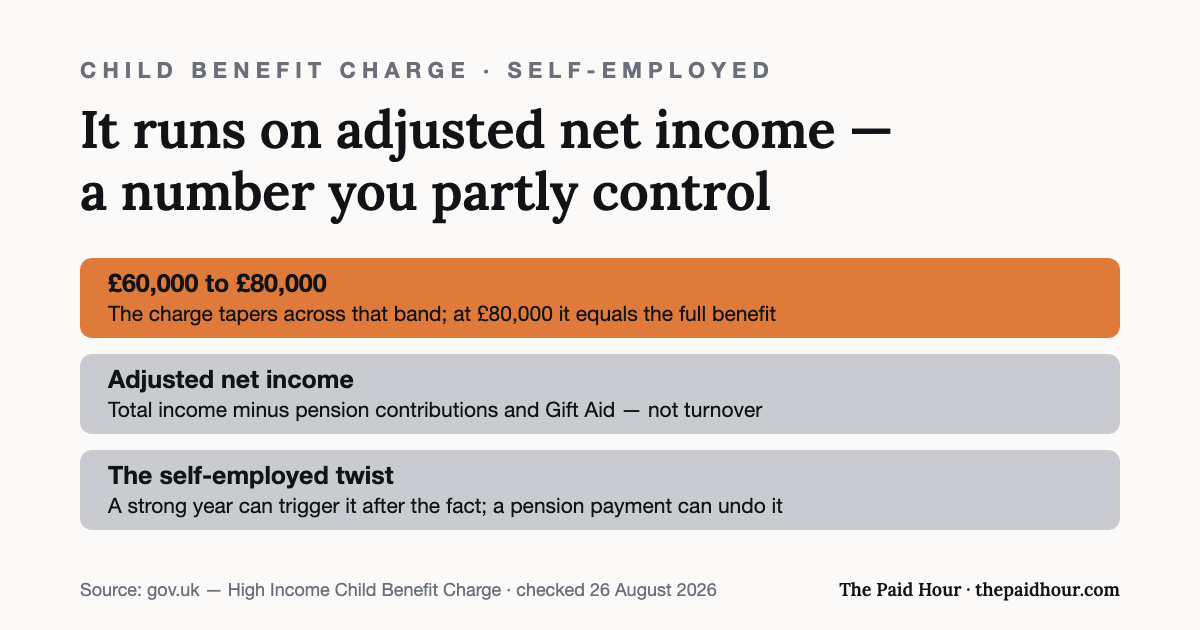
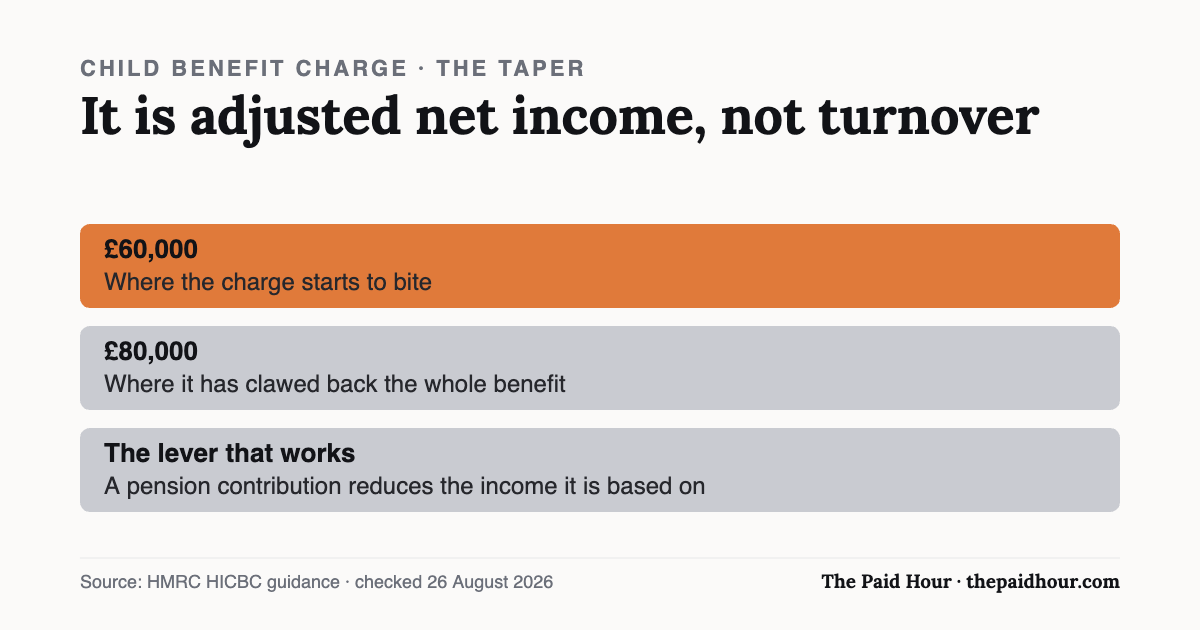
The High Income Child Benefit Charge claws back Child Benefit once one partner in a household earns above a threshold — it doesn’t matter which partner claims the benefit, only who earns more. For 2024/25 onwards, the charge starts once your adjusted net income passes £60,000, and by £80,000 you’re repaying all of it. Below £60,000, none of this applies and you keep the full amount.
Between those two figures it’s proportional: you repay 1% of the Child Benefit you received for every £200 of income over £60,000. Earn £70,000 and you’re halfway through the taper, repaying roughly half of what you claimed.
Adjusted net income, the part that trips up the self-employed
The High Income Child Benefit Charge isn’t based on turnover, and it isn’t based on your Self Assessment profit figure either instead of directly. It’s based on “adjusted net income,” and working that out takes a few steps:
- Start with your total taxable income — for a sole trader, that’s your trading profit after allowable expenses, same figure you’d report on your Self Assessment return, plus anything else taxable (rental income, dividends, savings interest).
- Subtract trading losses and pension contributions made gross.
- Deduct the “grossed-up” value of any Gift Aid donations — £1.25 for every £1 you gave.
- Deduct the grossed-up value of relief-at-source pension contributions, the same £1.25-per-£1 calculation.
What that means in practice: your trading profit is the starting point, but a pension contribution can pull your adjusted net income back down below £60,000 even if your actual profit sits above it. This is the single biggest lever self-employed people have over the High Income Child Benefit Charge that employees generally don’t — you can often decide, right up until you file, how much to pay into a pension and change which side of the threshold you land on.
Why the self-employed find this harder to plan around
An employee on a fixed salary knows in April roughly what they’ll earn by the following April. A freelancer with a lumpy year — a big contract that lands in month eleven, a slow first half, a client who pays late and pushes income into the next tax year — often doesn’t know their profit for certain until they’re doing the books. That makes it easy to drift over £60,000 without noticing, and easy to miss that you owe anything under the High Income Child Benefit Charge at all if nobody’s telling you to check.
HMRC doesn’t calculate this automatically the way it does with PAYE. If your adjusted net income goes over £60,000 and you or your partner still claim Child Benefit, you’re responsible for declaring the charge on a Self Assessment return and paying it — there’s no letter that arrives to remind you.
What to actually do about it
If your profit is unpredictable, check your rough position a couple of months before your accounting year ends, not after. A pension contribution, timed correctly, can be the difference between keeping Child Benefit in full and losing most of it. If you’re consistently well over £80,000, the pension trick stops being enough on its own and you’re simply repaying the whole amount — some people in that position choose to stop claiming Child Benefit altogether rather than claim it and hand it straight back through the charge, though you may still want to keep the claim registered even at £0, since it protects National Insurance credits for whoever isn’t working.
None of this is a reason to panic about a single good year. It’s a reason to check your adjusted net income against the High Income Child Benefit Charge threshold, not just your headline profit figure, before you assume you’re safely under it.
Source: gov.uk — Child Benefit tax charge, Adjusted net income guidance. Checked 23 August 2026.
A worked example of the high income child benefit charge
Say your adjusted net income for the year comes out at £68,000, and you’ve got two children, so you’re claiming £2,190.80 a year in Child Benefit (2026/27 rates). You’re £8,000 over the £60,000 starting point. Divide that by £200 and round down: 40 full amounts. The high income child benefit charge claws back 1% of your Child Benefit per £200 over the threshold, so you owe 40% of what you claimed back, roughly £876.
Push adjusted net income to £80,000 or above and the charge equals 100% of the Child Benefit, you’re paying it all back, which is why some self-employed people stop claiming altogether rather than do the paperwork for nothing.
Should you still claim if you’ll owe the charge?
Usually, yes, even if the charge wipes out the payment entirely. Claiming Child Benefit (rather than just registering and opting out of payment) is what protects your state pension National Insurance credits if you’re not otherwise paying Class 2 or Class 4 NI on qualifying income, and it gets your child a National Insurance number automatically at 16. You can claim and elect not to receive the payments, which avoids the self assessment admin of paying it back each year while keeping the credits.
Reducing adjusted net income to soften the high income child benefit charge
Because the charge is based on adjusted net income instead of turnover, pension contributions move the number. Paying into a relief-at-source pension reduces adjusted net income pound for pound, which can pull you back under £60,000 or at least shrink the taper. Charitable donations under Gift Aid work the same way. For a self-employed person with a variable year, this is one of the few levers you can pull retroactively before the self assessment deadline, since pension contributions made before 5 April count for that tax year.
This is worth modelling properly rather than guessing, see our guide to setting up a pension when self-employed for how the relief works, and how much room you’d need to pull income back under the threshold.
Common mistakes with the high income child benefit charge
- Forgetting the charge is based on the higher earner’s adjusted net income rather than household income. One partner on £45,000 and one on £65,000 still triggers it, even though combined household income might look fine.
- Not registering for self assessment at all, then getting an HMRC “failure to notify” penalty on top of the charge itself.
- Missing that adjusted net income includes taxable benefits and some pre-tax deductions get added back, it isn’t simply your Self Assessment profit figure.
- Assuming the £60,000/£80,000 figures are fixed forever, they were raised from £50,000/£60,000 in April 2024, so it’s worth checking gov.uk each tax year instead of relying on an old figure.
Households manage this charge in more ways than one: splitting income with a spouse has its own rules and its own traps.
Paying higher-rate tax and never claiming the relief?
Pension & Safety Net for the Self-Employed 2026/27. Eight modules and four working sheets that turn “I should sort my pension out” into a plan you can finish in an afternoon, with the tax relief doing a third of the work.
- Your State Pension forecast, qualifying years, and when voluntary Class 2 is worth paying and when it buys nothing
- The Self Assessment step that recovers higher-rate relief, which most people never claim
- Sick pay, income protection and critical illness: what each actually pays, and the underwriting traps for the self-employed
There is no statutory sick pay for the self-employed at all. Higher-rate pension relief is not automatic either. Both are fixable in an afternoon, and both are still costing most freelancers money.
Buying more than one? All ten 2026/27 courses for £107, against £328 at full price.
Sources
The £60,000–£80,000 taper and the adjusted-net-income definition were re-checked against gov.uk on 26 August 2026.
This is general information about how the rules work, not tax advice. The links above go to the primary sources; for your own circumstances, speak to an accountant or contact HMRC directly.