

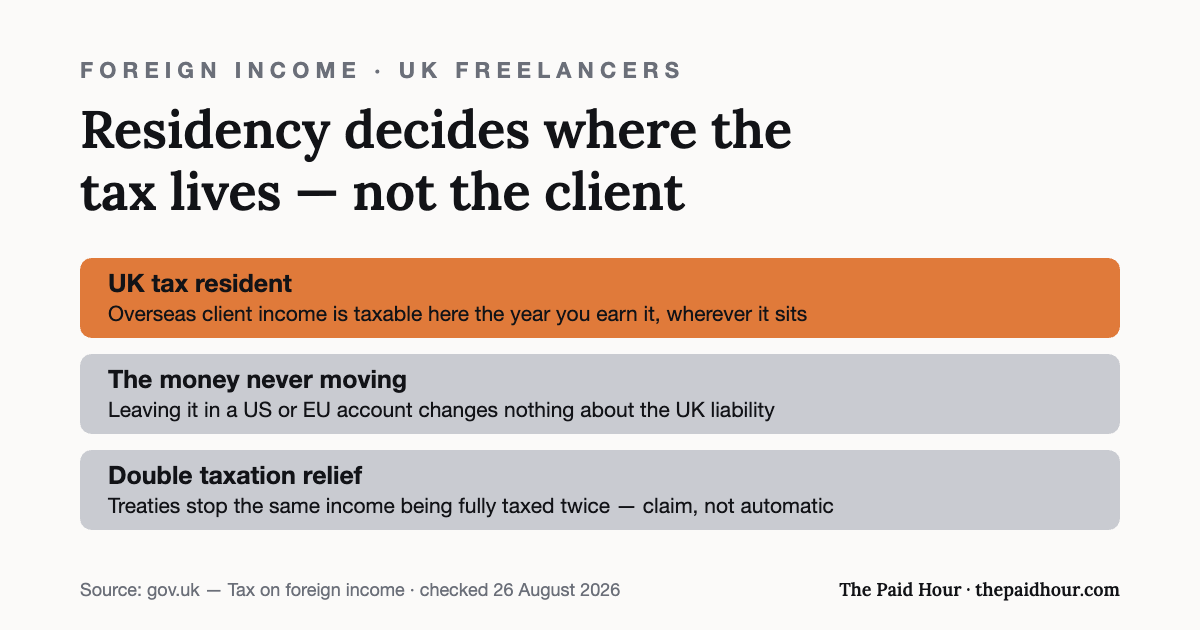
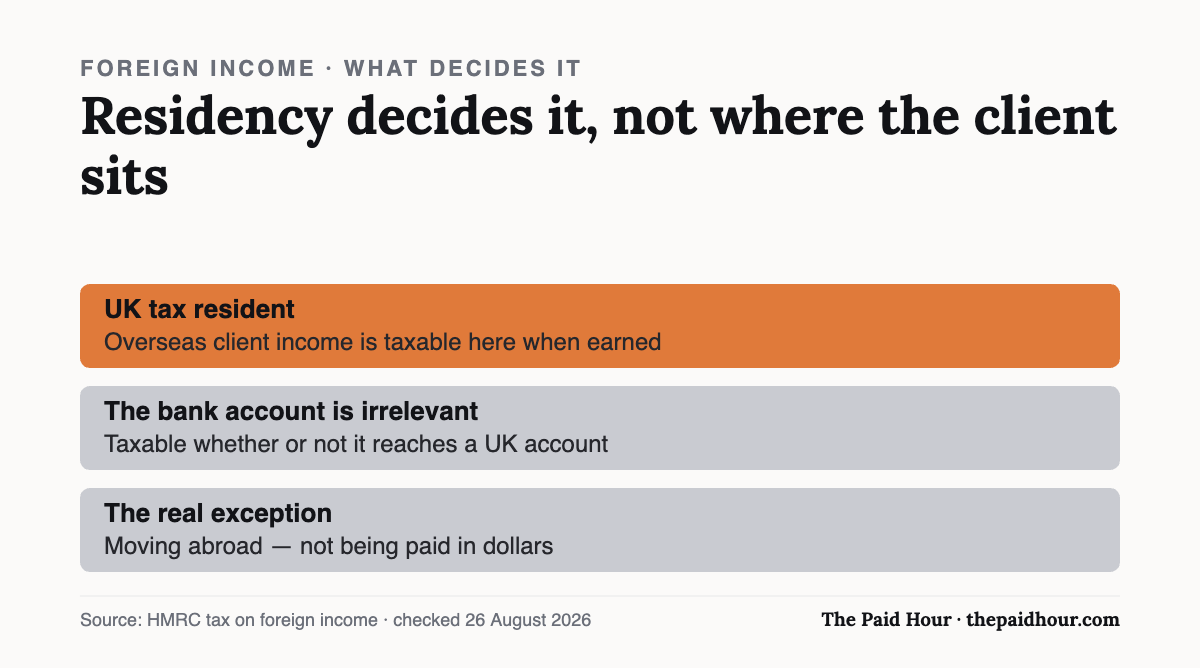
Quick answer: If you are UK tax resident, income from overseas clients is taxable here the year you earn it, whether or not the money ever reaches a UK bank account. Moving abroad is the exception rather than paying in dollars. Residency rather than the client’s location, decides where the tax lives.
Foreign income self-employed UK freelancers earn from overseas clients, platforms, or rental property is taxable in the UK the moment it lands, that’s the single fact this guide keeps coming back to.
A surprising number of self-employed people assume foreign income only becomes an HMRC question if they move abroad permanently. It doesn’t work like that. UK tax residents generally owe UK tax on foreign income the same year they earn it (a client based overseas, rental income on a property abroad, dividends from a foreign platform), regardless of whether the money ever touches a UK bank account.
Table of Contents
The basic rule
Per gov.uk’s guidance on foreign income, if you’re UK resident, you’ll normally pay UK tax on your foreign income: wages from work done abroad, overseas investment returns like dividends or savings interest, rental income from foreign property, and overseas pension income all count. If you’re not UK resident, you generally won’t owe UK tax on foreign income at all. Which category you fall into is determined by residency rules, not by nationality, where your business is registered, or where your clients happen to be based.
Why residency, not location of income, is what matters
This trips up freelancers who work with overseas clients while living in the UK, and freelancers who spend part of the year working from abroad while remaining UK tax resident. In both cases the income is foreign, but because the person is UK resident, it’s still reportable and taxable here. The reverse also happens: someone who stops being UK resident can find their overseas income falls outside UK tax entirely, even income from a business they still technically own in the UK, depending on the specifics.
Reporting it
Foreign income belongs on your Self Assessment tax return alongside your UK income, not on a separate filing. It still needs converting to sterling and declaring in the same return, on the same annual timetable as everything else you report.
Double taxation, the part people worry about unnecessarily
If a foreign client’s country also taxes the income at source, you’re not automatically paying tax twice on the same money. The UK has double taxation agreements with most countries people do business with, and relief is available — sometimes you’ll need a certificate of residence to claim it before foreign tax is deducted, sometimes you claim the relief afterwards through your UK return. It’s worth checking the specific agreement for the country in question rather than assuming, because the mechanics differ country to country.
A newer relief to know about
Since April 2025, a Foreign Income and Gains regime replaced the old domicile-based rules for some new UK residents, offering a time-limited exemption on qualifying foreign income for people in their first years of UK residency. It’s a narrow, specific relief rather than something most established UK freelancers will qualify for, but if you’ve recently become UK resident after living abroad, it’s worth checking whether you fall into that window before assuming all your foreign income is automatically taxable here from day one.
None of this is territory to guess your way through. Residency status does turn on a detailed set of tests, and getting it wrong in either direction, under-declaring foreign income, or over-paying UK tax you didn’t owe, is an expensive mistake to unwind later.
A common scenario worth spelling out
Say you’re a UK-resident freelancer with two US clients paying in dollars into a US-based payment platform account you rarely withdraw from. That income is still foreign income earned by a UK resident, taxable here the year you earn it, converted to sterling at the exchange rate on the date it was received, not the date you eventually transfer it to a UK bank. Leaving it sitting in the platform account doesn’t delay the tax point, and it’s a common assumption that is easy to get wrong.
The same logic applies to a UK freelancer who spends three months working from Portugal or Spain while still living in the UK the rest of the year, unless that time abroad is enough to actually change residency status under the detailed tests, the income earned during those months is still reportable as normal, not as something separate or exempt.
Source: gov.uk: Tax on foreign income. Checked 23 August 2026.
Foreign tax credit relief, with a worked example
Say a US client’s platform withholds 15% tax at source on a payment before it reaches your account. That tax was paid to another country’s tax authority, and the UK-US double taxation agreement means you don’t pay UK tax on top of it in full. You report the gross income and the foreign tax paid on your Self Assessment, and HMRC gives you credit for the foreign tax against your UK liability on that same income. Up to the amount of UK tax that would otherwise be due.
The credit can’t exceed what you’d have paid in the UK on that income, so if the foreign rate was higher than your UK rate, you don’t get the difference refunded. Keep the withholding statement or remittance advice from the client or platform, HMRC can ask for evidence of foreign tax paid.
Currency conversion and record-keeping for foreign income
Every invoice paid in a foreign currency needs converting to sterling for your Self Assessment, and HMRC accepts a consistent, reasonable method instead of mandating one specific rate: either the exchange rate on the day of the transaction, or HMRC’s published average rates for the period. Pick one method and use it consistently across the tax year rather than switching between them, since mixing methods is one of the things that draws HMRC’s attention on review.
Practically, this means keeping the original invoice in the foreign currency, the sterling amount received (after any platform fees, which are a separate allowable expense), and the date. Most accounting software converts automatically from a connected bank feed, which is one of the stronger arguments for using proper software rather than a spreadsheet once you’ve got several currencies in play, see our accounting software comparison if multi-currency handling matters to you.
Common mistakes with foreign income for the self-employed
- Assuming money that never touches a UK bank account doesn’t need declaring, as a UK resident, it does, wherever it’s paid or held.
- Netting off foreign tax withheld against income before declaring, instead of reporting the gross figure and claiming relief separately.
- Not registering for Self Assessment at all because the foreign income “feels separate” from a normal freelance invoice.
- Forgetting platform fees (Upwork, Fiverr, PayPal’s currency conversion spread) are allowable expenses in their own right, on top of any foreign tax credit.
None of this changes the core point: as a UK-resident, UK-domiciled freelancer, foreign income is taxed the same way as UK income, with relief available so you’re not taxed twice on the same money. For the mechanics of the return itself, see our guide on registering with HMRC and our Self Assessment deadlines calendar.
Foreign income self-employed checklist, in short
To recap the core points on foreign income self-employed freelancers need to get right: report the gross figure, claim foreign tax credit relief for tax already withheld, convert currency consistently, and check the Foreign Income and Gains regime only if you’ve recently become UK resident. Get those four right and the rest of the return follows normally.
Why foreign income self-employed cases get flagged by HMRC
Foreign income self-employed freelancers earn tends to draw more HMRC attention than domestic income, simply because it’s harder for HMRC to cross-check automatically against UK bank data. That’s changing fast: the UK now exchanges financial account data with over 100 countries under the OECD’s Common Reporting Standard, so a foreign income self-employed person fails to declare is increasingly likely to be flagged by data HMRC already has, not just picked up on audit.
In practice this means treating foreign income self-employed the same as any UK invoice from day one. Declared, converted, and kept on file, rather than assuming smaller or occasional overseas payments fly under the radar. They generally don’t anymore.
Charging VAT to Berlin, or not?
Cross-Border Invoicing & International Tax Standard 2026/27. Eight modules and nine templates built around one place-of-supply rule, with the exact invoice wording for every case and the W-8BEN walkthrough that stops 30% of a US fee vanishing.
- The master flowchart: is UK VAT charged, for any service, any client, any country
- Ready-made wording blocks (Article 196, outside the scope, not registered) to copy rather than compose
- FX rate log with automatic gain and loss, reverse-charge register, and the rolling twelve-month threshold monitor
Adobe, AWS and every other overseas service you buy counts towards your £90,000 VAT threshold. Get the reverse charge wrong and the bill arrives years later, with interest.
Buying more than one? The Complete Freelancer System, all five for £87, against £215 at full price.
Sources
The residency rule and treaty relief were re-checked against gov.uk on 26 August 2026.
This is general information about how the rules work, not tax advice. The links above go to the primary sources; for your own circumstances, speak to an accountant or contact HMRC directly.